9.7 - Magnetic Field Patterns (Bar Magnets)
The technique
Aim
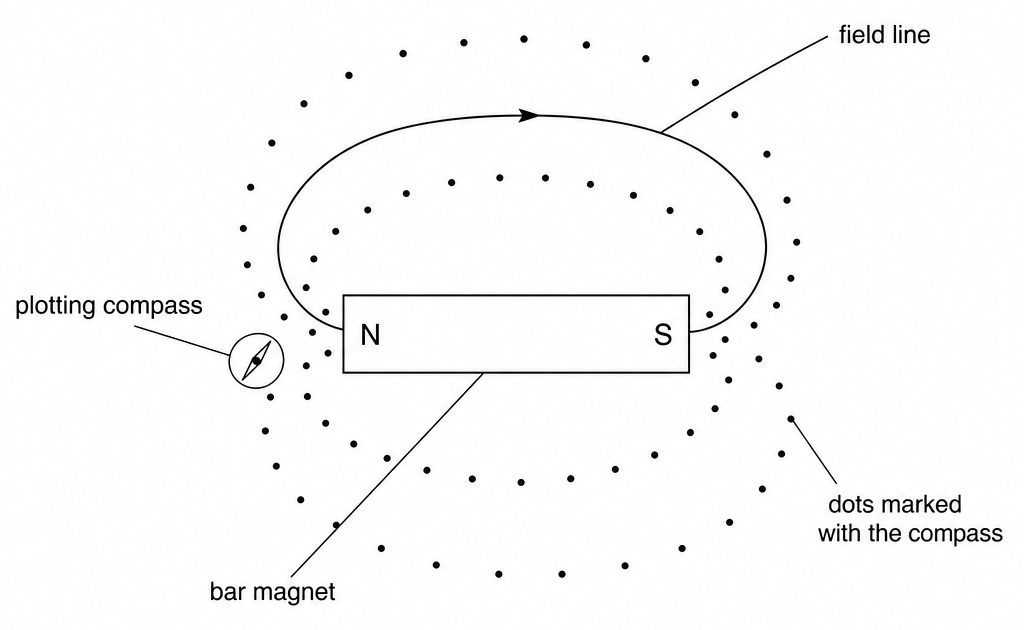
To find the shape and the direction of the magnetic field around a bar magnet, and the field between two bar magnets placed near each other, and to record them as a drawing of field lines.
Background
- A magnet has a magnetic field around it. This is a region where another magnet, or a magnetic material such as iron, feels a force.
- The field is drawn as field lines. Outside the magnet they run from the north pole to the south pole, and the closer together they are, the stronger the field.
- A plotting compass needle is a tiny magnet that's free to turn, so it lines up along the field line where it sits.
- Iron filings line up with the field in the same way, because each one becomes an induced magnet.
- You can't see a magnetic field, but you can see which way a compass needle or iron filings line up in it.
- So in this practical you follow a compass needle across paper to draw the field lines round one magnet and between two, and compare them with the pattern iron filings make.
Method
- Draw round the magnet - Put a bar magnet in the middle of a sheet of paper, draw round it, and label its north and south poles.
- Clear the bench - Move other magnets, and iron or steel objects such as scissors and clamp stands, well away.
- Mark the needle - Put a plotting compass next to one pole, let the needle settle, and mark a dot at its tip and a dot at its tail.
- Follow the field - Move the compass so the tail of the needle sits on the dot at its tip, and mark a new dot at the tip. Keep going until you reach the other pole or the edge of the paper.
- Draw the field line - Join the dots with a smooth curve, and add an arrow pointing from the north pole towards the south pole.
- Draw more lines - Start from different points round the magnet until you have about six lines. They're closest together at the poles, and they never cross.
- Plot opposite poles - On fresh paper, place two magnets a few centimetres apart with a north pole facing a south pole, and plot the field. In the gap, the lines run straight across, parallel and evenly spaced. This is a uniform field.
- Plot like poles - Turn one magnet round so two north poles face each other, and plot the field again.
- Use iron filings - Put the magnets under a sheet of card, sprinkle iron filings thinly on top, and tap the card gently until they settle into a pattern.
Safety
- Iron filings - Sprinkle them from a shaker, keep them away from your eyes, and wash your hands afterwards.
- Keep filings off the magnet - Keep the magnet under the card, because filings stuck to a magnet are very hard to remove.
Common exam questions
Question 1
Why can two magnetic field lines never cross?
A compass at any point settles in one direction only, so the field there has one direction. Crossing lines would mean two directions at the same point.
Question 2
Why should iron and steel objects be moved away from the bench before plotting starts?
In the magnet's field they become induced magnets, with fields of their own. Those fields pull the compass needle away from the direction of the magnet's field, so the pattern would be the wrong shape.
Question 3
A student finds that the compass points the same way everywhere along one edge of their paper, well away from the magnet. Explain this.
The magnet's field is too weak there to turn the needle much, so the compass lines up with the Earth's magnetic field and points north.
Question 4
Give one advantage of plotting the field with a compass rather than with iron filings.
The compass shows the direction of the field as well as its shape, and the drawing stays on the paper after the magnet is taken away. Iron filings show only the shape, and the pattern is lost when the card is moved.
Question 5
Two bar magnets are placed with their north poles a few centimetres apart. Describe the field between them.
The field lines curve away from each other rather than joining up. Between the magnets there's a point where the two fields are equal and opposite and cancel out, called a neutral point.