9.8 - Penetration & Absorption of Radiation
The experiment
Aim
To find out how well different materials absorb the radiation from a sealed source, and to use the results to identify which type or types of radiation the source gives out.
Background
- Alpha, beta, and gamma radiation are stopped by very different materials. Alpha is stopped by paper and beta by a few millimetres of aluminium. Gamma is never completely stopped, but thick lead absorbs most of it.
- Background radiation is around us all the time, whether or not a source is in the room.
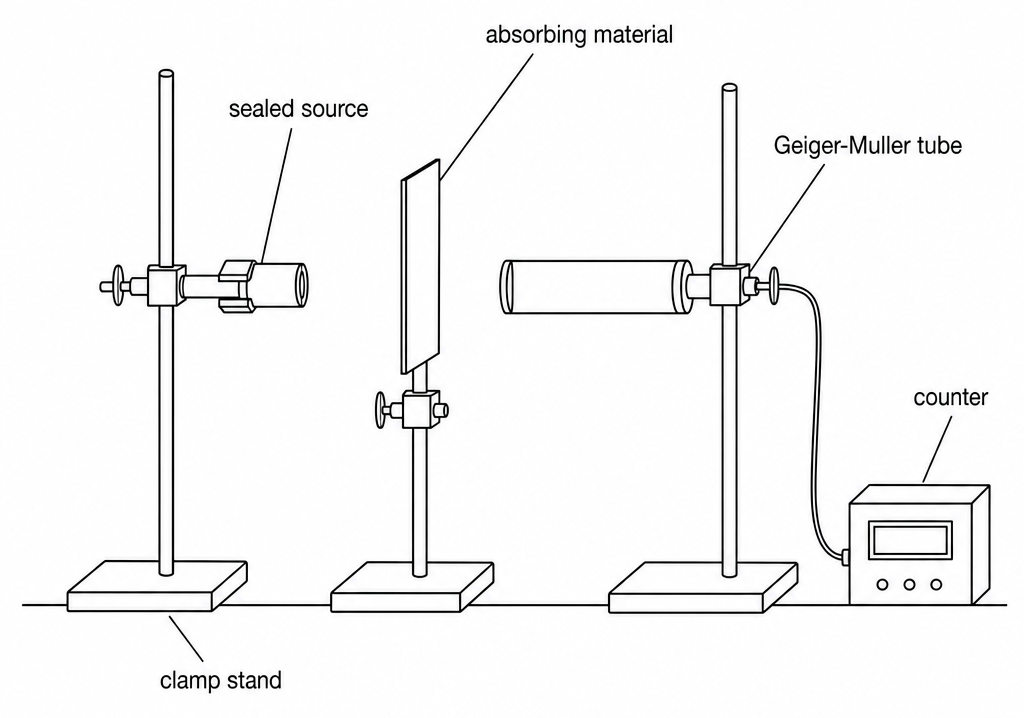
- You can't see the radiation, but a Geiger-Müller tube and counter records how much reaches the detector, as a count rate.
- So in this practical you put different materials between the source and the detector, and see which ones make the count rate drop. That tells you what the source gives out.
Variables
- Independent variable - The material in the gap (nothing, paper, aluminium, or lead).
- Dependent variable - The corrected count rate, in counts per second.
- Control variables - The source, the distance between the source and the detector, the counting time, and the position of the material in the gap.
Method
- Measure the background - With no source in the room, record the count over a fixed time, three times, and turn the mean into a count rate.
- Set up the source - Clamp the sealed source a fixed short distance from the detector window, pointing at the detector.
- Take readings with nothing in the gap - Record the count three times, find the mean count rate, and subtract the background count rate.
- Add each material in turn - Take three readings the same way with paper in the gap, then a few millimetres of aluminium, then a thick block of lead.
- Repeat with other sources - To compare the different types of radiation.
Safety
- Long-handled tongs - Only ever pick up a sealed source with tongs, never with your fingers.
- Stand back - Point the source away from people, and stand back once it's clamped.
- Lead-lined store - Keep the source in it until you need it, and put it straight back afterwards.
Worked example - Identifying a source's radiation
With no source present, a student measured the count over 60 seconds three times, and got 28, 33, and 29 counts. She then clamped a sealed source in front of the detector and recorded the mean count rate with each material in the gap.
| Material in the gap | Measured count rate (counts per second) |
|---|---|
| None | 24.5 |
| Paper | 24.3 |
| 3 mm aluminium | 6.5 |
| 2 cm lead | 0.5 |
Work out what type or types of radiation the source emits.
Step 1 - Find the background count rate
Divide the mean of the three readings by the counting time.
Step 2 - Correct every reading
Subtract 0.5 counts per second from each measured count rate.
- With nothing in the gap, 24.5 − 0.5 = 24.0 counts per second.
- With paper, 24.3 − 0.5 = 23.8 counts per second.
- With 3 mm aluminium, 6.5 − 0.5 = 6.0 counts per second.
- With 2 cm lead, 0.5 − 0.5 = 0.0 counts per second.
Step 3 - Read the paper result
Paper only drops the corrected count rate from 24.0 to 23.8, and paper stops alpha particles, so the source is not emitting alpha radiation.
Step 4 - Read the aluminium result
Aluminium drops the corrected count rate from 24.0 to 6.0 counts per second. Aluminium stops beta particles, so most of the radiation is beta. Some still gets through, so beta isn't the only radiation present.
Step 5 - Read the lead result and give the answer
Lead brings the corrected count rate to 0.0. Only gamma rays get through aluminium, and thick lead absorbs them, so the 6.0 counts per second that got through the aluminium were gamma. The source emits beta and gamma radiation.
Step 6 - See why the background correction matters
Without the correction, the lead reading of 0.5 counts per second would look like radiation getting through the lead. The correction shows the lead absorbed almost all of it, leaving too little to tell apart from the background.
Common exam questions
Question 1
Why is the background measured with the source taken out of the room, rather than switched off?
A radioactive source can't be switched off. It emits all the time, so it has to be taken far enough away that it doesn't reach the detector.
Question 2
With a background count rate of 0.5 counts per second, a source gives 8.2 counts per second with nothing in the gap and 0.6 with paper. What does this show?
The corrected count rates are 8.2 − 0.5 = 7.7 and 0.6 − 0.5 = 0.1 counts per second. Paper absorbs almost all the radiation, so the source emits alpha particles.
Question 3
Why is each reading taken three times and averaged?
Radioactive decay is random, so the count over any one period varies even when nothing has changed. A mean of three readings evens out that variation.
Question 4
Why must the source stay the same distance from the detector throughout?
The count rate falls as the source moves further away, because the radiation spreads out and the air absorbs alpha and beta. A drop could then be caused by the move rather than the material.
Question 5
Why are sealed sources handled with long-handled tongs?
They keep the source as far from your body as possible. The radiation gets weaker quickly with distance, so your dose is much smaller than if you held it.