3.7 - X-Rays & Gamma Rays
X-rays let us see inside the body
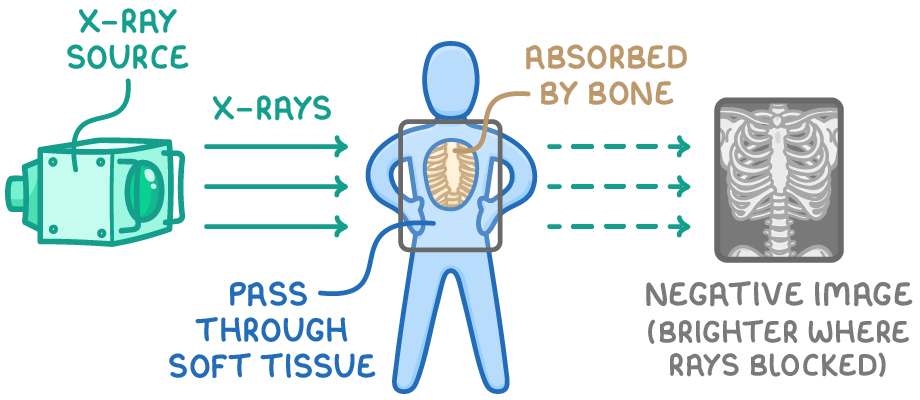
X-rays pass easily through soft tissue but are absorbed by denser material such as bone or metal.
Forming an X-ray image
- Radiation is directed through the body onto a detector plate.
- The result is a negative image: lighter areas show where X-rays were absorbed by dense material (such as bone), while darker areas show where they passed through soft tissue.
Uses of X-ray imaging
- Diagnosing broken bones and dental problems - Dense bone shows up clearly against surrounding tissue.
- CT scans - Use multiple X-rays taken from different angles to build a 3D image of the body.
- Airport security scanners - Detect hidden objects inside baggage.
Sterilising with gamma rays
Medical instruments
- Gamma rays sterilise medical instruments by killing microbes (such as bacteria).
- They pass through packaging and reach into deep crevices.
- They can sterilise items that would melt or be damaged by heat, such as plastic instruments.
Food
- Gamma radiation kills microbes on food, keeping it fresh for longer without cooking or freezing.
- The treatment does not make the food radioactive, so it's safe to eat.
Staying safe around X-rays
- X-rays are ionising, so exposure can damage living cells.
- Exposure is kept as low as possible by:
- Using lead aprons and shields to absorb stray radiation.
- Keeping the exposure time to a minimum.
TermDefinition
CT scanA scan that uses multiple X-rays taken from different angles to build a 3D image of the body.