1.1 - The Skeleton & Movement
The main functions of the skeleton
The skeleton is a framework of bones that provides essential support for the human body. It plays several key roles in maintaining health, enabling movement, and protecting vital parts of the body.
Key functions of the skeleton
- Support and shape - The skeleton forms a rigid structure that gives the body its overall shape and supports soft tissues such as muscles and skin. For example, it helps maintain good posture.
- Protection - Bones are strong and durable, shielding important organs from injury. The skull protects the brain, the ribs safeguard the heart and lungs, and the spine guards the spinal cord.
- Movement - Bones work with muscles and joints to enable motion. Muscles attach to bones via tendons and pull on them to create movement at joints.
- Making blood cells - Certain bones contain bone marrow, which produces red blood cells and white blood cells. Red blood cells improve oxygen delivery to muscles.
- Mineral storage - Bones store essential minerals such as calcium and phosphorus, which can be released when needed. These minerals are important for bone strength and muscle contraction.
Different types of bones and their purposes
The human skeleton contains various types of bones, each adapted for specific roles based on their shape and structure.
Main types of bones
- Long bones - These are elongated bones, such as the humerus, that are strong and act as levers for large-scale movements.
- Short bones - These are compact bones, found in areas like the wrist or ankle (e.g., the talus), that support fine movements and bear weight.
- Flat bones - These are broad and plate-like bones, such as the ribs, that provide protection for internal organs and offer large surfaces for muscle attachment.
Major bones in the skeleton and their roles
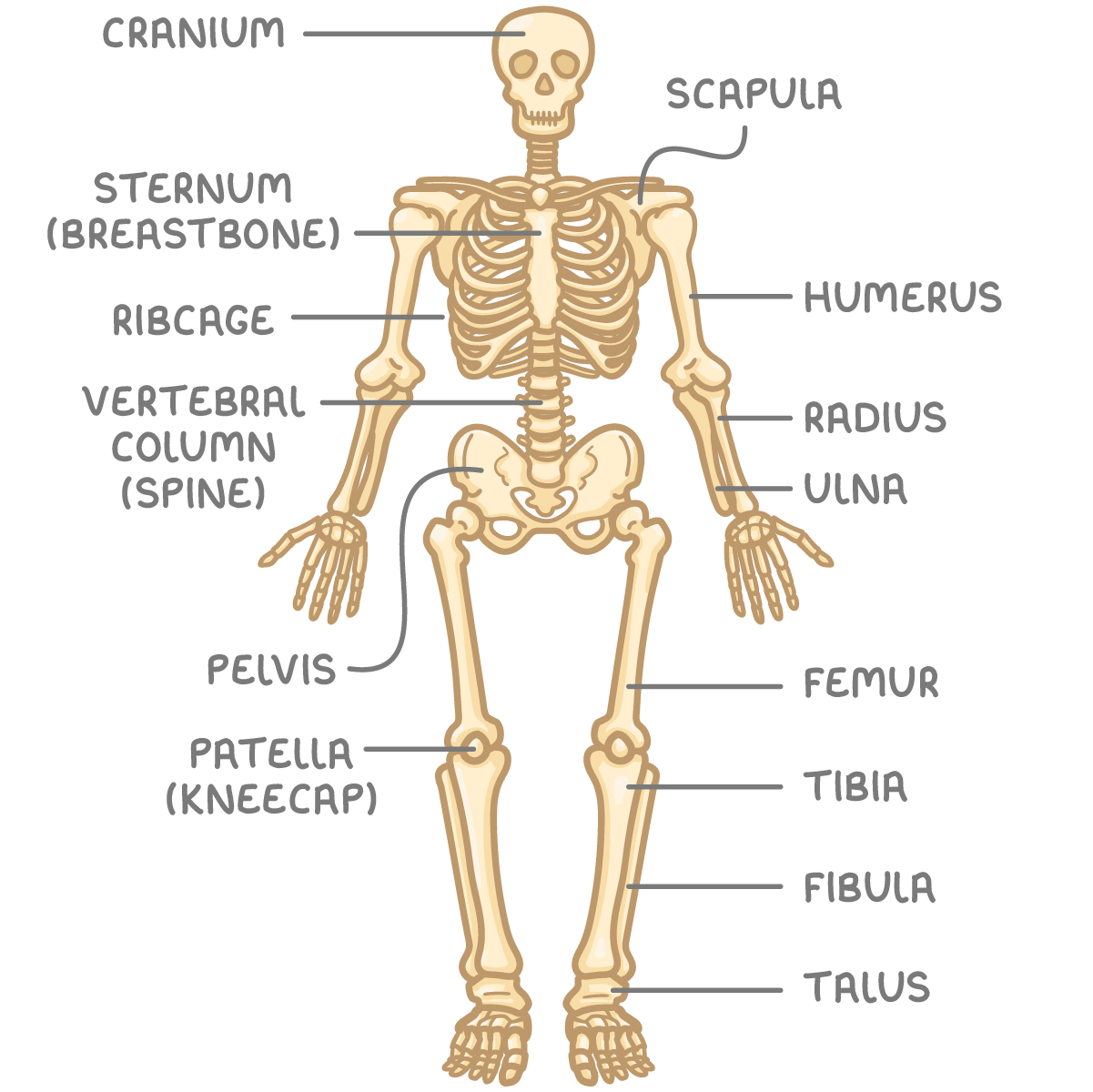
The skeleton includes key bones that form the structure of the body, each contributing to movement, protection, or support.
Long bones and their roles
- Humerus - Located in the upper arm, it allows movement of the entire arm, such as swinging a badminton racket.
- Ulna and radius - These form the forearm and enable bending at the elbow, for example, when throwing a netball.
- Femur - The thigh bone, used for moving the whole leg, such as in walking or running.
- Tibia and fibula - These lower leg bones allow actions like kicking a football.
Flat bones and their roles
- Cranium - The skull bone that protects the brain from impacts.
- Sternum and ribs - The breastbone and rib cage protect the heart, lungs, and kidneys.
- Scapula - The shoulder blade, which protects the shoulder joint and serves as an attachment point for muscles involved in arm and shoulder movements.
- Pelvis - Protects organs like the bladder and reproductive system, and provides attachment for leg muscles to aid movement.
Short and other bones and their roles
- Talus - Part of the tarsal bones in the ankle, it bears the body's weight during activities like standing or running.
- Vertebral column (spine) - Composed of irregular bones called vertebrae, it protects the spinal cord.
- Patella - A sesamoid bone that protects the knee joint by preventing tendon friction against the femur during movement.
Types of joints and their articulating bones
Joints are points where two or more bones meet, allowing movement and flexibility. The bones that connect at a joint are called articulating bones.
Major joints and their articulating bones
- Hip - Formed by the pelvis and femur.
- Shoulder - Involves the humerus and scapula.
- Knee - Connects the femur and tibia.
- Ankle - Joins the tibia, fibula, and talus.
- Elbow - Links the humerus, radius, and ulna.
Main types of joints
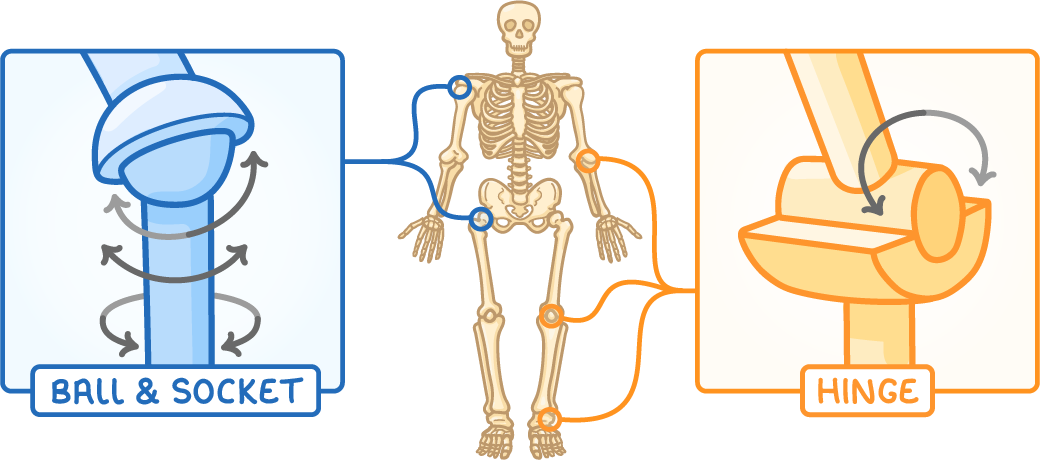
Joints are classified by their structure and the movements they allow. The two primary types in the body are ball and socket joints and hinge joints.
| Type | Examples | Flexion and extension | Adduction and abduction | Rotation | Circumduction |
|---|---|---|---|---|---|
| Ball and socket | Hip, shoulder | ✓ | ✓ | ✓ | ✓ |
| Hinge | Knee, ankle, elbow | ✓ | × | × | × |
Joint movements and examples in sports
Joint movements describe how bones shift relative to each other at joints, enabling actions in sports.
Types of joint movements
| Movement | Description | Sporting example |
|---|---|---|
| Flexion | Bending or closing a joint | Curling the arm at the elbow before throwing a basketball |
| Extension | Straightening or opening a joint | Extending the leg at the knee when kicking a football |
| Adduction | Moving a limb towards the body's imaginary centre line | Bringing the arm inward during a golf swing |
| Abduction | Moving a limb away from the centre line | Drawing back a tennis racket |
| Rotation | Twisting a limb clockwise or anticlockwise | Shoulder rotation in a tennis forehand |
| Circumduction | Circular movement of a limb | The arm action in overarm cricket bowling |
| Plantar flexion | Pointing the foot downward at the ankle | Pushing off during a gymnastics routine |
| Dorsiflexion | Lifting the foot upward at the ankle | Raising the toes during gymnastics |
Examples of movements in sports
Many sports combine these movements.
Examples of combined movements:
- To do a push-up or a football throw-in, flexion at the elbow is used to bend the arms, and extension is used to straighten them.
- Running, kicking, basic squats, and standing vertical jumps all use flexion and extension at the hip and knee, as well as plantar flexion and dorsiflexion at the ankle.
- Bowling in cricket involves the movement of the arm in a circular motion at the shoulder, using circumduction.
Connective tissues in the skeletal system
Connective tissues link bones, muscles, and joints, providing stability and enabling smooth movement.
Main types of connective tissues
- Ligaments - Tough, fibrous tissues that connect bones at joints, limiting excessive movement to maintain stability and prevent dislocations. They also absorb shock.
- Tendons - Strong cords that attach muscles to bones (or to other muscles), transmitting the force of muscle contractions to move bones.
- Cartilage - A flexible, cushioning tissue that covers bone ends at joints, absorbing shock, reducing friction, and enhancing joint stability during movement.
The structure and components of synovial joints
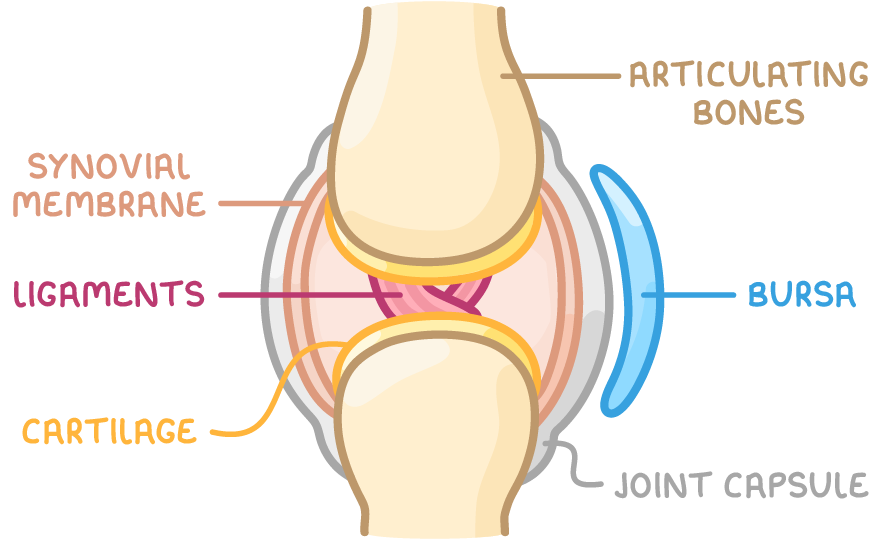
Synovial joints are freely movable joints enclosed in a joint capsule, allowing a wide range of motion. They include ball and socket and hinge types.
Key components of a synovial joint
- Articulating bones - The bones meeting at the joint, shaped to fit together and move smoothly.
- Joint capsule - A fibrous sac enclosing the joint, providing support and containing synovial fluid.
- Synovial membrane - The inner lining of the capsule that produces synovial fluid to reduce friction and nourish the joint.
- Cartilage - Covers the ends of bones, acting as a shock absorber to prevent damage during movement.
- Ligaments - Surround and strengthen the joint, holding bones together.
- Bursae - Small fluid-filled sacs that cushion areas between bones and tissues, further reducing friction.