2.3 - William Harvey & Blood Circulation
Key facts and dates
William Harvey's work during the Renaissance period challenged ancient medical theories and promoted evidence-based approaches to understanding the human body. His discovery of blood circulation represented a key shift from traditional ideas, although acceptance was gradual.
Timeline of key events
- Early 17th century – Harvey conducts experiments on animal hearts and human dissections, influenced by Vesalius and new mechanical inventions.
- 1628 – Harvey publishes De Motu Cordis, providing proof that blood circulates around the body.
- 1640s–1650s – Initial resistance from doctors who preferred Galen's theories; no immediate changes in medical treatments.
- Late 17th century – Harvey's ideas begin to be taught in universities, laying foundations for modern physiology.
- 19th century onwards – Long-term impact seen in developments like blood transfusions and evidence-based medicine.
Prevailing beliefs about blood before Harvey
Before William Harvey's work in the 17th century, medical understanding of blood was dominated by ancient theories that persisted through the medieval and Renaissance periods. These ideas, largely based on the work of the Roman physician Galen, shaped how doctors viewed the body's functions.
Traditional ideas from Galen
- Production in the liver - Blood was thought to be constantly created in the liver from digested food, serving as a vital nutrient for the body.
- Consumption by the body - Once produced, blood was believed to be distributed to organs and tissues, where it was completely used up or "burned" to provide energy and warmth.
- No circulation - There was no concept of blood returning to the heart; instead, it was seen as a one-way flow that required ongoing replenishment.
- Influence on medicine - These beliefs supported treatments like bloodletting, where excess blood was removed to restore balance, reflecting a reliance on untested ancient authority.
Harvey's experiments on blood circulation
Image 1 of 2: Harvey tied off blood vessels to show that blood flows in one direction
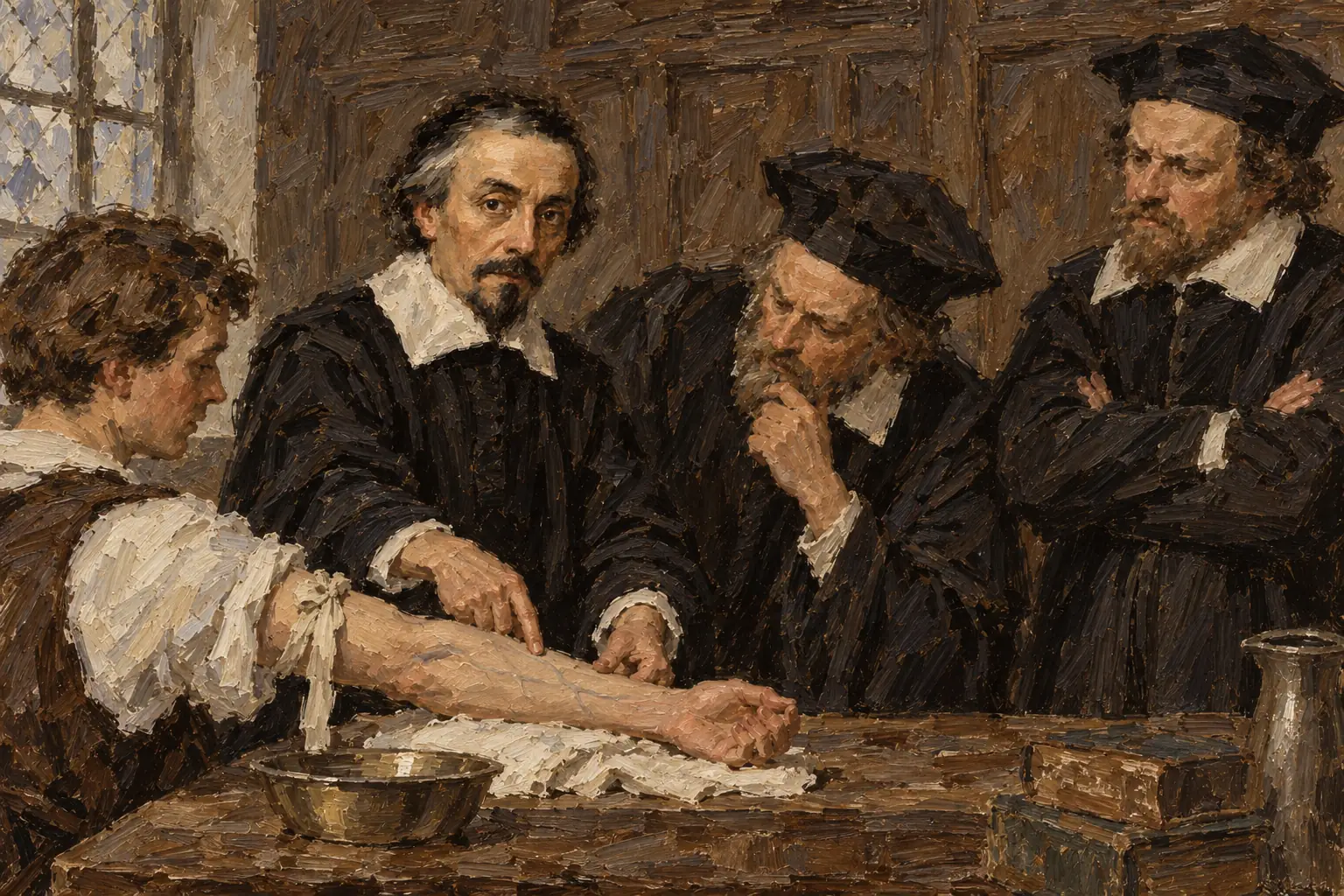
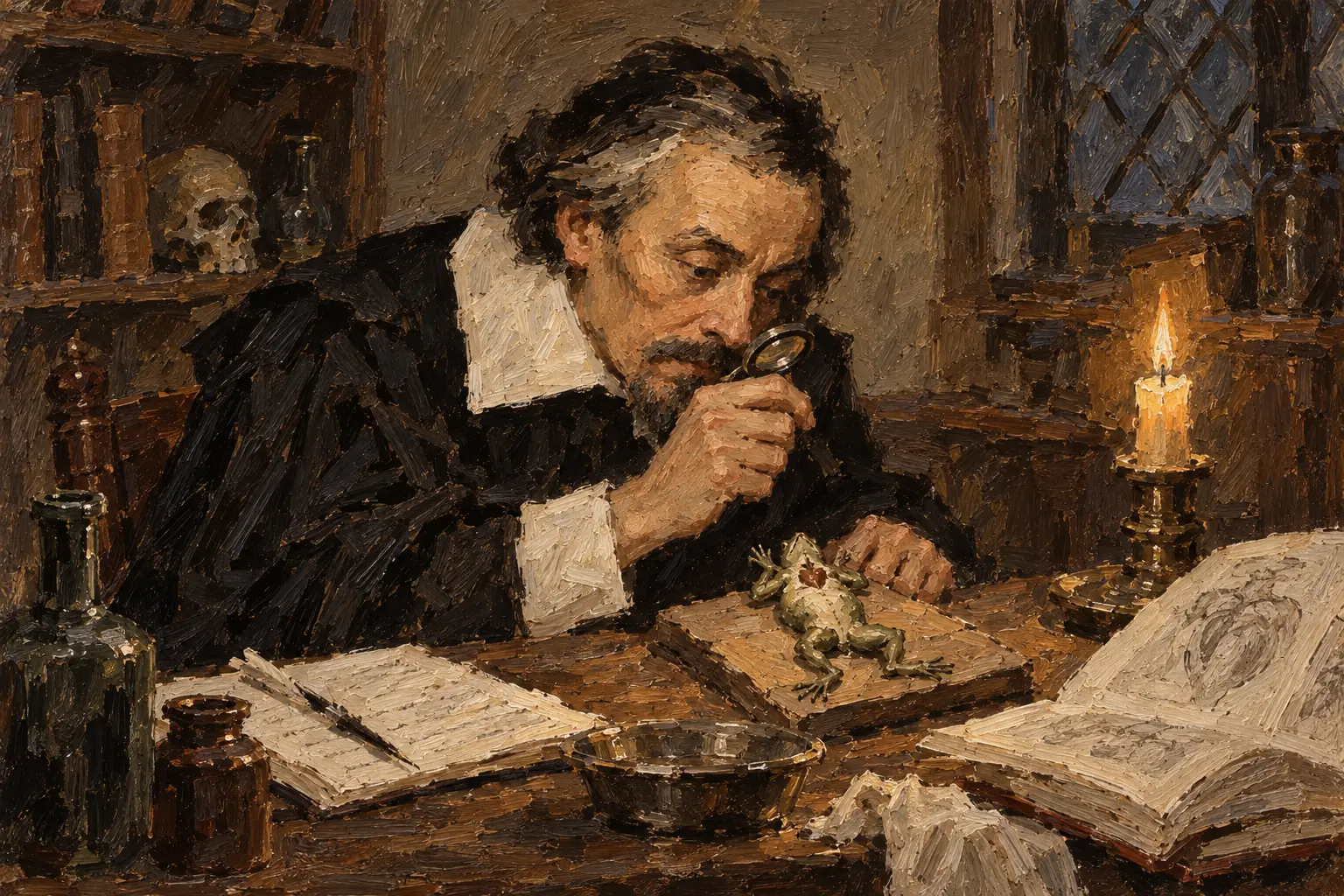
William Harvey, a royal physician in England, revolutionised medical knowledge through systematic investigation. In 1628, he published his findings in De Motu Cordis, demonstrating that blood moves in a closed loop rather than being continually produced and consumed.
Methods used in Harvey's research
- Animal studies - Harvey examined hearts in animals, including live cold-blooded creatures like frogs, where the slower heartbeat allowed clear observation of contractions and blood flow.
- Human dissections - He performed detailed dissections on human bodies to trace the paths of arteries and veins, noting how blood vessels connected in a continuous system.
- Tying off vessels - By ligating (tying) blood vessels in experiments, Harvey showed that blood could not pass certain points, proving directional flow from arteries to veins.
- Blood volume calculations - He measured the heart's output, estimating that it pumps about 2 litres of blood per minute; this volume was too large to be newly produced each time, indicating recirculation.
Key elements of Harvey's circulation theory
- Heart as a pump - The heart functions like a mechanical pump, propelling blood outwards through arteries during contractions.
- Continuous circuit - Blood travels from the heart to the body via arteries, returns through veins, and is not consumed but reused in an ongoing loop.
- Role of valves - Valves in veins prevent backflow, ensuring blood moves towards the heart, contradicting the idea of one-way consumption.
Influences on Harvey's work
Harvey's groundbreaking ideas did not emerge in isolation but built on earlier discoveries and contemporary developments. His approach reflected the Renaissance emphasis on observation and challenging established doctrines.
Key influences shaping Harvey's research
- Vesalius's anatomical work - The 16th-century anatomist Andreas Vesalius identified valves in veins through precise dissections, providing Harvey with evidence of directed blood flow.
- Mechanical inventions - The development of pumps in 17th-century Europe, used for tasks like draining mines, inspired Harvey to compare the heart to a pump mechanism.
- Scientific method - Harvey adopted Renaissance principles of experimentation and measurement, moving away from reliance on ancient texts towards empirical evidence.
Impacts of Harvey's discovery
Harvey's theory faced initial scepticism but eventually transformed medical science. While it did not immediately change daily practices, its influence grew over time, promoting a more accurate understanding of human physiology.
Short-term effects and resistance
- Opposition from doctors - Many physicians rejected Harvey's ideas as they contradicted Galen's long-accepted theories, leading to debates and slow adoption in medical education.
- Delayed university teaching - It took several decades for circulation to be included in curricula, with some institutions clinging to traditional views into the late 17th century.
- No immediate treatment advances - Knowledge of circulation did not lead to new cures around 1650, as diseases were still poorly understood, limiting practical applications.
Long-term significance
- Foundation for modern physiology - Harvey's work established the basis for studying the cardiovascular system, enabling later research into heart function and blood-related conditions.
- Innovations in medicine - It paved the way for procedures like blood transfusions in the 19th century and contributed to evidence-based approaches in healthcare.
- Shift to scientific inquiry - By demonstrating the value of observation and experimentation, Harvey exemplified the Renaissance move from ancient authority to empirical methods, influencing broader scientific progress.