3.1 - Farming: New Technology & Methods
Key facts and dates
Farming on the Great Plains underwent significant transformations in the 19th century, driven by technological innovations and cooperative efforts that addressed environmental challenges. These developments shifted agriculture from small-scale subsistence to commercial production, influencing settlement patterns and economic growth.
Key facts to remember
- Mechanisation – Introduction of reapers and binders increased harvesting efficiency.
- Steel ploughs – Enabled breaking through tough sod more effectively than iron versions.
- Seed drills – Improved planting precision and crop yields.
- Improved wind pumps – Enhanced water access from deep wells in arid regions.
- Dry-farming methods – Techniques like deep ploughing and fallowing conserved soil moisture.
- Drought-resistant wheat – Varieties such as Turkey Red adapted to Plains conditions.
- Community solutions – Barn raisings and the Granger movement fostered local cooperation.
- Overall impact – These innovations reduced barriers like water scarcity and sod density, promoting market-oriented farming.
Spread of mechanisation and new farming tools
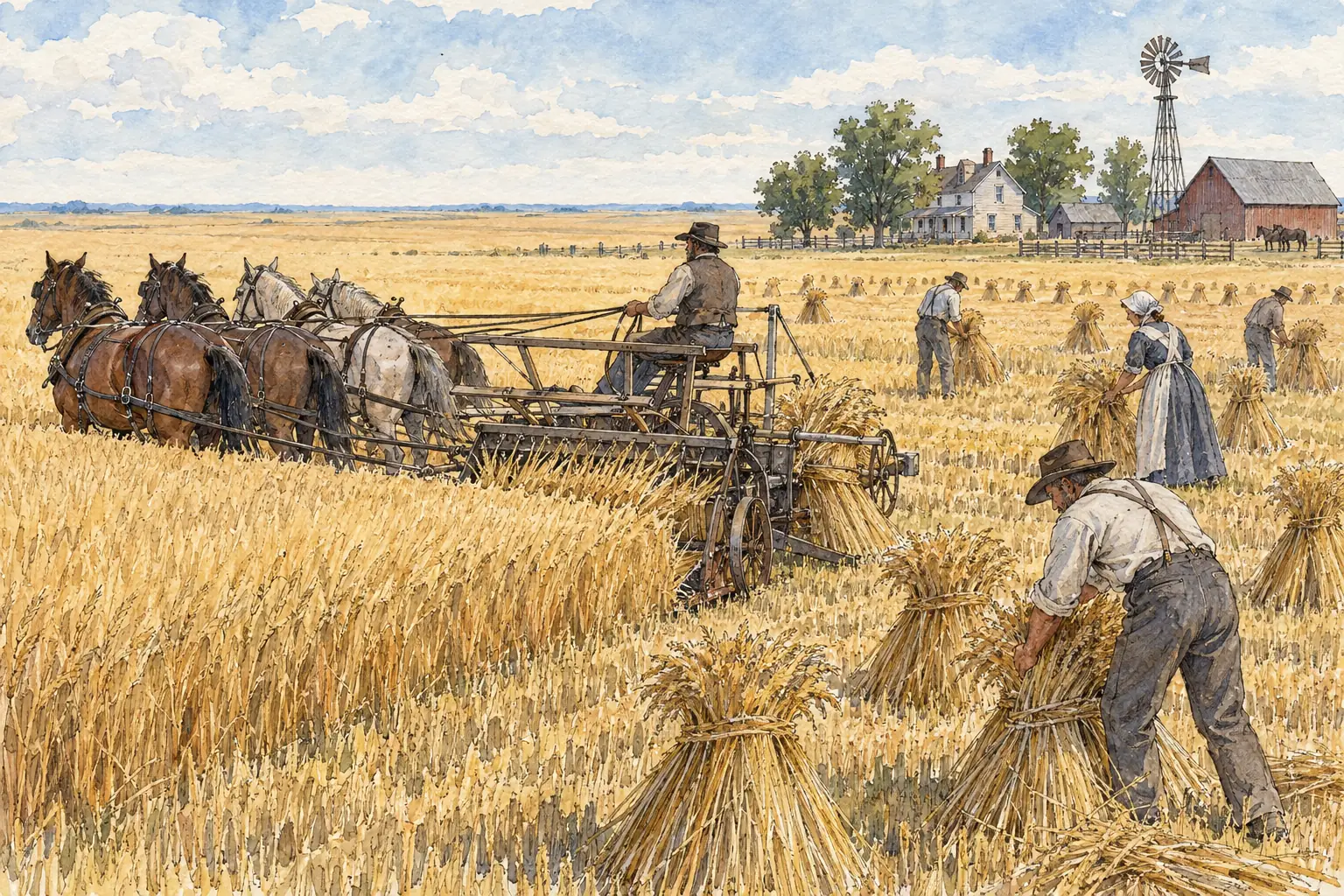
The 19th century saw a rapid adoption of mechanical devices and improved implements on the Great Plains, transforming labour-intensive tasks into more efficient processes. These tools were crucial for homesteaders facing the region's harsh terrain and vast scale.
Key innovations in farming technology
- Reapers and binders - These machines automated the cutting and bundling of crops, significantly speeding up harvest times and reducing the need for manual labour on large fields.
- Steel ploughs - Stronger and sharper than traditional iron ploughs, they effectively cut through the dense sod layer, making it easier to prepare land for cultivation.
- Seed drills - Devices that planted seeds in even rows at consistent depths, improving germination rates and overall crop productivity compared to hand-scattering methods.
- Improved wind pumps - Advanced designs drew water from deeper underground sources, providing a reliable supply for irrigation and livestock in areas with limited surface water.
These tools spread through commercial availability and farmer demonstrations, often supported by agricultural societies, enabling settlers to manage larger areas with fewer workers.
Dry-farming techniques
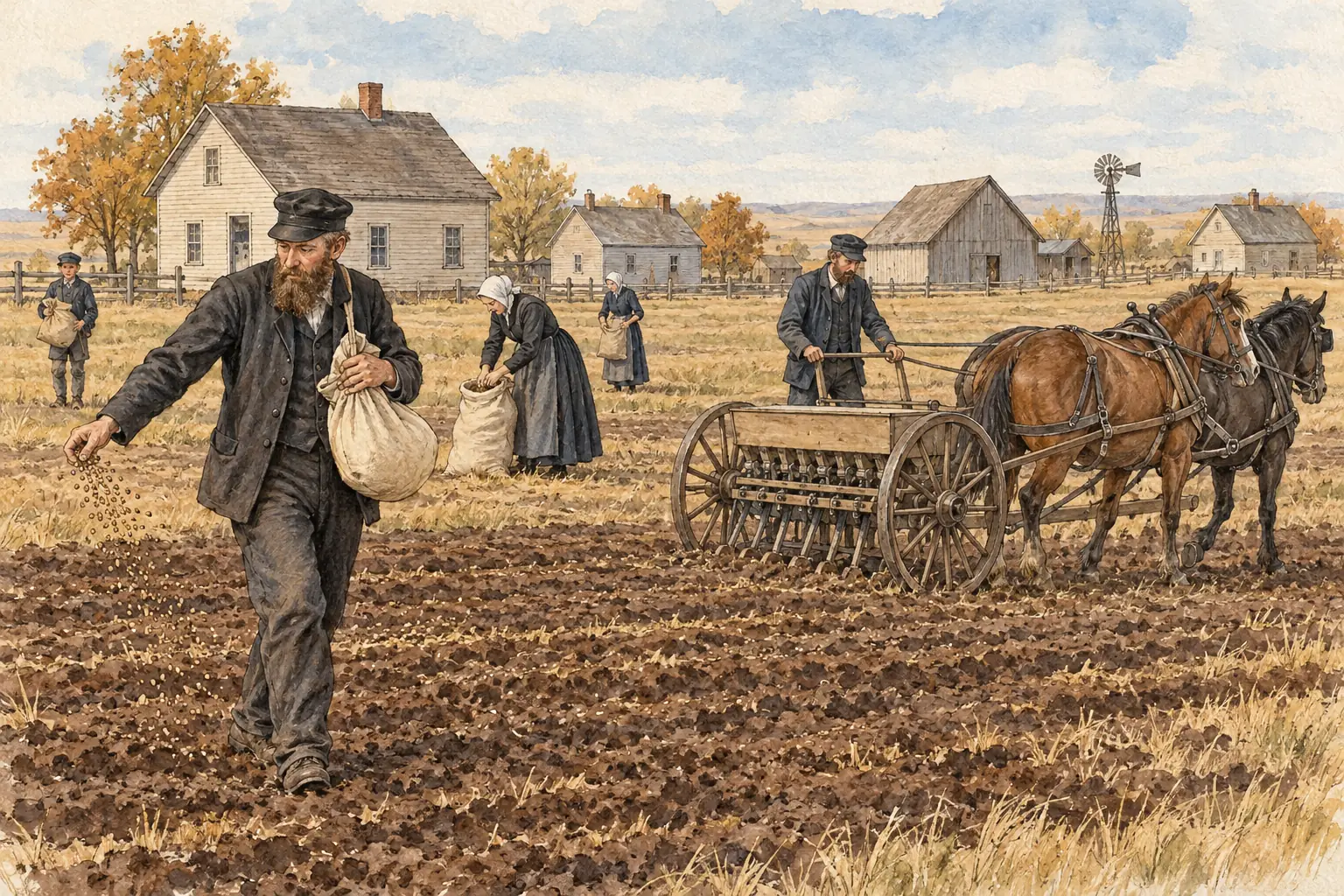
In response to the Plains' low rainfall and frequent droughts, farmers developed dry-farming methods that maximised soil moisture without relying on extensive irrigation. These techniques were essential for sustainable crop production in semi-arid conditions.
Main elements of dry-farming
- Deep ploughing - Involves turning the soil to greater depths, which helps retain moisture by breaking up hard layers and allowing better water absorption.
- Fallowing - Leaving fields unplanted every other year to accumulate moisture and restore soil nutrients, preventing exhaustion from continuous cropping.
- Drought-resistant wheat - Varieties like Turkey Red wheat, introduced from other regions, could withstand dry spells and produce viable yields with minimal water.
These methods, promoted through agricultural experiments and extension services, allowed farmers to cultivate crops successfully where traditional farming had failed.
Community and cooperative solutions
Plains farmers often relied on collective efforts to overcome isolation and resource limitations, building social networks that supported agricultural development. These cooperative approaches addressed practical challenges and fostered resilience.
Forms of community support
- Barn raisings - Community events where neighbours gathered to construct barns or other structures quickly, sharing labour and tools to complete tasks that individuals could not manage alone.
- Granger movement locally - An organisation of farmers that formed cooperatives to buy supplies in bulk, negotiate better rail rates, and advocate for fair policies, strengthening local economies.
Such initiatives not only solved immediate problems but also built a sense of community, encouraging knowledge-sharing about new techniques.
Overcoming barriers to large-scale agriculture
The introduction of new technologies and methods directly tackled longstanding obstacles on the Plains, paving the way for expansive, commercial farming operations. This shift marked a transition from survival-based homesteading to profitable, market-driven agriculture.
Overcoming key barriers to Plains farming
| Barrier | How addressed | Impact on agriculture |
|---|---|---|
| Water scarcity | Improved wind pumps accessed deeper wells; dry-farming techniques like fallowing conserved soil moisture | Allowed consistent crop growth and livestock rearing in dry areas, expanding cultivable land |
| Fencing issues | Mechanisation reduced labour needs, while cooperatives shared costs for materials like barbed wire | Enabled enclosure of large fields without prohibitive expense, protecting crops from roaming animals |
| Dense sod | Steel ploughs broke through tough grass roots effectively | Facilitated initial land preparation, turning prairies into arable farmland more quickly |
These solutions collectively enabled farmers to scale up operations, producing surplus crops for distant markets via railroads. As a result, agriculture became more oriented towards commercial sales, boosting regional economies and attracting further settlement, though it also led to soil erosion risks from intensive practices.