2.1 - Hitler & the Early Nazi Party
Key facts and dates
The period from 1919 to 1922 marked the formation and early development of the Nazi Party in post-war Germany, amid economic hardship and political instability following the First World War. Adolf Hitler's involvement transformed a small fringe group into a more organised political force with nationalist and extremist ideologies.
Timeline of key events
- September 1919 – Hitler joins the German Workers' Party (DAP) as an army informant and quickly becomes its chief propagandist.
- February 1920 – The DAP is rebranded as the National Socialist German Workers' Party (NSDAP), adopting the swastika as its symbol.
- 24 February 1920 – Hitler announces the Twenty-Five Point Programme at a public meeting in Munich.
- July 1921 – Hitler assumes leadership of the NSDAP after threatening resignation, consolidating his control.
- August 1921 – Formation of the Sturmabteilung (SA), initially as a protection squad for party meetings.
- 1922 – The SA expands its role to include intimidation of opponents and street violence.
Hitler's entry into the DAP and rise to leadership
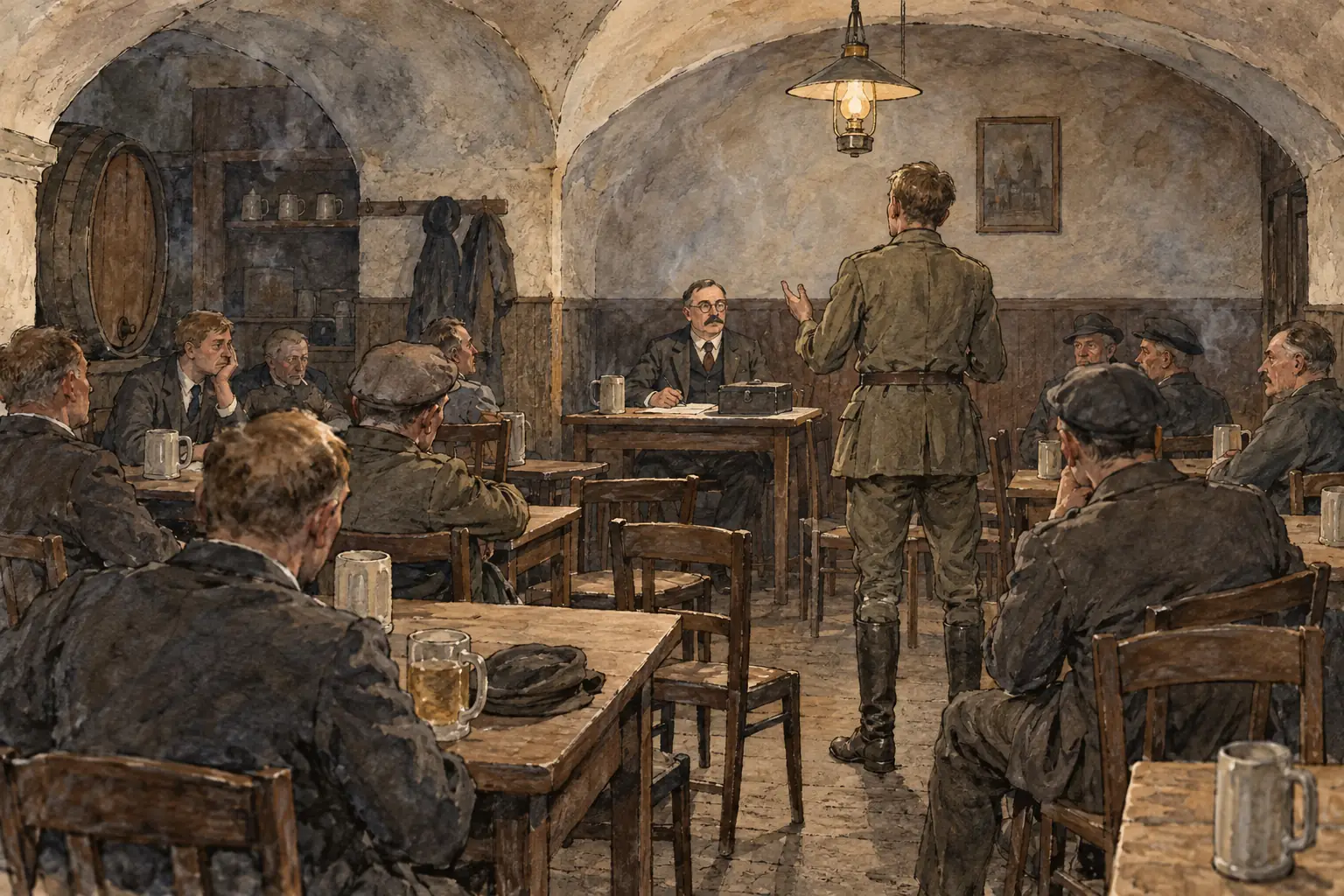
In the chaotic aftermath of Germany's defeat in the First World War, small political groups emerged in Munich, reflecting widespread discontent with the new Weimar Republic. Adolf Hitler, a former soldier, became involved in one such group, which laid the foundations for his political career.
Hitler's involvement and rapid ascent
- Initial entry - In September 1919, Hitler attended a meeting of the German Workers' Party (DAP) on assignment from the army to monitor extremist groups. Impressed by his speaking skills, the party's founder, Anton Drexler, invited him to join.
- Role as propagandist - Hitler quickly rose to become the DAP's chief propagandist, using his oratory talents to attract new members and organise public events that highlighted grievances against the Treaty of Versailles and perceived betrayals by politicians.
- Path to leadership - By 1921, Hitler had built a strong following within the party. He threatened to resign unless given dictatorial powers, leading to his appointment as chairman in July 1921, where he centralised decision-making under his control.
Rebranding to the NSDAP
The DAP's transformation into a more structured organisation reflected Hitler's ambitions to broaden its appeal and establish a distinct identity. This rebranding incorporated nationalist and socialist elements to draw support from disaffected workers and veterans.
Key aspects of the rebranding
- Name change - In February 1920, the party was renamed the National Socialist German Workers' Party (NSDAP), combining nationalist ideals with appeals to the working class to differentiate it from other right-wing groups.
- Symbolism and imagery - The NSDAP adopted the swastika as its emblem, along with red banners and uniforms, to create a sense of unity and visual impact during rallies and marches.
- Organisational growth - Under Hitler's influence, the party expanded its membership from a few dozen to thousands by 1922, focusing on Munich as its base while establishing branches in other Bavarian towns.
The Twenty-Five Point Programme
Announced by Hitler in February 1920, the Twenty-Five Point Programme served as the NSDAP's foundational manifesto, outlining its core ideologies. It blended extreme nationalism, racial theories, and social policies to appeal to those frustrated with Germany's post-war situation.
Main elements of the Twenty-Five Point Programme
| Category | Key points | Aims and implications |
|---|---|---|
| Nationalism and foreign policy | Overturn the Treaty of Versailles; pursue Lebensraum (living space) through expansion | Reject post-war settlements and promote territorial growth to strengthen Germany. |
| Anti-Marxism and economic policies | Oppose communism and nationalise key industries; provide social measures for Volksgemeinschaft (people's community) | Combat left-wing ideologies while promising welfare for ethnic Germans to foster national unity. |
| Racial exclusion | Exclude Jews and non-Aryans from citizenship; promote racial purity | Enforce antisemitic policies to create an ethnically homogeneous society. |
| Political structure | Establish strong central leadership under a single leader | Advocate authoritarian rule to replace the democratic Weimar system. |
These points were designed to remain fixed, though the programme was later adapted as the party's power grew.
Creation and role of the Sturmabteilung (SA)
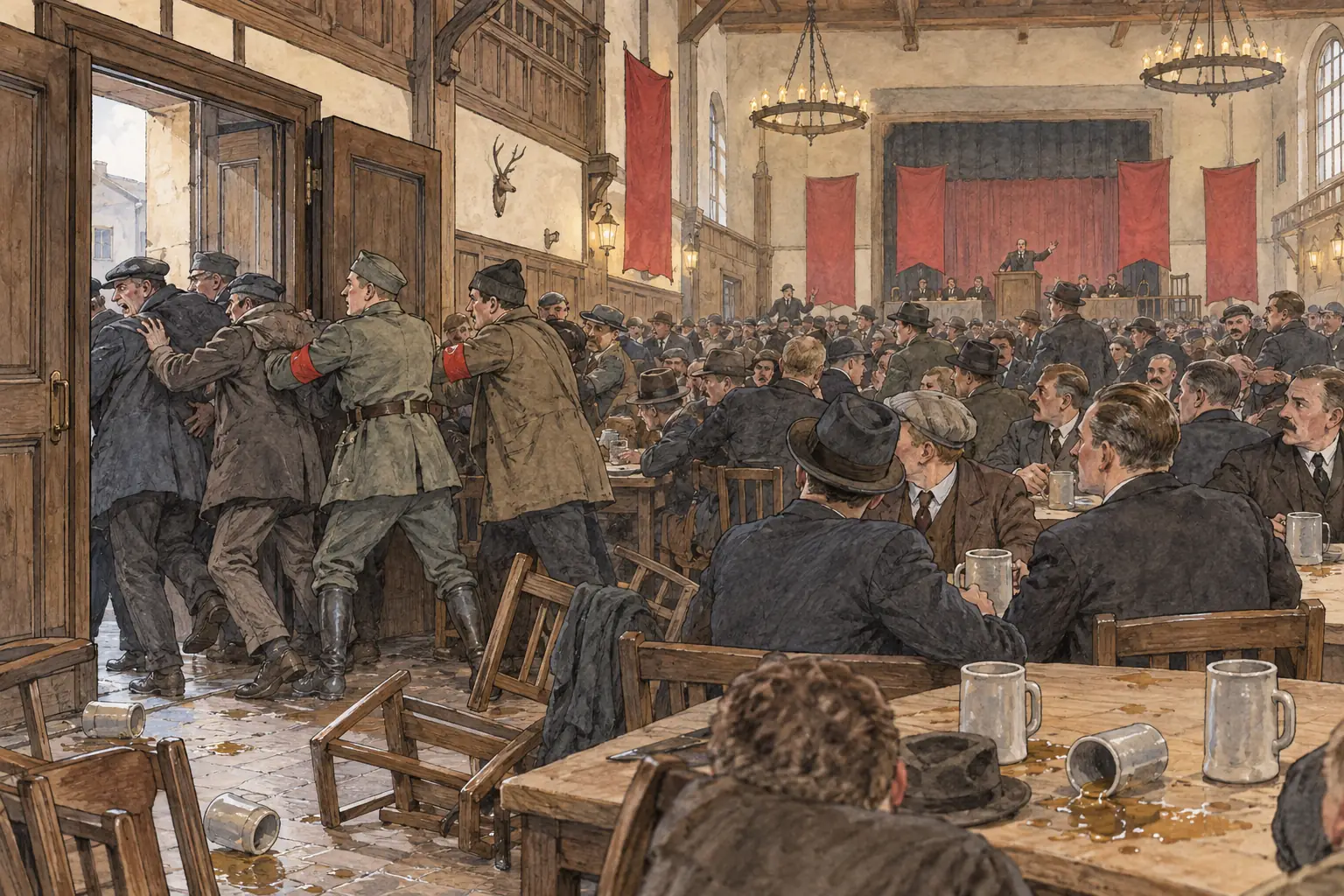
To protect its activities and assert dominance in a turbulent political landscape, the NSDAP formed a paramilitary wing. This group evolved from a simple security detail into a tool for broader intimidation and propaganda.
Development and functions of the SA
- Formation - Established in August 1921 as the Sturmabteilung (SA), or stormtroopers, it began as a squad to safeguard party meetings from disruptions by communists and other rivals.
- Paramilitary structure - Led by figures like Ernst Röhm, the SA adopted military-style uniforms and training, recruiting mainly from unemployed ex-soldiers to build a disciplined force.
- Roles in party activities - The SA provided protection at rallies, intimidated political opponents through violence and street fights, and generated publicity by marching in public displays of strength, helping to boost the NSDAP's visibility and recruitment by 1922.