2.2 - Vesalius, Paré & Harvey: Surgery & Anatomy
Key facts and dates
The work of Andreas Vesalius, Ambroise Paré and William Harvey during the Renaissance period challenged ancient medical theories, particularly those of Galen, through direct observation and experimentation. Their innovations in anatomy and surgery laid foundations for modern medicine, though they faced significant opposition. The following timeline outlines the major milestones in their contributions and the dissemination of their ideas.
Timeline of key events
- 1543 – Vesalius publishes On the Fabric of the Human Body, using dissections to correct Galen's errors.
- 1545 – Paré introduces ligatures for bleeding control and soothing ointments in his surgical writings.
- 1553 – Thomas Geminus publishes an English edition of Vesalius's work, aiding its spread in Britain.
- 1570s – William Clowes promotes Paré's methods in English surgical texts.
- 1628 – Harvey publishes On the Motion of the Heart, proving blood circulation through experiments.
- 1640s – Harvey's ideas gain traction in Britain via translations and medical networks.
Vesalius's dissections and illustrations
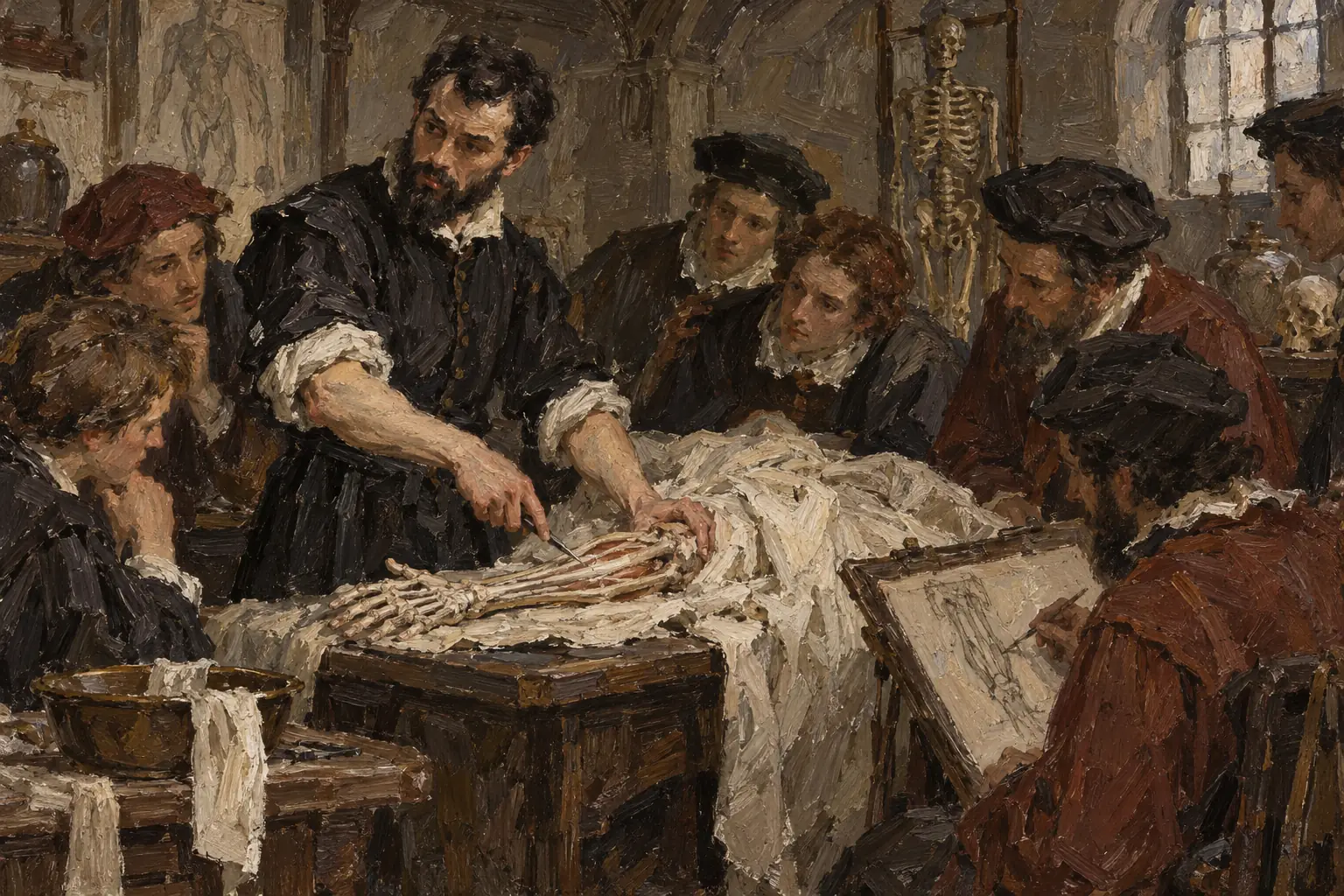
Andreas Vesalius, a Flemish anatomist, revolutionised the study of human anatomy in the 16th century by prioritising hands-on investigation over reliance on ancient texts. His approach exposed inaccuracies in the long-accepted ideas of Galen, who had based much of his work on animal dissections.
Methods Vesalius used to challenge traditional anatomy
- Human dissections - Vesalius performed public dissections on executed criminals, allowing direct observation of human structures, which revealed errors such as Galen's incorrect descriptions of the jawbone and breastbone.
- Detailed illustrations - He collaborated with artists to create precise drawings of bones, muscles and organs, making complex anatomical details accessible and accurate for study.
- Publication of key text - In On the Fabric of the Human Body (1543), Vesalius compiled his findings into a comprehensive book that combined text with images, encouraging others to verify claims through their own dissections.
Paré's surgical innovations
Image 1 of 2: Paré replaced boiling oil with a soothing ointment of egg yolk, rose oil and turpentine
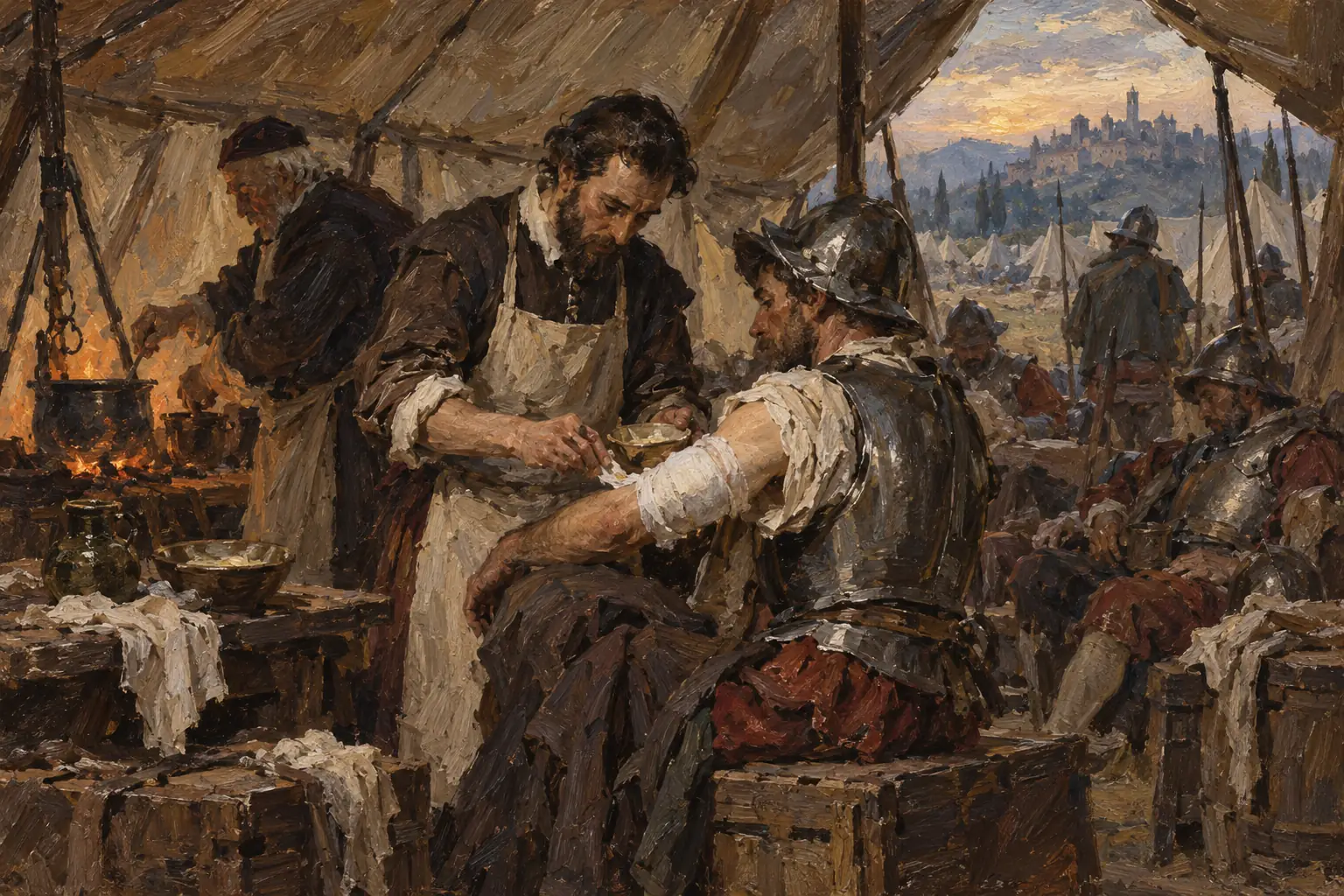
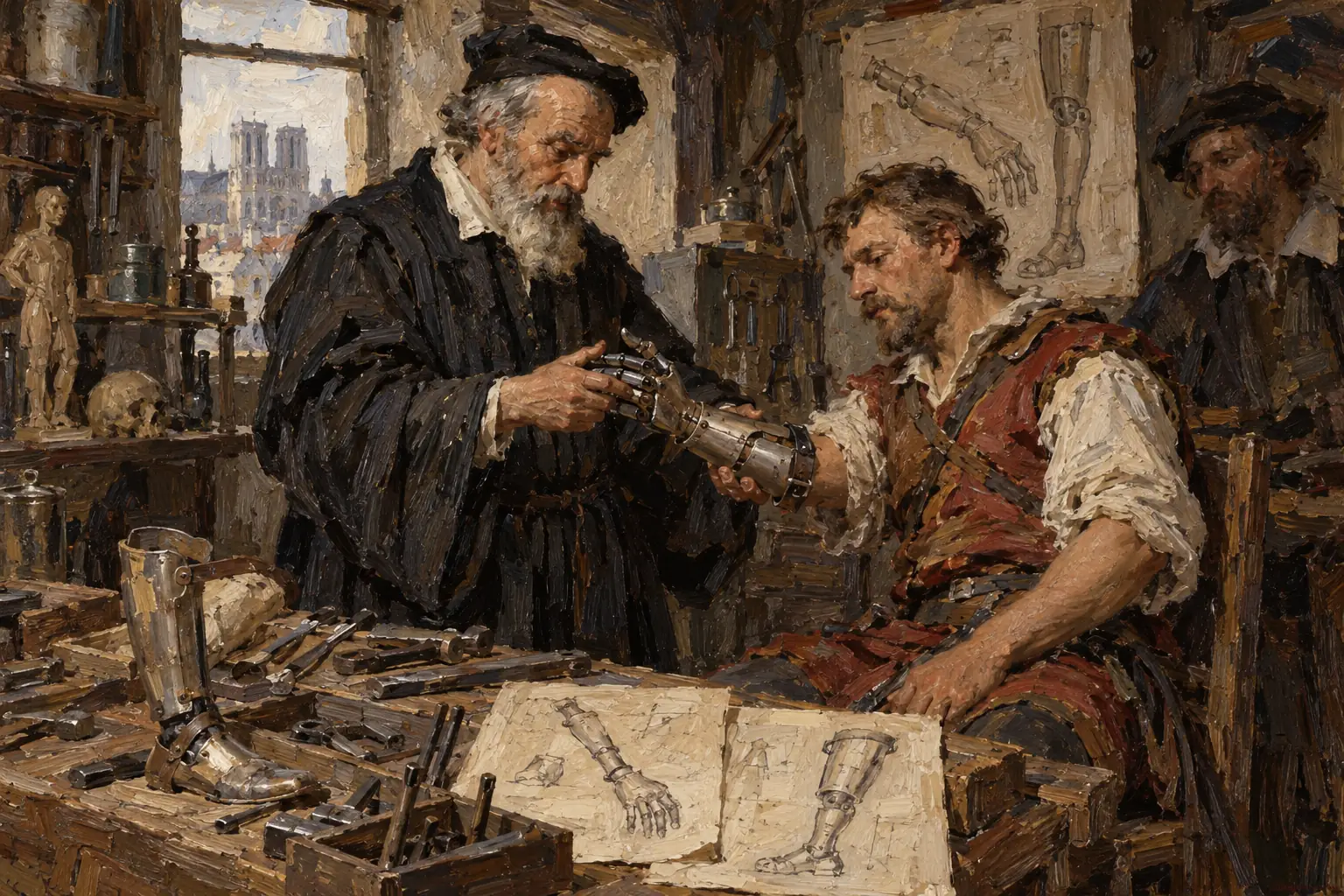
Ambroise Paré, a French surgeon, developed practical improvements to surgical techniques during the 16th century, drawing from his experiences treating wounded soldiers in military campaigns. His methods focused on reducing pain and infection, moving away from harsh traditional practices.
Key innovations introduced by Paré
- Ligatures for bleeding control - Instead of using hot irons (cautery) to seal wounds, Paré tied blood vessels with silk threads, which lessened patient suffering and improved healing rates.
- Soothing wound ointments - He replaced boiling oil treatments with gentler mixtures of egg yolk, rose oil and turpentine, which proved more effective at preventing infection based on his observations.
- Improved prosthetics - Paré designed advanced artificial limbs, such as mechanical arms with movable joints, enhancing mobility for amputees injured in battle.
Harvey's demonstration of blood circulation
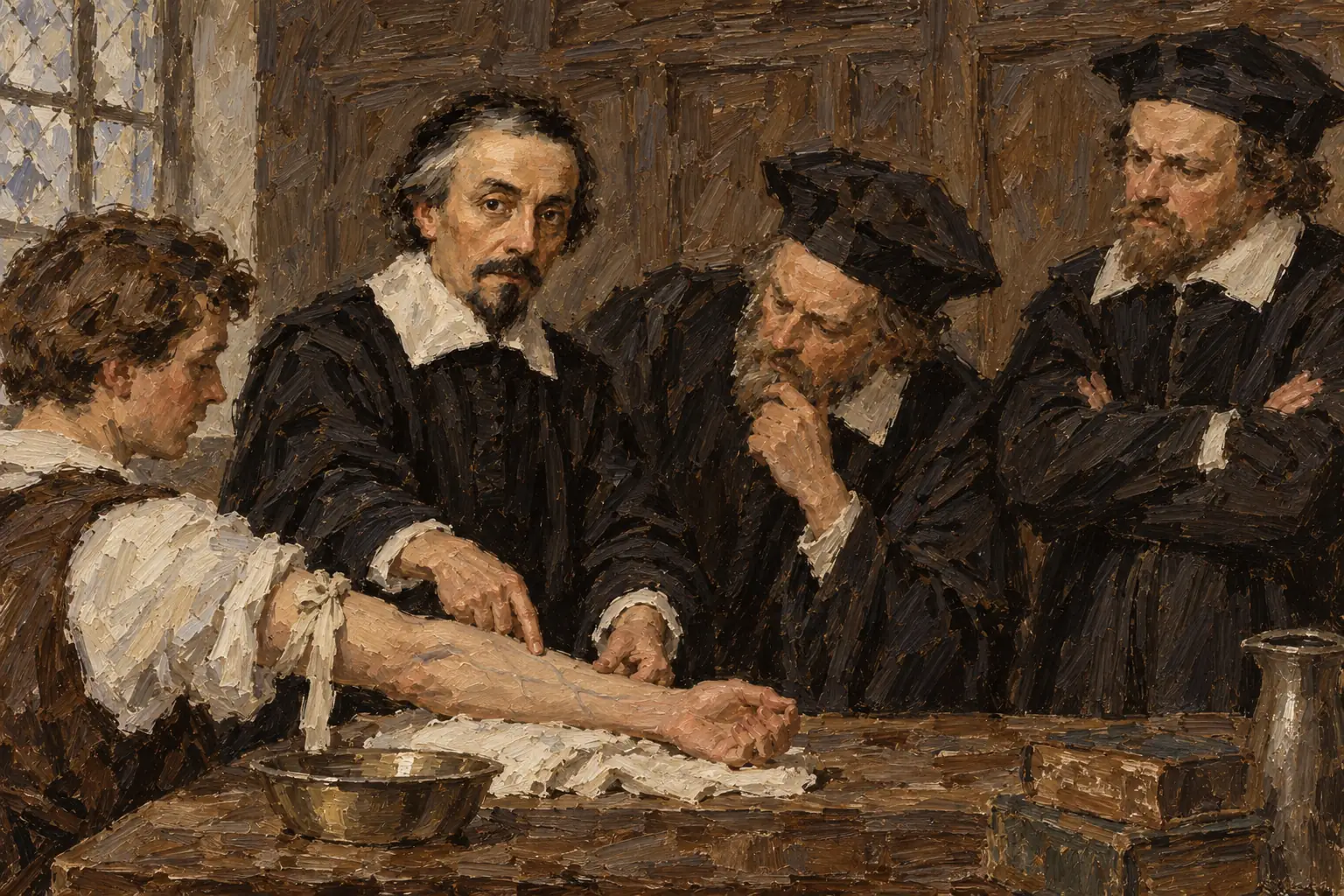
William Harvey, an English physician, transformed understanding of the cardiovascular system in the 17th century through rigorous scientific methods. His work disproved Galen's theory that blood was produced in the liver and consumed by the body, introducing the concept of a closed circulatory system.
Harvey's approach to proving blood circulation
- Use of experiments - Harvey conducted vivisections on animals and simple tests on humans, such as tying ligatures on arms to observe vein swelling, demonstrating that blood flows in one direction.
- Mathematical calculations - He estimated the volume of blood pumped by the heart, showing it was too great to be constantly produced anew, supporting the idea of recirculation.
- Publication of findings - In On the Motion of the Heart (1628), Harvey presented evidence that blood circulates continuously from the heart through arteries and back via veins, aided by one-way valves.
Resistance to change and spread to Britain
The groundbreaking ideas of Vesalius, Paré and Harvey encountered strong opposition from those loyal to ancient authorities like Galen. Despite this, their concepts gradually spread to Britain through various channels, influencing local medical practice.
Factors causing resistance to new medical ideas
- Loyalty to tradition - Many physicians and universities dismissed the innovations as disrespectful to established texts, delaying acceptance for decades.
- Practical challenges - Dissections were often restricted by religious or legal rules, and Harvey's circulation theory faced scepticism because it contradicted visible observations of blood flow.
Ways ideas reached and influenced Britain
- Translations of texts - English versions of Vesalius's work appeared by the mid-1500s, making anatomical details widely available to British scholars.
- Influence of local surgeons - Figures like Thomas Geminus reproduced Vesalius's illustrations in 1545, while William Clowes incorporated Paré's techniques into his 1570s treatises on surgery.
- Medical networks - Harvey, working in Britain, shared his findings through lectures and publications, with ideas circulating via European scholarly exchanges.
Significance and long-term impact
The contributions of Vesalius, Paré and Harvey marked a shift towards evidence-based medicine, emphasising observation and experimentation. Their work improved the precision of anatomical and surgical knowledge, with enduring effects on medical practice.
Evaluation of methods and accuracy
- Innovative approaches - Vesalius's dissections and illustrations, Paré's battlefield trials and Harvey's experiments promoted empirical testing over blind acceptance of ancient theories.
- Enhanced precision - Corrections to Galen's errors, such as accurate depictions of the heart and blood vessels, provided reliable foundations for future studies.
Long-term impact on medical practice
- Foundation for modern anatomy - Vesalius's emphasis on human dissection became standard in medical education, leading to more accurate surgical procedures.
- Advances in surgery - Paré's humane techniques reduced mortality from wounds and influenced trauma care in later centuries.
- Revolution in physiology - Harvey's circulation model enabled developments like blood transfusions and heart surgery, transforming understanding of bodily functions.