1.10 - Volcanoes: Causes & Effects
Formation of volcanoes at plate boundaries
Volcanoes are geological structures formed by the eruption of molten rock from beneath the Earth's surface. This molten rock, known as magma when underground, becomes lava when it reaches the surface. Many volcanoes form at the boundaries of tectonic plates due to the movement and interaction of these massive slabs of the Earth's crust.
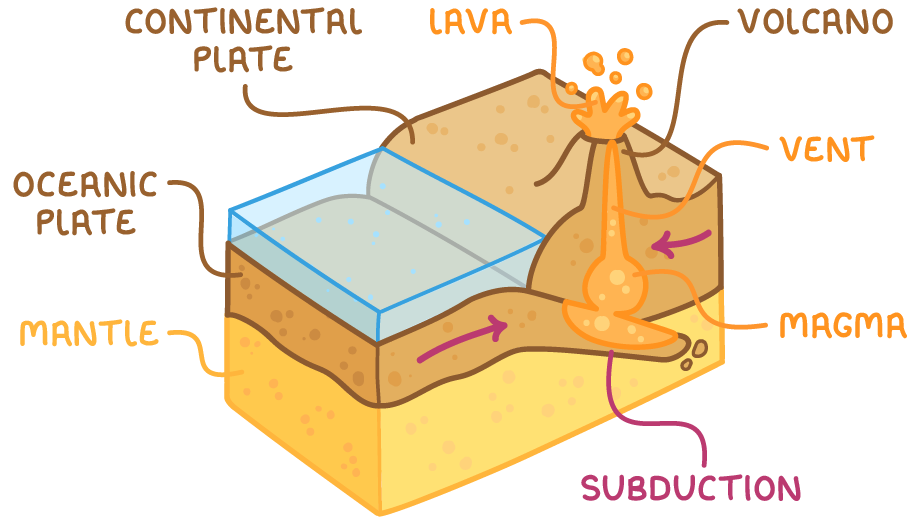
Processes at convergent plate boundaries
- Plate subduction - At convergent boundaries, an oceanic plate, being denser, is forced beneath a continental plate in a process called subduction.
- Melting in the mantle - As the oceanic plate descends into the mantle, it melts due to intense heat and pressure, forming a reservoir of magma.
- Magma ascent - This magma rises through weaknesses or cracks in the overlying crust, known as vents.
- Volcanic eruption - Eventually, the magma breaks through to the surface as lava, creating a volcano over time.
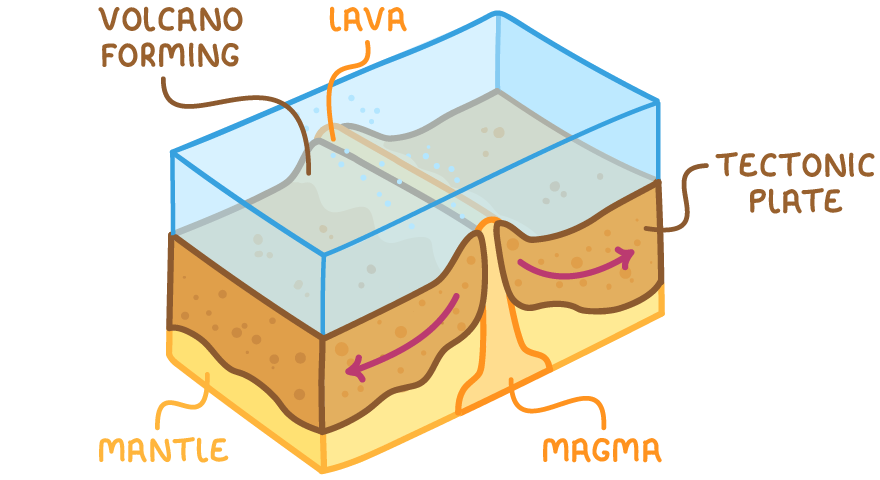
Processes at divergent plate boundaries
- Plate separation - At divergent boundaries, tectonic plates move apart, creating a gap in the Earth's crust.
- Magma upwelling - Magma from the mantle rises to fill this gap, cooling and solidifying as it reaches the surface.
- Volcano formation - This process results in the formation of a volcano, often underwater in oceanic settings, such as along mid-ocean ridges.
The role of hotspots in volcanic formation
Not all volcanoes form at plate boundaries; some emerge in the middle of tectonic plates due to unique geological features known as hotspots.
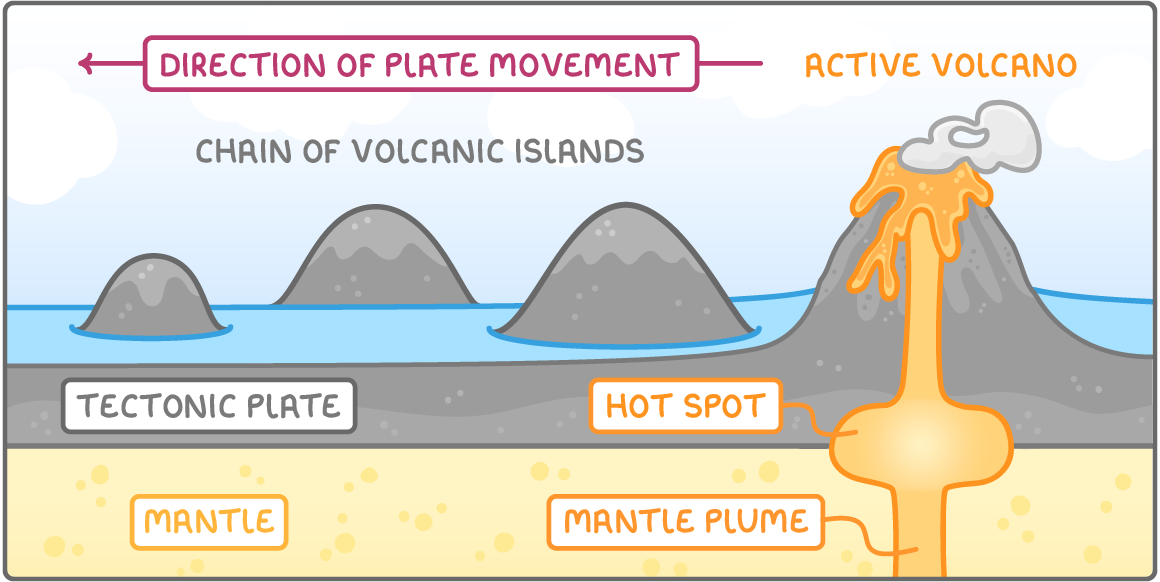
Mechanism of hotspot volcanism
- Mantle plume - Hotspots are locations where a plume of unusually hot magma rises from deep within the mantle towards the Earth's surface.
- Heat flow - This plume generates a significant transfer of heat from the mantle to the crust, weakening the crust above.
- Surface eruption - Magma can penetrate the crust, leading to eruptions that form volcanoes over time.
- Stationary nature - Hotspots remain fixed in position while the tectonic plate above moves, resulting in a chain of volcanic islands as new volcanoes form over the hotspot.
The Hawaiian Islands in the Pacific Ocean are an example of a volcanic chain formed by a hotspot in the centre of the Pacific plate.
Characteristics of volcanic eruptions
Volcanic eruptions vary widely in their intensity and impact, releasing a range of materials that can affect the surrounding environment.
Materials released during eruptions
- Lava - The primary material is lava, the molten rock that flows from the volcano once magma reaches the surface.
- Gases - Eruptions release various gases, which can pose health risks and contribute to atmospheric changes.
- Ash clouds - Many volcanoes emit fine ash particles, which can blanket large areas, disrupt agriculture, and even block sunlight.
- Pyroclastic flows - Some eruptions produce deadly pyroclastic flows, which are fast-moving currents of super-heated gas, ash, and rock fragments that can devastate everything in their path.
Different types of volcanoes and their features
Volcanoes are classified into different types based on their formation, eruption style, and the composition of the lava they produce. The two primary types are composite and shield volcanoes, each with distinct characteristics.
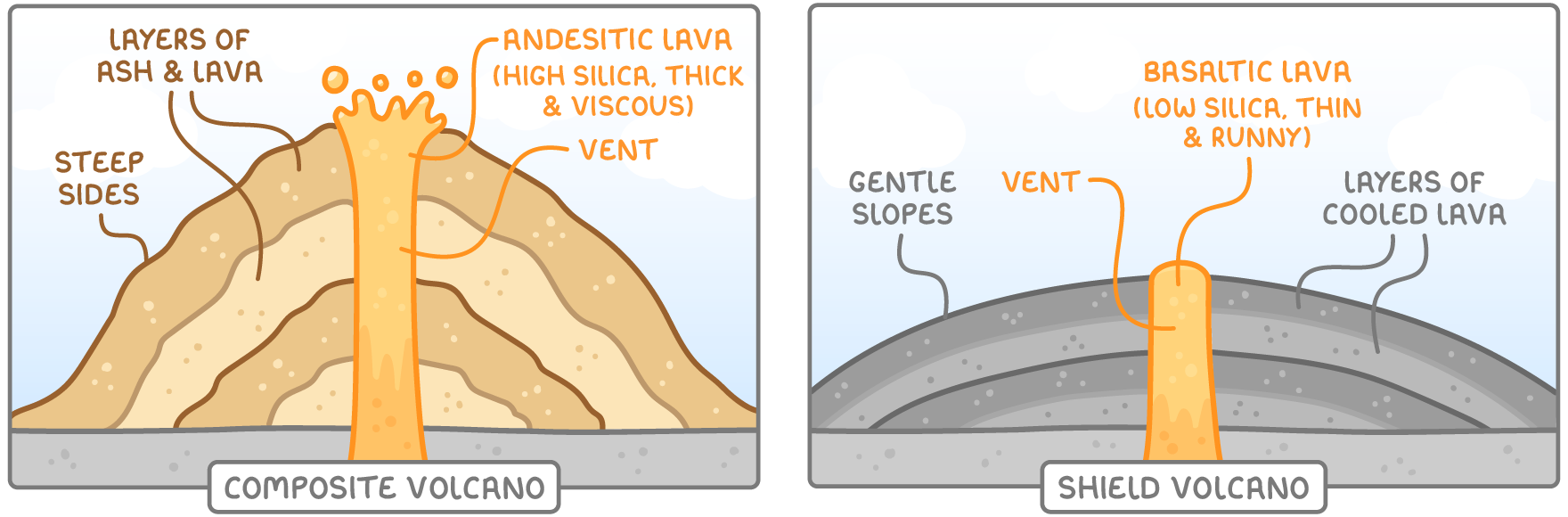
Features of composite volcanoes
- Location - Typically found at convergent plate boundaries where subduction occurs.
- Composition influence - The subducted oceanic crust often contains water, which interacts with magma to produce gases, leading to highly explosive eruptions.
- Eruption style - Eruptions begin with ash-heavy explosions, depositing layers of ash around the volcano.
- Lava type - They erupt andesitic lava, which has a high silica content, making it thick and viscous.
- Shape formation - Due to the sticky nature of the lava, it does not flow far, resulting in steep-sided, conical structures.
Features of shield volcanoes
- Location - Commonly form at hotspots or divergent plate boundaries.
- Eruption style - These volcanoes have less explosive eruptions, primarily consisting of lava flows without significant ash or gas outbursts.
- Lava type - They erupt basaltic lava, which has a low silica content, making it thin and runny.
- Shape formation - The fluid lava spreads over wide areas before cooling, creating broad, gently sloping volcanoes.