1.11 - Earthquakes: Causes & Effects
Causes of earthquakes at plate boundaries
Earthquakes are powerful natural events that happen due to the movement of tectonic plates. They occur at the boundaries where these plates interact, as tension builds up from the plates' movements and is suddenly released.
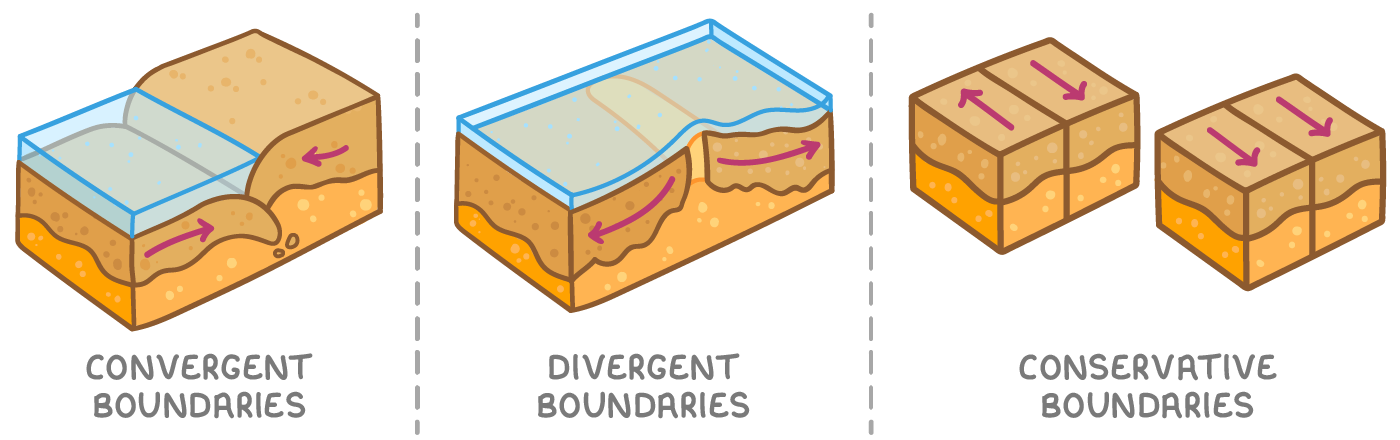
Types of plate boundaries and earthquake formation
| Boundary type | How tension builds and releases |
|---|---|
| Convergent boundaries | Tension accumulates when one tectonic plate becomes stuck while sliding beneath another into the mantle, leading to a sudden release of energy as an earthquake. |
| Divergent boundaries | Tension develops along fractures within the plates as they pull apart from each other, causing the ground to shake when the stress is released. |
| Conservative boundaries | Tension builds when plates sliding past each other get stuck, resulting in a jerking motion that triggers vibrations known as an earthquake. |
These sudden movements send out shock waves, which are the vibrations felt during an earthquake, radiating from the point of origin through the Earth's crust.
The measurement of earthquake magnitude
Earthquakes vary in strength, and their intensity is quantified using a specific scale to assess the energy they release.
Earthquake magnitude scales
- Moment magnitude scale - This is the current standard used by scientists to measure the energy released by an earthquake.
- Richter scale - Previously used to measure earthquake energy, this scale is no longer employed by scientists.
Shallow-focus and deep-focus earthquakes
Earthquakes originate at different depths within the Earth, which influences their characteristics and the extent of damage they cause.
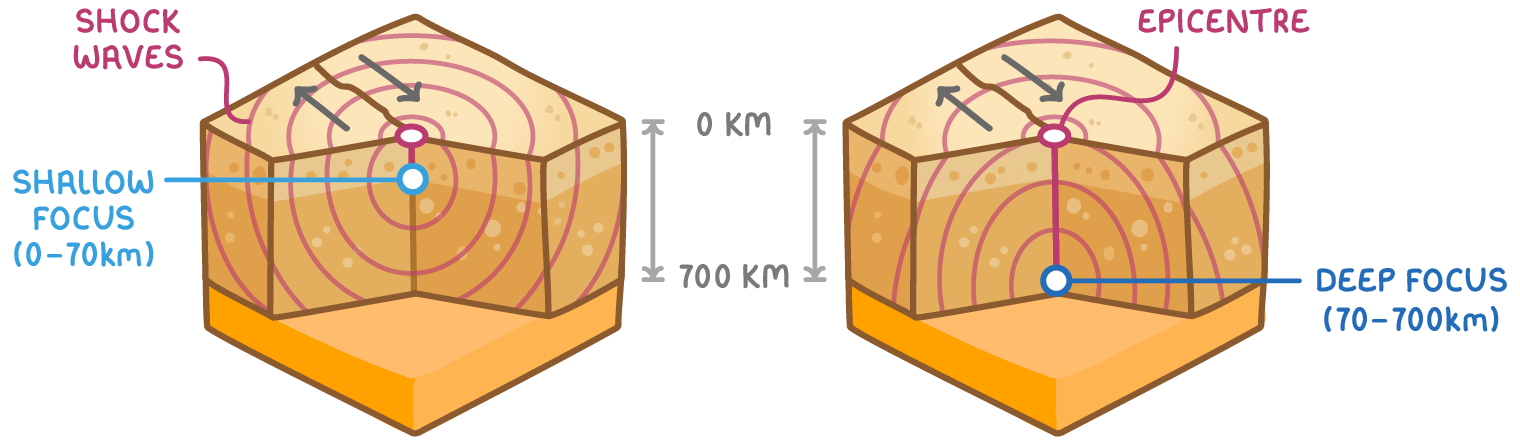
Earthquake focus, depth, and damage
The focus of an earthquake is the location inside the Earth where the earthquake begins, ranging from the surface to as deep as 700 km below.
There are two main types of earthquakes according to the depth of their focus:
- Shallow-focus earthquakes:
- These occur at or near the Earth's surface, with a focus between 0 km and 70 km deep.
- They are typically caused by the direct movement of tectonic plates.
- Earthquakes closer to the surface generally cause more severe damage because the shock waves have less distance to travel, retaining much of their energy upon reaching the ground.
- Deep-focus earthquakes:
- These originate deeper within the Earth, with a focus between 70 km and 700 km.
- They are often linked to subducted crust moving towards the Earth's core, heating up or breaking down as it descends.
- Deeper earthquakes tend to cause less destruction at the surface.
- The shock waves must pass through more layers of rock, which absorbs and dissipates some of their energy before they reach the surface.
The relationship between earthquakes and tsunamis
Earthquakes, particularly those occurring under the ocean, can trigger tsunamis, which are massive waves capable of causing widespread devastation.
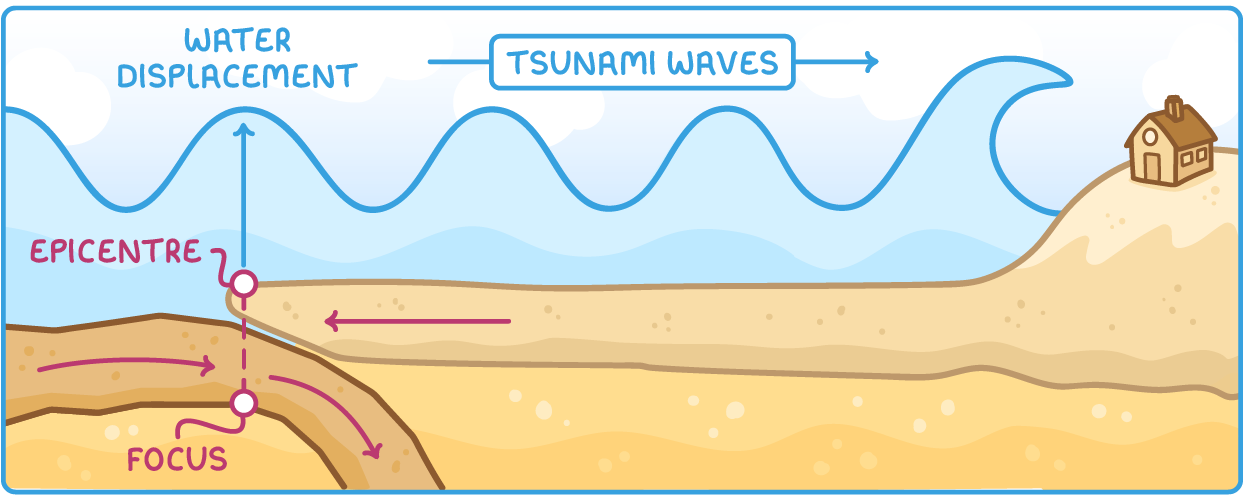
How earthquakes cause tsunamis
- Water displacement - Underwater earthquakes cause the seabed to shift dramatically, displacing large volumes of water above it.
- Wave formation - This displacement generates a series of enormous waves that spread outwards from the epicentre, which is the point on the Earth's surface directly above the earthquake's focus.
Tsunami waves travel extremely quickly in deep water, often reaching coastal areas with little warning, which can result in significant loss of life due to the lack of preparation time.
Impact of earthquake depth on damage and tsunamis
The depth at which an earthquake occurs not only affects the level of destruction on land but also influences the magnitude of associated tsunamis.
Earthquake depth and tsunami magnitude
| Earthquake depth | Effect on tsunami magnitude |
|---|---|
| Shallow-focus earthquakes | These earthquakes, being closer to the seabed, displace a greater volume of water, leading to larger and more destructive tsunamis. |
| Deep-focus earthquakes | Earthquakes with a deeper focus result in less water displacement due to their distance from the surface, typically producing smaller tsunamis or none at all.. |