3.4 - How Cities Change
The stages of urban development
Urban areas evolve through distinct stages as they grow and adapt to economic, social, and technological changes. These stages involve cycles of population movement, where people shift into, out of, and back into cities, influenced by changing economic conditions.
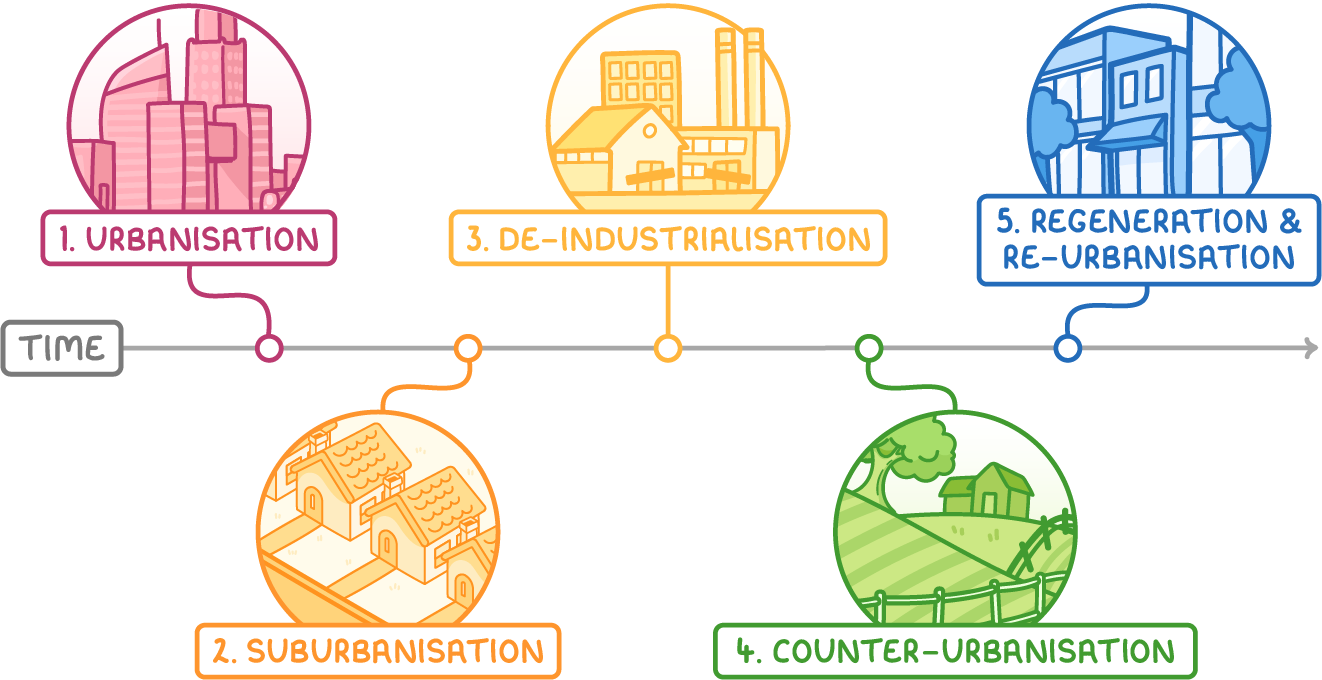
Key stages in urban development
- Urbanisation - An increase in the proportion of people living in built-up urban environments, often driven by industrial growth.
- Suburbanisation - The outward expansion of urban areas as populations move from city centres to the outskirts seeking better living conditions.
- De-industrialisation - The decline of manufacturing industries in urban areas, leading to economic and population shifts.
- Counter-urbanisation - The migration of people from large urban centres to smaller towns or rural areas for a better quality of life.
- Regeneration and re-urbanisation - The revitalisation of city centres through investment, attracting people and businesses back into urban cores.
The process of urbanisation
Urbanisation marks the initial phase of urban growth, where a growing proportion of a population resides in urban areas, leading to the physical expansion of cities into surrounding rural landscapes.
Historical drivers of urbanisation
- Industrial Revolution impact - During the period from 1760 to 1850, cities in developed countries expanded rapidly as industrialisation drew workers to urban centres for factory jobs.
- Housing patterns - Workers often lived in small terraced homes near factories in city centres to be close to their workplaces.
- Global industrial shifts - From the 1970s and 80s onwards, as factories moved to developing countries, urban areas in those regions saw growth with the development of slums and apartment blocks to accommodate workers.
The impact of suburbanisation on urban areas
Suburbanisation refers to the movement of people from crowded city centres to the outskirts, resulting in the rapid expansion of urban areas through the development of housing in surrounding regions.
Causes and consequences of suburbanisation
- Timing in developed countries - This trend emerged in the early 20th century as urban centres became increasingly overcrowded.
- Push factors from cities - High pollution levels, lack of green spaces, and cramped living conditions in cities encouraged outward movement.
- Pull factors to suburbs - Suburban areas offered more open, family-friendly environments with access to greenery.
- Role of transport - Improvements in transport networks made commuting from suburbs to city centres feasible, supporting this shift.
The effects of de-industrialisation on cities
De-industrialisation occurs as economies evolve, with manufacturing industries relocating away from traditional urban areas, often causing significant social and economic challenges in the affected regions.
Impacts of industrial relocation
- Movement within countries - Industries often shift from city centres to rural areas where rents are cheaper.
- Global shift - Many industries move overseas to countries where costs are lower, impacting local economies.
- Population decline - As jobs disappear, people leave industrial areas, leading to depopulation in both city centres and industrial zones on urban edges.
- Economic and social fallout - Rising unemployment results in reduced living standards, increased poverty, and the closure of commercial amenities as the population decreases.
Counter-urbanisation and regeneration
As urban areas face decline, two contrasting trends emerge: counter-urbanisation, where people move away from cities to rural areas, and regeneration, where efforts are made to revive urban centres through investment and redevelopment.
Features of counter-urbanisation
- Emergence in developed countries - This trend began in the 1970s and 80s as people sought improved quality of life outside urban centres.
- Motivations for movement - Lower house prices and a higher quality of life in rural areas attract residents away from cities.
- Enabling factors - Increased car ownership, improved public transport, and high-speed internet access allow commuting and remote working from distant locations.
- Business relocation - Some companies also move to rural areas where land is cheaper, further encouraging population shifts.
Characteristics of regeneration and re-urbanisation
- Revitalisation since the 1990s - Many city centres in developed countries have seen regeneration efforts to reverse declines caused by earlier urban trends.
- Investment focus - Investments are made in new developments like high-quality flats and office blocks, as well as upgrading infrastructure.
- Cycle of growth - Initial investments often encourage other businesses to invest, creating a continuing cycle of development.
- Demographic appeal - Young, single individuals are often drawn back to urban areas for proximity to work and access to entertainment services, a process known as re-urbanisation.