3.5 - Patterns of Urban Land Use
Categories of urban land use
Urban areas are divided into distinct types of land use based on their primary function.
Types of urban land use
- Commercial - Includes areas designated for business activities, such as office buildings, shopping centres, and hotels, which cater to economic and service needs.
- Industrial - Encompasses zones with factories and warehouses, focusing on manufacturing and storage operations.
- Residential - Covers spaces where people live, including houses, flats, and apartments of varying sizes and styles.
The zonal structure of cities
Cities often develop in a pattern of concentric rings, each zone having distinct characteristics and functions. These zones are visible on maps and satellite imagery, reflecting how different types of land use cluster together due to shared requirements.
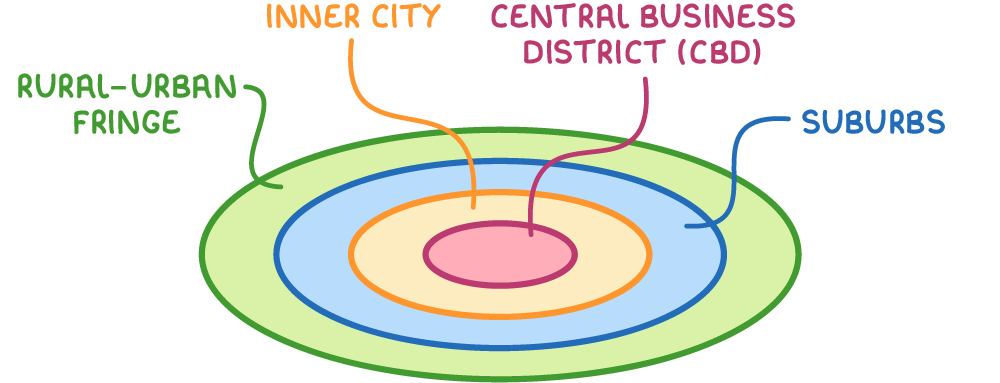
Typical zones in a city
- Central business district (CBD) - The core of the city with a focus on commercial and public activities.
- Inner city - Surrounds the CBD, predominantly residential with some older industrial areas.
- Suburbs - Residential areas further out from the inner city, with a more spacious layout.
- Rural-urban fringe - The outermost zone, blending urban and rural features with mixed land uses.
Characteristics of different city zones
Each zone within a city has unique features that define its role and appearance.
Features of the CBD
- Dominant land use - Primarily commercial with public buildings like government offices and major retail hubs.
- Building density - High-density structures due to limited space, often featuring tall skyscrapers.
- Infrastructure - Major roads converge here, making it a transport hub with train and bus stations.
Features of the inner city
- Dominant land use - Mainly residential with low-cost housing, alongside older industrial sites.
- Street layout - Characterised by short, parallel roads and tightly packed terraced housing.
- Building types - Includes larger, ageing factory buildings from earlier industrial periods.
Features of the suburbs
- Dominant land use - Predominantly residential with medium-cost housing for families.
- Street layout - Features short, curved streets and cul-de-sacs, designed for quieter, residential living.
- Density - Lower building density compared to inner zones, allowing for more open space.
Features of the rural-urban fringe
- Dominant land use - A mix of commercial business parks and high-cost residential properties.
- Space and greenery - More open green spaces compared to urban zones, reflecting a transition to rural areas.
- Building types - Larger office complexes and shopping centres with extensive car parking facilities.
Factors influencing urban land use patterns
The distribution of land use within a city is shaped by several key factors. These elements determine where certain types of buildings and activities are located, creating the distinct zoning patterns observed in urban areas.
Accessibility as a determining factor
- City centre accessibility - Central areas are highly accessible due to the presence of major transport hubs like train stations and the convergence of road networks, attracting shops and offices that rely on large customer bases.
- Edge-of-city locations - Some businesses opt for sites near motorway junctions or out-of-town airports to bypass central congestion, ensuring easier access for logistics and employees.
Availability of land for development
- Central constraints - In city centres, nearly all land is occupied, leading to high demand and vertical expansion with taller buildings to maximise limited ground space.
- Redevelopment opportunities - Brownfield sites in central areas are often converted into commercial spaces, while old inner-city housing is upgraded into luxury residences for professionals.
- Peripheral space - The edges of cities offer more available land, allowing for the construction of larger structures like warehouses or expansive retail parks.
Cost considerations in land use
- Price gradient - Land values are highest in the city centre and decrease towards the outskirts, influencing what can be built where.
- Central affordability - Only certain businesses and shops can afford central locations, with residential properties being scarce due to high costs.
- Housing size variation - As land prices drop from the inner city to the suburbs, house sizes tend to increase, reflecting more affordable land for larger properties.
Impact of planning regulations
- Control over development - City planners regulate urban growth by specifying what types of structures can be built in different zones, shaping the city's layout.
- Central restrictions - Strict rules in city centres often prohibit polluting industries to maintain a cleaner, more attractive environment for commercial activities.
- Greenbelt protection - Many cities impose limits on development in the rural-urban fringe, designating areas as greenbelt land to prevent urban sprawl and protect surrounding countryside.
TermDefinition
Central business district (CBD)The commercial and economic core of a city, usually located in the centre.
Inner cityThe zone surrounding the CBD, typically containing older, high-density housing and former industrial sites.
SuburbsThe mainly residential areas towards the edge of a city, featuring lower-density housing and more open space.
Rural-urban fringeThe boundary zone where the city meets the countryside, containing a mix of urban and rural land uses.
Brownfield siteAn area of previously developed land that is no longer in use and can be cleared for new building.
GreenbeltProtected open space around a city where development is strictly restricted to prevent urban sprawl.