4.7 - How Deposition Creates Coastal Landforms
The process of material transportation along coasts
Coastal environments are dynamic, with materials constantly being moved and reshaped by natural processes. Transportation refers to the movement of eroded materials along the coastline, primarily driven by wave action.
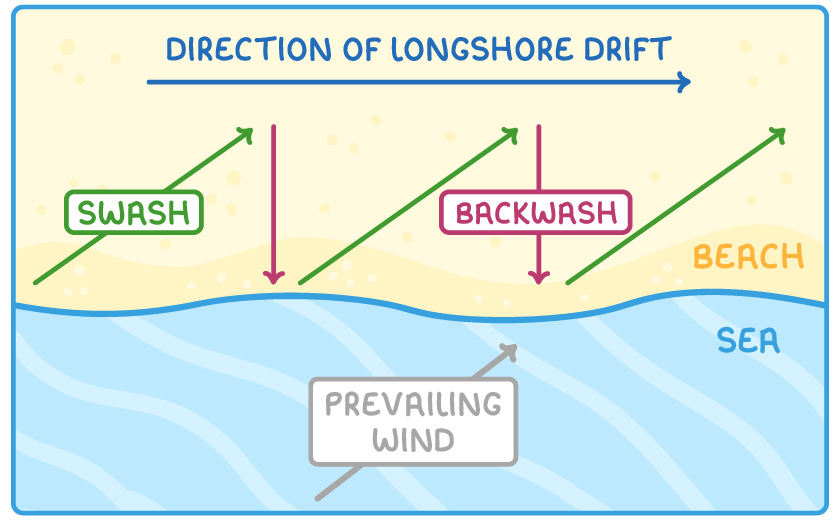
How materials are transported along the coast
- Longshore drift - This is the main process of material movement along coasts. It occurs due to the action of waves that follow the direction of the prevailing wind.
- Wave approach - Waves typically approach the shore at an oblique angle, meaning they hit the coast at any angle other than a right angle.
- Swash movement - The swash, which is the forward movement of water up the beach, carries material in the same direction as the incoming waves.
- Backwash movement - The backwash, which is the return flow of water down the beach, pulls material back towards the sea at a right angle to the shore.
- Zigzag pattern - Over time, this alternating swash and backwash action causes materials to move in a zigzag pattern along the coastline.
The role of constructive waves in deposition
Deposition happens when materials carried by seawater are dropped onto the coast. This process occurs when water carrying sediment slows down so it isn't moving fast enough to carry the sediment.
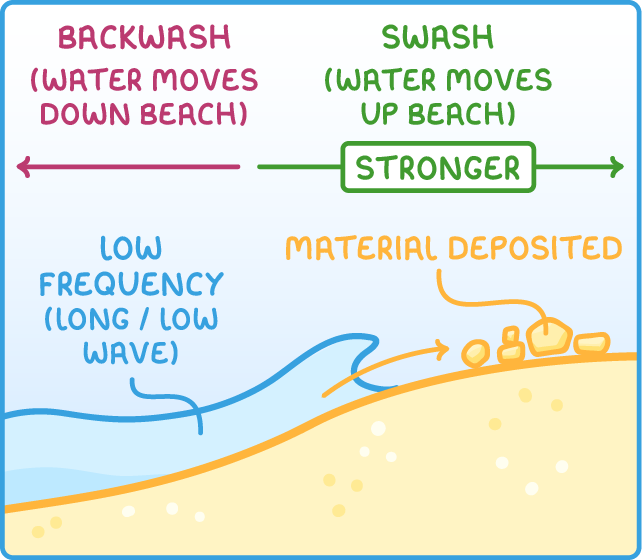
Characteristics of constructive waves
- Definition - Constructive waves are waves that deposit more material than they erode, contributing to the growth of coastal landforms.
- Wave profile - These waves are low in height, long in length, and have a low frequency, typically producing 6-8 waves per minute.
- Swash strength - The swash of constructive waves is strong, pushing materials like sand and shingle (gravel) up the beach.
- Backwash strength - The backwash is weaker, meaning it does not carry much material back down to the sea, allowing for net deposition.
- Resulting landforms - Through this process, constructive waves create features such as beaches by accumulating sediment along the coast.
The formation and features of spits
Spits are distinctive coastal landforms created by the deposition of sediment in specific coastal configurations. They often develop in areas where the coastline changes direction.
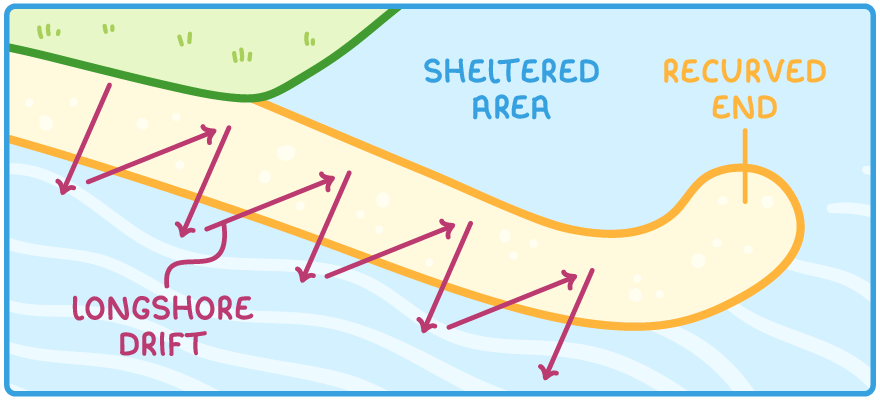
How spits are formed and their characteristics
- Location of formation - Spits typically form at sharp bends in the coastline, such as near the mouth of an estuary.
- Role of longshore drift - Sediment, including sand and shingle, is transported by longshore drift past the bend and deposited into the sea, extending the landform outwards.
- Recurved ends - Strong winds and wave action can bend the tip of the spit, creating a hooked or recurved end.
- Sheltered areas - Behind the spit, a protected zone forms where wave energy is reduced, allowing for further sediment accumulation.
- Development of ecosystems - Over time, the sheltered area can transform into mud flats or salt marshes as plants begin to establish themselves in the deposited material.
The formation and characteristics of bars
Bars are another type of depositional landform that can significantly alter coastal geography.
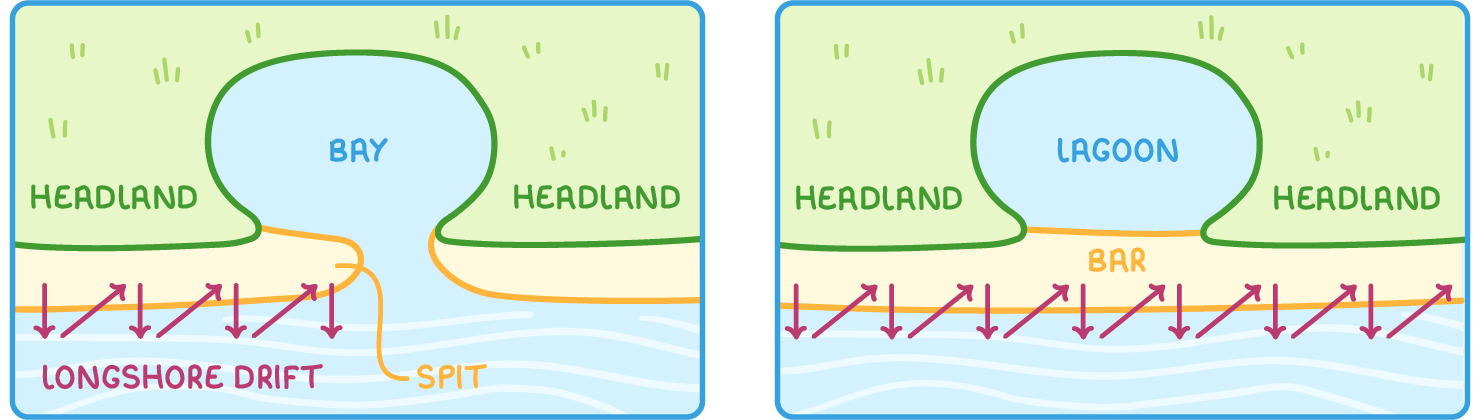
How bars are formed and their features
- Formation process - A bar develops when a spit extends across a bay, eventually connecting two headlands together.
- Isolation of bays - As the bar forms, it cuts off the bay from the open sea, creating an enclosed area of water.
- Lagoon creation - Behind the bar, a lagoon often forms, which is a body of still water separated from the sea by the deposited sediment..
TermDefinition
Longshore driftThe zigzag movement of sediment along a coast, driven by waves approaching at an oblique angle.
Constructive waveA low, long wave with a strong swash and weak backwash that deposits material on a beach.
DepositionThe dropping of eroded material by water when it loses energy and slows down.
SpitAn extended ridge of sand or shingle projecting into the sea from the land, usually formed at a sharp bend in the coastline.
BarA ridge of sand or shingle that extends completely across a bay, connecting two headlands.
LagoonA body of still water cut off from the open sea by a bar.