4.18 - Sediment & River Landforms
The concept of sediment load in rivers
Sediment load refers to the material transported by a river. The amount and type of sediment a river carries are influenced by several physical factors: climate, geology, and slope processes.
Climate's impact on rivers and sediment load
Climate significantly affects the behaviour of rivers by influencing the amount of water in the system and the energy available for erosion and transportation.
How climate shapes river landscapes and sediment load
- Higher discharge in wet climates - Rivers in wetter climates have higher discharge because there's more water entering the river channel.
- Increased erosion rates - Higher volume of water gives rivers more power to erode their banks and bed, adding material to the load.
- Formation of flood plains - In the lower course, lateral erosion dominates, creating wide, flat flood plains.
- Enhanced transportation - Higher discharge provides rivers with more energy to carry material.
- Weathering contributions - Temperature fluctuations lead to rock fragmentation, increasing the likelihood of material falling into river channels.
Geology's role in rivers and sediment load
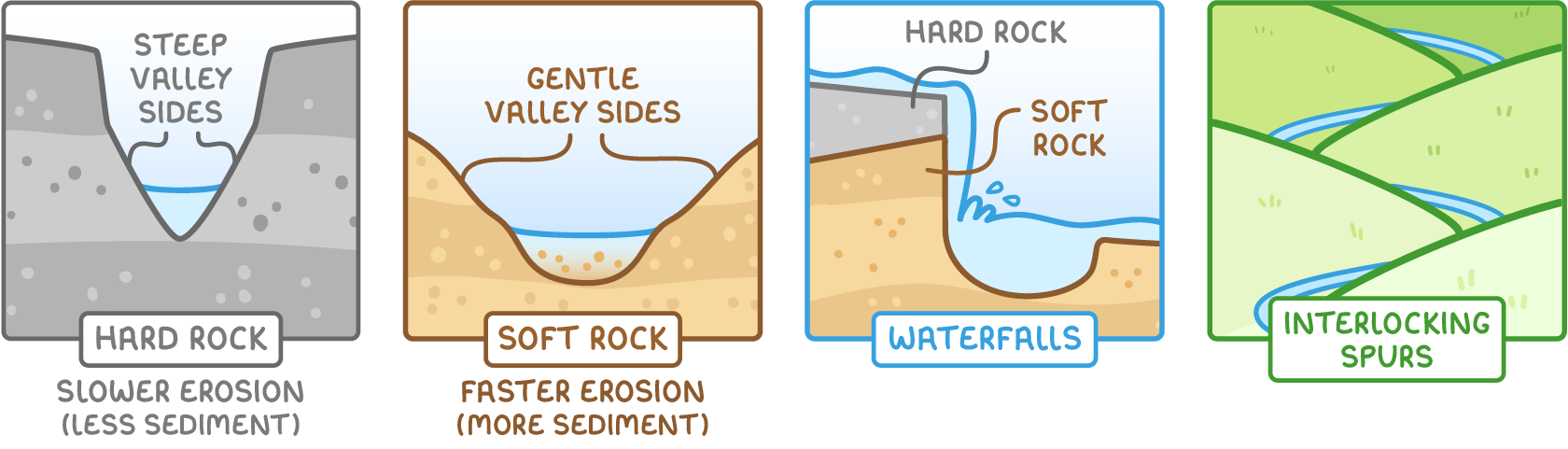
The type of rock through which a river flows has a profound effect on the rate of erosion and the resulting landscape features.
Effects of geology on river landscapes and sediment load
- Resistance of hard rock - Rivers flowing through hard rock have a slower rate of erosion and lower sediment load.
- Erosion in softer rock - Areas with softer rocks experience more erosion, adding more material to the river's sediment load.
- Valley side steepness - Landscapes with more resistant rocks tend to have steeper valley sides, while less resistant rocks have gentle sloping valley sides.
- Formation of waterfalls - These occur where a layer of hard rock overlies softer rock.
- Development of interlocking spurs - These form where softer rock is eroded first, leaving areas of harder rock sticking out.
Slope processes, rivers and sediment load
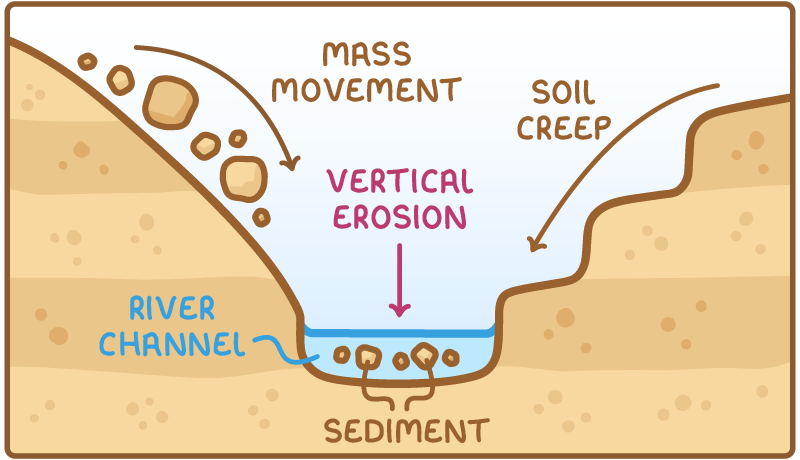
Slope processes involve the movement of material down valley sides towards the river channel, directly impacting the sediment load and the shape of the surrounding landscape.
Key slope processes affecting river landscapes and sediment load
- Impact of vertical erosion - Rivers erode downwards, steepening valley sides, which increases the movement of material down the slopes.
- Mass movement events - These can add large amounts of material to the river's load, often triggered by:
- Cold weather, where freeze-thaw weathering loosens material.
- Intense rainfall, which saturates the ground, making it heavier and less stable.
- Soil creep dynamics - This is when soil particles move down a slope because of gravity and the expansion and contraction of soil due to water content.
- Features from soil creep - Soil creep produces small step-like features on gradual inclines, forming distinctive miniature platforms visible on hillsides.
- Contribution to sediment load - Soil creep can add lots of fine material to the river's load.
TermDefinition
DischargeThe volume of water flowing through a river channel, which gives the river its energy for erosion and transportation.
Lateral erosionErosion that cuts sideways into the river banks, widening the channel and creating flat flood plains.
Vertical erosionDownward erosion that deepens the river channel, often creating steep valley sides.
Mass movementThe large-scale downhill movement of weathered material under the force of gravity.
Soil creepThe slow, gradual downward movement of soil particles due to gravity and changes in soil moisture.