4.5 - Coastal Weathering & Erosion
The processes of weathering in coastal zones
The coastal zone is the dynamic area where land meets the sea, and it is subject to various processes that break down rocks. Weathering is the disintegration of rocks in situ, without any movement of the material.
Types of weathering at the coast
- Mechanical weathering - This involves the physical breakdown of rocks without altering their chemical makeup. A key process in coastal areas is salt weathering, where:
- Seawater penetrates cracks in rocks.
- As the water evaporates, it leaves behind salt crystals.
- These crystals grow and exert pressure on the rock, widening cracks over time.
- Repeated cycles of this process cause fragments of rock to break away.
- Chemical weathering - This process changes the chemical composition of rocks, leading to their breakdown. A prominent type in coastal regions is carbonation, which happens in warm, wet conditions:
- Rainwater and seawater absorb carbon dioxide, forming a mild carbonic acid.
- This acid reacts with rocks containing calcium carbonate, like limestone, causing them to dissolve gradually.
- Biological weathering - This occurs when living organisms contribute to the breakdown of rocks. For example:
- Plant roots, such as those of coastal shrubs, grow into rock fissures, exerting force and splitting the rock apart as they expand.
The role of mass movement in coastal retreat
Mass movement refers to the downward shift of rocks and loose material along a slope, such as a coastal cliff or bluff. This process significantly contributes to the retreat of coastlines.
Causes and types of mass movement
- Driving forces - Mass movement happens when the gravitational pull on a slope exceeds the forces holding the material in place. Wet conditions increase the likelihood of movement because water:
- Acts as a lubricant, reducing friction.
- Adds weight to the material, making it more prone to sliding.
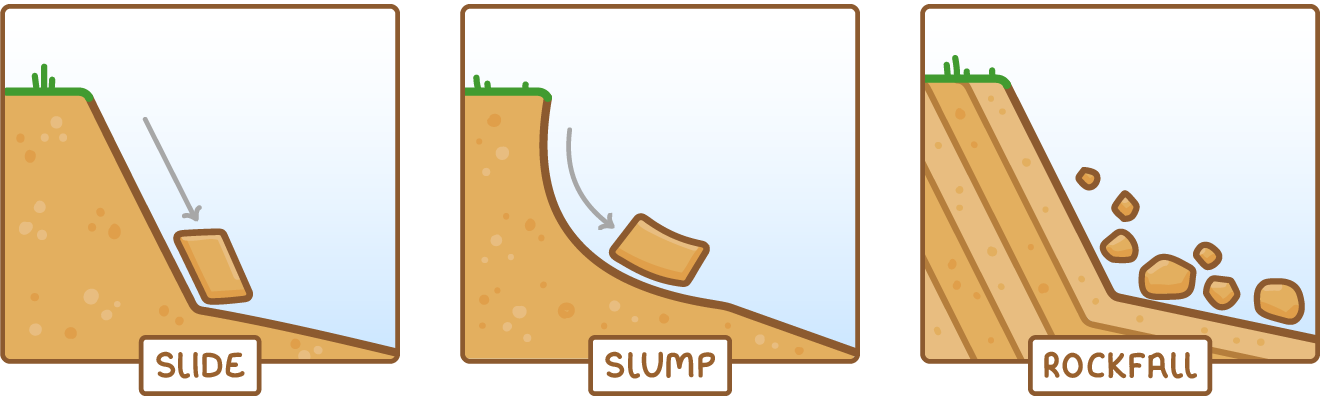
- Variations of mass movement - There are three primary forms observed in coastal environments:
- Slides - Material moves downwards in a straight path.
- Slumps - Material shifts with a rotational motion.
- Rockfalls - Fragments of rock detach and fall directly down the slope.
The processes of erosion by waves at the coast
Erosion is the process by which rocks are broken down and then transported away, primarily by the action of seawater in coastal zones. Waves are powerful agents of erosion, wearing away the coast through distinct mechanisms.
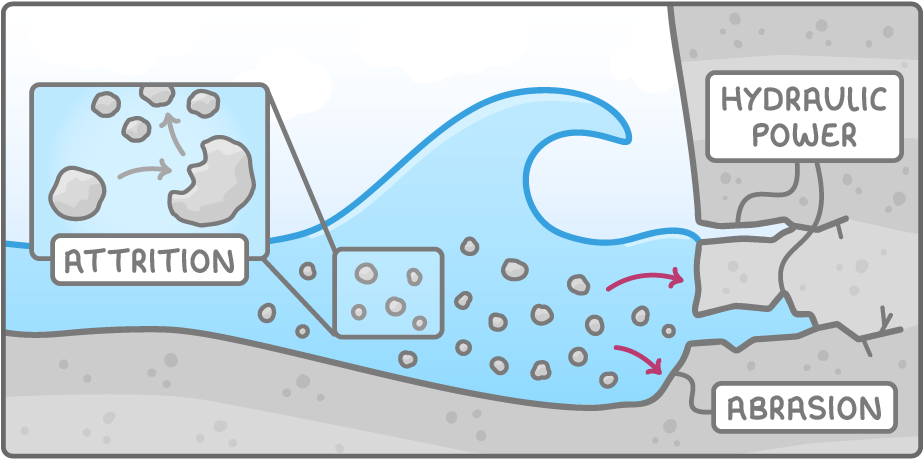
Mechanisms of wave erosion
- Hydraulic power - This is the force exerted by waves as they strike the coast:
- Waves crash against rocks, compressing air within existing cracks.
- The repeated pressure from this action enlarges the cracks over time.
- Eventually, pieces of rock are dislodged and break off due to this stress.
- Abrasion - This process involves the physical wearing away of rocks by sediment carried in the water:
- Particles, such as sand and pebbles, are dragged by waves against the rock surface.
- This scraping action removes small fragments.
- Attrition - This occurs within the water as eroded materials interact:
- Particles carried by waves collide with each other during movement.
- These collisions break the particles into smaller pieces and round off their sharp edges..
TermDefinition
WeatheringThe breakdown of rocks in situ, without the material being moved.
Mass movementThe downhill shift of rock and loose material under the influence of gravity.
ErosionThe wearing away and transportation of rock by agents such as waves, wind, or ice.
CarbonationA type of chemical weathering where mildly acidic water dissolves rocks containing calcium carbonate.
Hydraulic powerThe process where waves compress air inside cracks in a rock, forcing it apart.
AbrasionThe wearing away of a cliff surface by sediment being dragged or thrown against it by waves.
AttritionThe process of eroded particles colliding in the water, breaking into smaller, rounder pieces.