4.6 - How Erosion Creates Coastal Landforms
Influence of geology on coastal erosion
Coastal erosion shapes landforms over thousands of years, with the geological structure of a coastline playing a significant role in determining the types of features formed. The resistance of rocks and their arrangement affects how quickly erosion occurs and what landforms emerge.
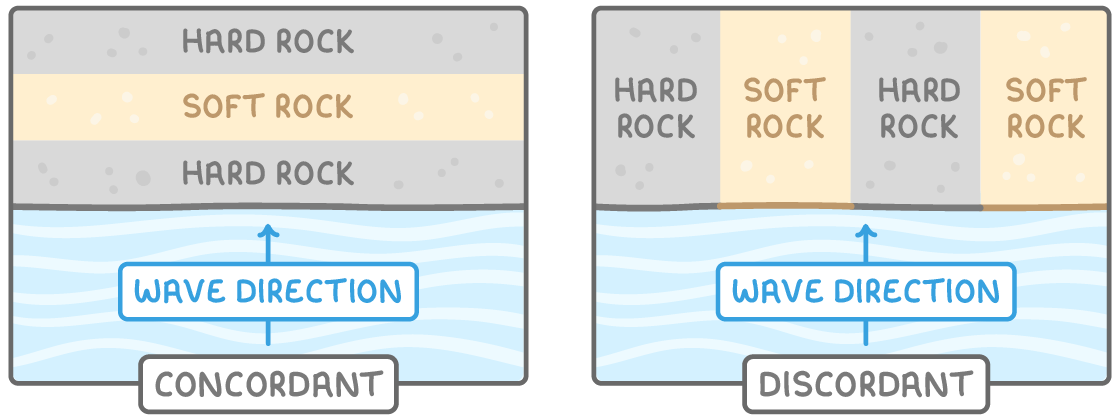
Factors affecting rock resistance to erosion
- Rock hardness - Hard rocks, such as limestone and chalk, resist erosion for longer due to their durability. Softer rocks, like clay and sandstone, wear away more rapidly.
- Presence of weaknesses - Joints and faults in rocks create cracks and weak points, making them more susceptible to erosion. Rocks with many weaknesses erode faster.
- Coastline type - Coastlines are classified as concordant or discordant based on rock band orientation:
- Discordant coastlines have alternating bands of hard and soft rock at right angles to the coast, leading to varied erosion rates and distinct landforms.
- Concordant coastlines have bands of hard and soft rock parallel to the coast, resulting in more uniform erosion and fewer distinct erosional features.
Impact of weather and waves on erosion
Weather patterns and wave characteristics significantly influence the rate and intensity of coastal erosion. Seasonal changes and storm events can accelerate the breakdown of coastal materials.
Seasonal temperature and weather effects on erosion
- Temperature variations - Coastal temperatures fluctuate with the seasons, being coldest in winter, warm in spring, hottest in summer, and cooler in autumn. Mild temperatures enhance salt weathering as water evaporates more, leaving salt crystals that weaken rocks.
- Storm frequency - Storms are common in coastal areas, particularly in winter, bringing intense rainfall and strong winds. Rainfall saturates cliffs, increasing the likelihood of mass movement like landslides.
- Wind patterns - Prevailing winds, often bringing storms, affect south-facing coasts more due to greater exposure. Cold northerly winds frequently impact eastern coasts, contributing to erosion through wave energy.
Characteristics of destructive waves in erosion
- Wave structure - Destructive waves are tall, steep, and frequent, with 10-14 waves per minute. They have a stronger backwash (water moving down the beach) compared to swash (water moving up), leading to material removal from the coast.
- Erosional power - These waves perform most erosion at the base of cliffs. Storms amplify their destructive force, increasing the rate of coastal retreat.
The formation of wave-cut notches and platforms
Erosion by waves at the base of cliffs creates distinct features over time. This process is repetitive and leads to significant changes in coastal landscapes.
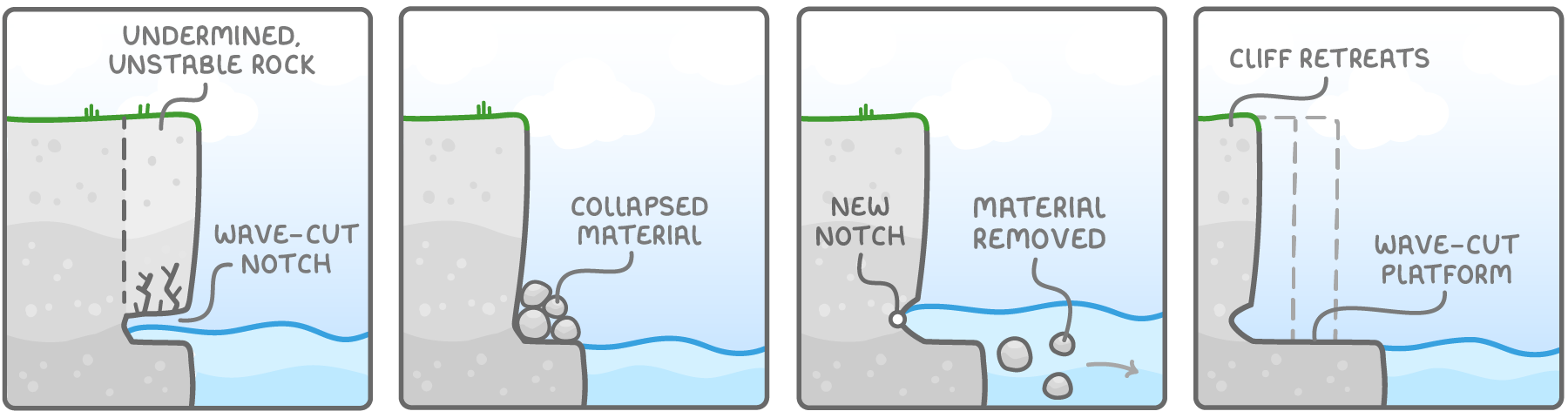
Stages of wave-cut notch and platform development
- Waves erode the foot of a cliff, forming a small indentation called a wave-cut notch.
- Continuous erosion enlarges the notch, undermining the rock above it.
- The unsupported rock becomes unstable and collapses into the sea.
- Collapsed material is swept away by waves, and a new notch begins to form at the base of the retreated cliff.
- Over time, repeated collapsing causes the cliff to retreat inland, leaving behind a flat, rocky area known as a wave-cut platform.
The development of bays and headlands
The differential erosion of rocks with varying resistance along discordant coastlines results in the formation of bays and headlands. These features are prominent where geological structures are diverse.
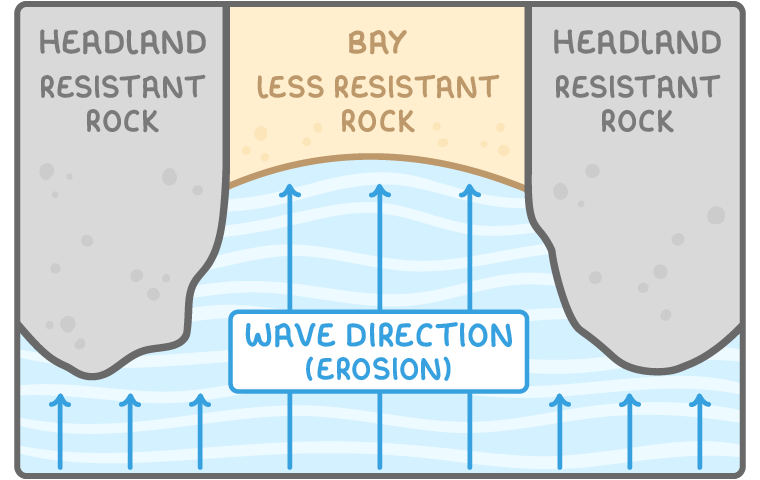
Process of bays and headlands formation
- Differential erosion rates - Less resistant rocks, such as clay, erode quickly, creating bays with gentle, curved slopes. More resistant rocks, like chalk, erode slowly, forming headlands with steep, protruding sides.
- Location on coastlines - Bays and headlands are more common on discordant coastlines due to the alternating bands of hard and soft rock perpendicular to the shore. This contrast in resistance shapes the uneven coastline.
The creation of caves, arches, and stacks
Headlands, often composed of resistant rocks, undergo a sequence of erosional processes due to wave action targeting weaknesses in the rock structure. This leads to the formation of unique coastal features.
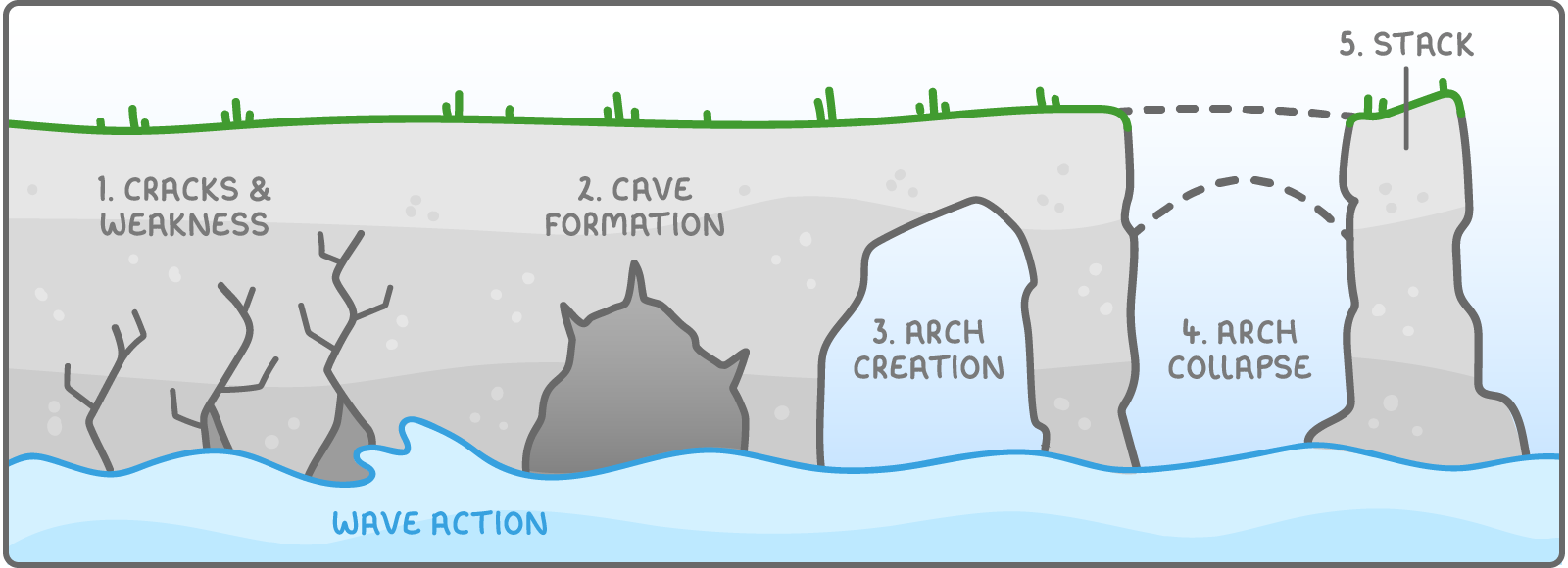
Sequence of cave, arch, and stack formation
- Waves crash against headlands, targeting cracks and weaknesses through hydraulic action (force of water) and abrasion (rubbing of materials).
- Repeated erosion enlarges these cracks, forming caves within the headland.
- Continued erosion deepens the cave until it breaks through to the other side, creating a natural arch.
- Over time, the rock supporting the arch is worn away by relentless wave action, causing the arch to collapse.
- The collapse leaves an isolated pillar of rock, known as a stack, standing separate from the headland.