2.3 - Global Inequalities: Effects
Uneven distribution of wealth between countries
The distribution of wealth across the globe is highly unequal, with significant disparities between the richest and poorest nations. This uneven development creates a stark divide in economic resources and opportunities, shaping the lives of populations in different regions.
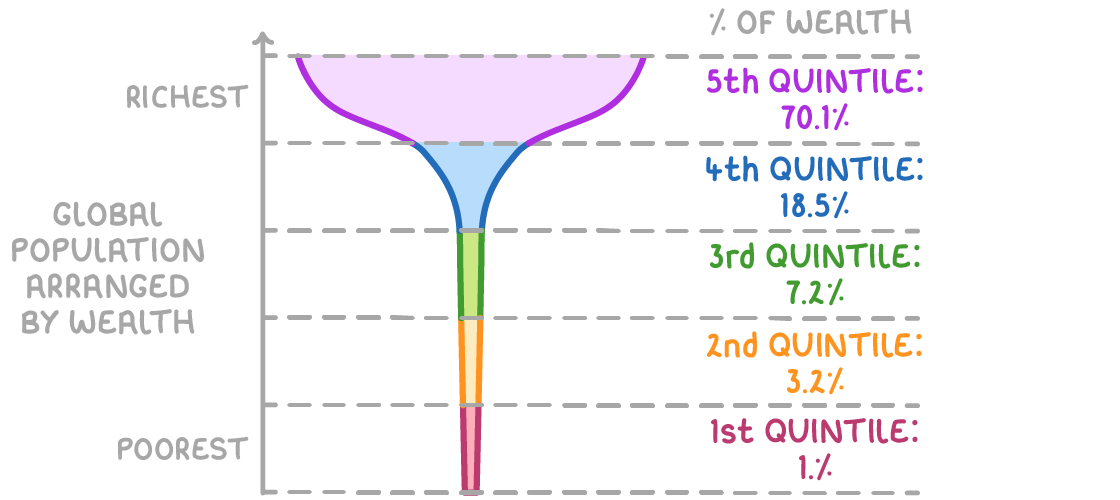
Wealth disparities across global quintiles
Countries are grouped into five quintiles based on their wealth, measured by gross domestic product (GDP) per capita.
The share of global wealth across the quintiles:
- 5th quintile: 70.1%
- 4th quintile: 18.5%
- 3rd quintile: 7.2%
- 2nd quintile: 3.2%
- 1st quintile: 1.0%
What this means is that the richest 20% of countries (5th quintile) hold approximately 70.1% of the world's wealth, while the poorest 20% (1st quintile) possess only 1.0%.
Social consequences of global inequalities
Global inequalities have profound social impacts, particularly in the areas of education and health. These disparities often trap populations in cycles of disadvantage, limiting their ability to improve their circumstances.
Impacts on education
- Limited investment - Poorer nations struggle to allocate sufficient funds to education systems compared to wealthier countries.
- Financial barriers - Families in economically disadvantaged areas often cannot afford school fees, preventing children from attending.
- Child labour - Children from low-income households may need to work to support their families, sacrificing education for immediate survival needs.
- Cycle of poverty - Without access to education, individuals are unable to secure skilled, better-paid jobs, perpetuating a cycle of poverty across generations.
Impacts on health
- Increased disease risk - Populations in developing countries face a higher likelihood of contracting diseases due to inadequate living conditions and resources.
- Lower life expectancy - Higher disease prevalence contributes to reduced life expectancy in poorer nations compared to wealthier ones.
- High infant mortality - Infant mortality rates are significantly elevated in developing countries due to limited healthcare access.
- Restricted healthcare and nutrition - Economically disadvantaged communities often lack access to quality medical services and nutritious food, exacerbating health issues.
Political consequences of global inequalities
Uneven development and wealth disparities also lead to significant political challenges, affecting stability and international relations for many countries, particularly those in lower economic brackets.
Political challenges arising from inequality
- Instability and unrest - Inequalities often fuel political instability, crime, and widespread social discontent in poorer nations.
- Conflict prevalence - Civil wars and internal conflicts are more common in developing countries, further deepening inequality.
- Resource diversion - During conflicts, resources are redirected from development initiatives to military efforts, hindering progress.
- Dependency on richer nations - Developing countries frequently rely on aid or support from wealthier nations, diminishing their autonomy.
- Reduced global influence - This dependency limits their ability to play a significant role in regional and global decision-making processes.
Environmental impacts of global inequalities
The pursuit of economic development and the disparities in wealth distribution have serious environmental repercussions. These impacts are often more pronounced in developing countries due to industrial practices and resource constraints.
Environmental pressures from uneven development
- Rising consumption - As countries develop economically, the demand for food, water, and energy increases, straining scarce resources.
- Ecosystem threats - This heightened consumption places pressure on natural ecosystems, risking long-term damage.
- Pollution from industrialisation - Industrial activities lead to elevated levels of air, water, and land pollution, particularly in developing regions.
- Climate change contribution - Emissions of greenhouse gases intensify the greenhouse effect, driving global climate change.
- Waste management challenges - Issues include overflowing landfill sites, untreated sewage, chemical waste, and agricultural runoff polluting rivers and lakes.
- Manufacturing shift - Many developed countries establish factories in developing nations or import goods produced there, resulting in higher pollution levels in these poorer regions.
- Environmental poverty traps - Economically disadvantaged populations are often caught in cycles of environmental degradation, unable to escape the damage.
- Deforestation through resource reliance - Limited access to modern energy sources forces reliance on firewood collection, contributing to deforestation and further environmental decline..