2.4 - Explaining Development: Models & Theories
Rostow's modernisation theory and its five stages
Rostow's modernisation theory predicts how a country's level of economic development changes over time. It describes economic progression from primary industry (agriculture) to secondary industry (manufacturing) to tertiary and quaternary industry (services and research). Standard of living improves as countries develop economically.
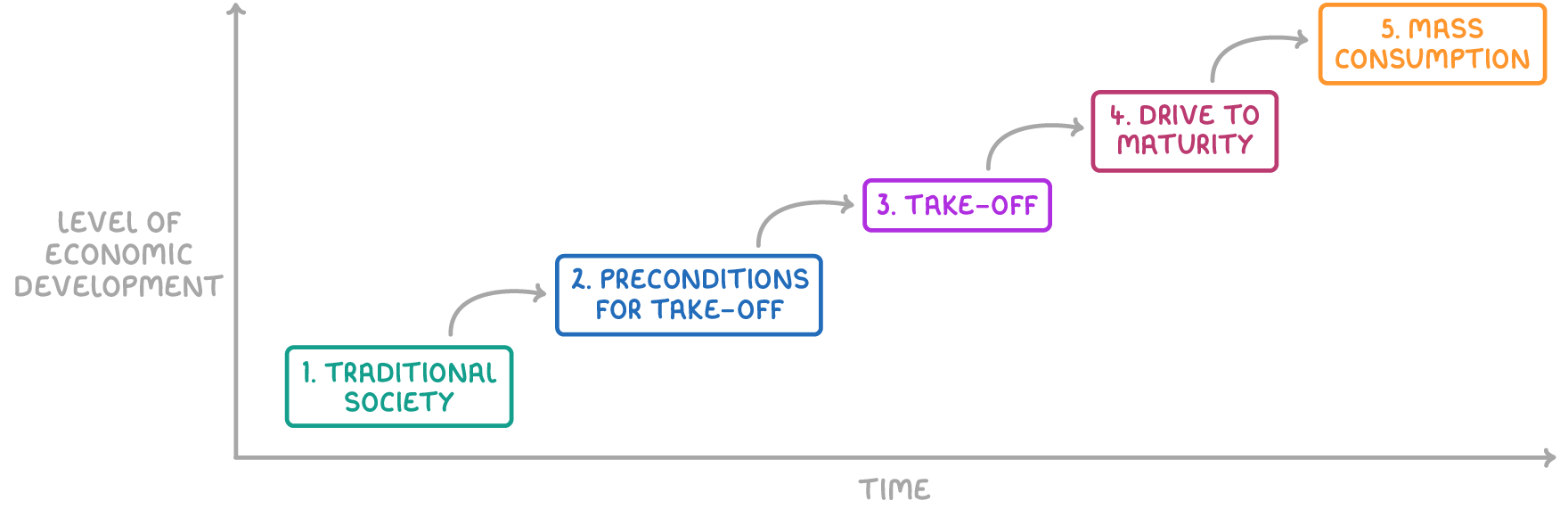
The five stages of economic development in Rostow's theory
- Traditional society - This initial stage is characterised by a subsistence-based economy heavily reliant on agriculture, alongside activities like fishing and forestry. Trade is minimal, and the focus is on meeting basic needs.
- Preconditions for take-off - At this stage, the seeds of industrialisation are sown with the emergence of manufacturing. Infrastructure begins to develop, and international trade starts to play a role in the economy.
- Take-off - Marked by rapid and intensive economic growth, this stage sees large-scale industrialisation. Wealth accumulation begins as industries expand and modernise.
- Drive to maturity - Economic growth generates significant wealth, leading to rising living standards. Technology becomes widely adopted across various sectors, further driving progress.
- Mass consumption - The final stage features extensive trade networks and mass production of goods. High levels of wealth enable substantial consumer spending and a focus on service-based economies.
Frank's dependency theory: core and periphery
Frank's dependency theory was developed as an alternative to Rostow's model. It explains why some countries are more developed than others. The theory suggests that poorer, weaker countries (the periphery) remain poor because they depend on core countries (richer and more powerful).
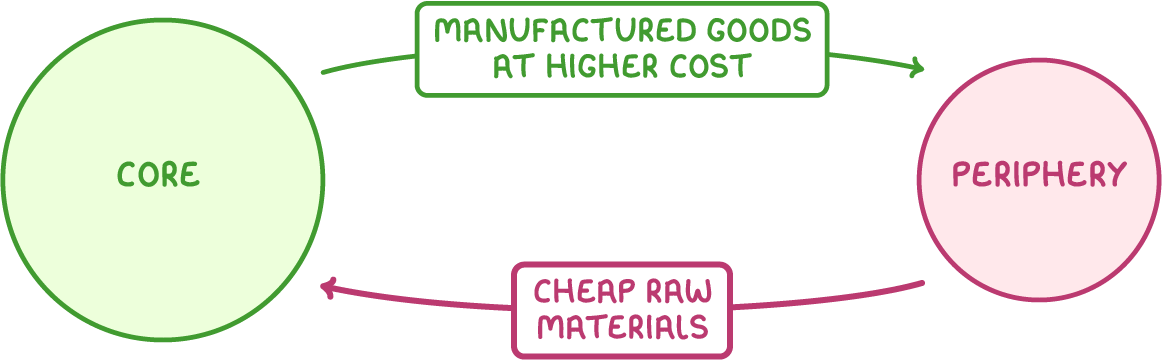
Core concepts of dependency theory
- Historical exploitation - The theory suggests that the exploitation that began during the colonial period has continued through neo-colonialism, where former colonial powers continue to dominate the trading system despite colonized countries gaining independence.
- Structural dependency - Periphery nations are trapped in a cycle of dependency, unable to develop independently due to their economic ties with core countries.
- Power imbalance - Rich countries take advantage of cheap raw materials and labor available in poorer nations.
Economic dynamics of dependency theory
Dependency theory highlights specific economic relationships that perpetuate inequality between core and periphery nations.
Economic interactions in dependency theory
- Export of primary products - Poorer countries grow export crops and sell primary products cheaply to core nations.
- Import of manufactured goods - These countries must then import manufactured goods at higher cost.
- Poverty trap - This creates a poverty trap and dependency on core economies.
- Exploitation mechanisms - Rich countries exploit poor nations through political interference and high-interest loans causing large debts.
- Systemic limitation - Some argue these countries cannot develop while remaining in this system.
Contrasting perspectives on economic development
Rostow's modernisation theory and Frank's dependency theory present fundamentally different views on how economic development occurs and why disparities exist between nations.
Comparison of Rostow's and Frank's theories
| Aspect | Rostow's modernisation theory | Frank's dependency theory |
|---|---|---|
| View on development | Linear progression through five stages towards modernity | Structural dependency prevents development |
| Role of richer nations | Potential partners in trade and progress | Exploiters maintaining control over poorer nations |
| Focus of economy | Transition from agriculture to industry and services | Reliance on exporting raw materials, importing goods |
| Solution to underdevelopment | Following stages of industrialisation and modernisation | Breaking free from capitalist system dependency |