7.4 - Population Growth & Resource Pressure
The impact of population growth on resource demand
The global population is expanding, creating a greater need for essential resources such as food, water, and energy. As more people inhabit the planet, the demand for these resources continues to rise, putting pressure on supply systems.
Trends in population growth
- Current increase - The world's population is growing, leading to heightened resource needs.
- Future predictions - Forecasts suggest this growth will persist, though exact numbers are uncertain.
- Population projections - These are estimates of future global population sizes, based on current data. While past and present figures are reliable, predicting far into the future becomes increasingly challenging.
- UN forecasts - The United Nations has provided three scenarios for population growth by the year 2100, with the highest estimate suggesting a total of 15 billion people.
Factors increasing resource consumption
Beyond population growth, several social and economic changes are driving up the demand for resources. Rising wealth, urbanisation, and industrialisation each play significant roles in shaping consumption patterns, particularly in developing regions.
Effects of increasing wealth on resource use
- Economic development - As countries develop economically, individuals become more affluent, gaining more disposable income.
- Higher consumption - Wealthier people tend to purchase more food, often exceeding their actual needs, and invest in energy-consuming items like household appliances and digital gadgets.
- Water usage - Affluence also leads to greater water consumption through the use of flushing toilets, showers, and water-dependent appliances.
- Manufacturing impact - Producing these goods and the energy to power them requires substantial amounts of water and other resources.
Impacts of urbanisation on resource demand
- Definition of urbanisation - Urbanisation refers to the increasing proportion of a country's population living in urban areas rather than rural ones.
- Resource intensity in cities - Urban areas are typically more resource-heavy compared to rural regions due to:
- Energy use for lighting systems and digital displays.
- Water needs for urban green spaces and decorative water features.
- Transport demands - Food and water must often be transported over long distances to supply cities, increasing energy consumption.
- Waste management - Removing waste from urban areas further adds to energy use.
Consequences of industrialisation on resource needs
- Definition of industrialisation - Industrialisation is the transition of a country's economy from primary activities like farming to secondary activities such as manufacturing.
- Energy consumption - Manufacturing processes, including producing transport equipment and consumer electronics, require significant energy to operate machinery and heat materials for shaping.
- Water requirements - Water is heavily used in industrial processes for cooling and cleaning components.
- Processed goods production - Industrialisation boosts the output of processed items, such as refined cooking oils, increasing the demand for raw materials like vegetable oils grown on vast plantations.
- Regional growth - Over the coming decades, much of this industrial and economic expansion is expected to occur in Africa, particularly in emerging countries.
The interconnections between resource demands
The rising demand for one resource often triggers increased needs for others, creating a complex web of dependencies. This interconnectedness amplifies the overall pressure on global resource systems.
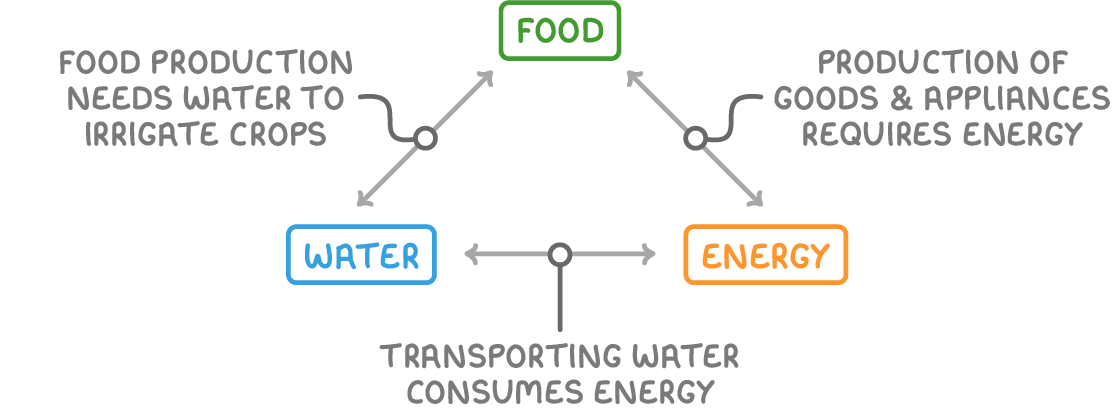
How demands for resources are linked
- Food and water - A growing population requires more food production, which in turn increases the need for water to irrigate crops.
- Water and energy - As water demand rises, it may need to be transported from water-rich regions to areas with shortages, a process that consumes considerable energy.
- Energy and manufacturing - The production of goods and the operation of modern appliances, driven by wealth and industrialisation, rely heavily on energy, further linking resource demands.
Theories on population and resource availability
Two prominent economists, Thomas Malthus and Ester Boserup, have proposed contrasting theories on the relationship between population growth and resource availability. These ideas provide different perspectives on whether humanity can sustain itself as numbers increase.
Thomas Malthus' theory on population and resources
- Historical context - An 18th-century economist, Malthus argued that population grows faster than the supply of resources.
- Catastrophic prediction - He believed that when population exceeds resource availability, catastrophic events like famine, disease, and war would reduce numbers back to a sustainable level.
- Graphical representation - On a graph, the point where population surpasses resources marks the 'point of catastrophe', after which population declines until resources are sufficient again.
Ester Boserup's theory on population and resources
- Modern perspective - A 20th-century economist, Boserup proposed that humans would always find ways to meet resource needs, no matter how large the population grows.
- Innovation and adaptation - She argued that when resources become scarce, people develop new methods, such as technological advancements, to boost production and avoid hardship.
- Graphical representation - On a graph, as population reaches the level of resource supply, the supply increases through innovation, ensuring resources remain adequate.
Evaluating Malthus and Boserup's theories
- Mixed outcomes - Neither theory has been proven entirely correct or incorrect.
- Evidence of famine - Localised famines have occurred in some regions, supporting Malthus' warnings of resource limits.
- Global food production - On a worldwide scale, food production has largely kept pace with population growth, aligning more with Boserup's optimism about human ingenuity.