8.1 - Tropical Rainforests: Characteristics
The interdependence of rainforest ecosystems
Tropical rainforests are intricate ecosystems where the biotic components (living elements like plants, animals, and people) and abiotic components (non-living elements such as climate, soils, and water) are deeply interconnected. A change in one part of the system can ripple through and impact the entire ecosystem.
Key relationships within rainforest ecosystems
- Climate and plant growth - The consistently warm and wet climate promotes rapid plant growth, creating dense vegetation.
- Leaf cover and protection - A thick canopy of leaves shields the forest floor from harsh winds and intense rainfall, maintaining a stable environment below.
- Root systems and soil stability - Extensive root networks anchor the soil, preventing erosion and maintaining the landscape's integrity.
- Pollination and animal reliance - With minimal wind near the forest floor, plants depend heavily on animals for pollination and seed dispersal.
- Symbiotic partnerships - Many plants and animals form mutual relationships, relying on each other for survival, such as certain insects and flowering plants.
- Epiphyte strategies - Epiphytes, plants that grow on other plants, gain access to sunlight by positioning themselves high in the canopy, though they lack direct access to soil nutrients.
- Impact of deforestation - Clearing rainforest areas reduces the absorption of carbon dioxide (CO2) from the atmosphere, contributing to the greenhouse effect and altering global climate patterns.
Plant adaptations to the hot, wet climate
Plants in tropical rainforests have evolved specific features to thrive in the hot, humid conditions. The forest structure is layered, or stratified, with each layer hosting plants adapted to its unique conditions.
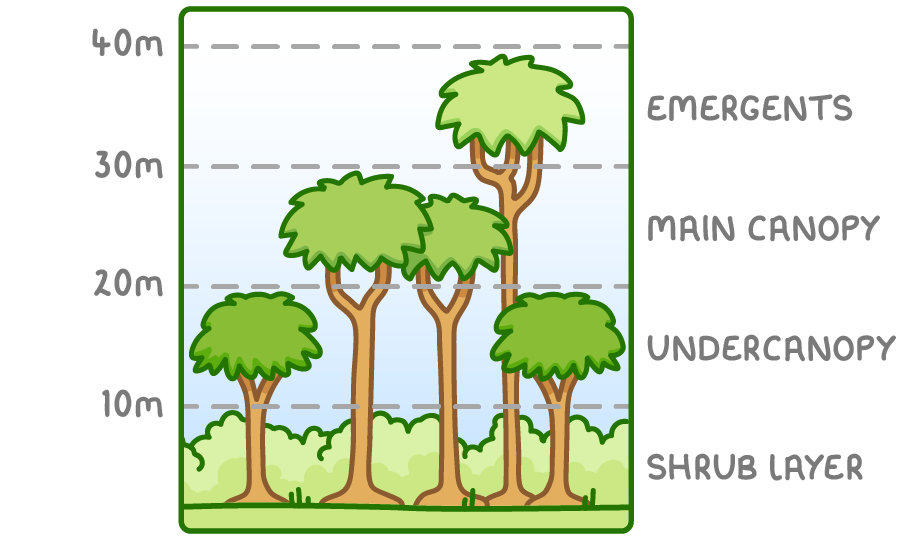
Structural layers of the rainforest
| Layer | Characteristics |
|---|---|
| Emergents | The tallest trees, with long, straight trunks and foliage only at the top, reaching above the main canopy for maximum sunlight. |
| Main canopy | A dense, continuous layer of trees that blocks much of the sunlight, creating shade for lower levels. |
| Undercanopy | Composed of younger trees that grow in gaps where light penetrates the main canopy. |
| Shrub layer | Closest to the ground, this dark layer contains plants with large, broad leaves to capture the limited light available. |
Adaptations of rainforest plants
- Leaf design - Many plants have thick, waxy leaves with pointed drip-tips, allowing water to run off quickly and preventing the growth of fungi or bacteria.
- Bark characteristics - Trees often feature smooth, thin bark, as there is no need for protection against cold temperatures.
- Climbing strategies - Lianas and other climbing plants use tree trunks to reach sunlight higher up in the canopy.
- Continuous growth - Unlike seasonal environments, rainforest plants shed leaves gradually throughout the year, supporting constant growth.
Animal adaptations to physical conditions
Rainforest animals have developed remarkable adaptations to navigate the challenges of their environment, from finding food to avoiding predators, in a habitat with dense vegetation and varied terrain.
Key adaptations of rainforest animals
- Canopy dwellers - Many species live entirely in the canopy, equipped with strong limbs for climbing and leaping between branches.
- Specialised movement - Some animals have skin flaps for gliding between trees or suction cups on their feet for gripping surfaces while climbing.
- Camouflage tactics - Numerous species blend into their surroundings to evade predators, using colouration and patterns to remain hidden.
- Nocturnal lifestyles - To conserve energy in the hot climate, many animals are active at night, feeding when temperatures are cooler.
- Enhanced senses - In the dim undercanopy, animals rely on acute hearing and smell to detect predators or locate food.
- Aquatic abilities - Many rainforest creatures are adept swimmers, enabling them to cross rivers and streams within the ecosystem.
The rapid nutrient cycle in rainforests
The nutrient cycle describes how essential nutrients move through an ecosystem, between living organisms, dead organic matter, and the soil. In tropical rainforests, this cycle operates at an accelerated pace due to the unique environmental conditions.
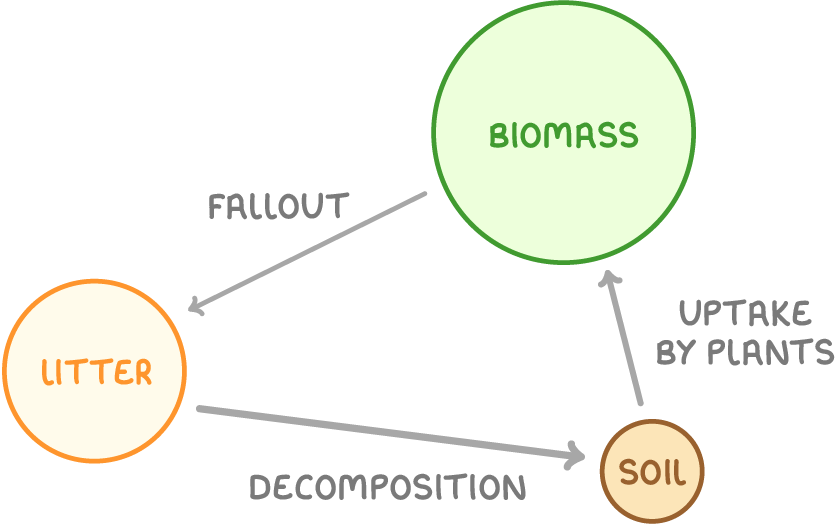
Features of the rainforest nutrient cycle
- Storage locations - Nutrients are held in three main stores: biomass (living organisms), litter (dead organic material), and soil.
- Dominance of biomass - Most nutrients are stored in the biomass due to the abundance of living plants and animals.
- Rapid transfer mechanisms - Nutrients move quickly between stores because:
- Trees are evergreen, shedding leaves continuously throughout the year.
- The warm, moist climate accelerates decomposition by fungi and bacteria.
- Dense vegetation and fast plant growth result in quick uptake of nutrients by roots.
High biodiversity in tropical rainforests
Biodiversity refers to the variety of life forms within a specific area. Tropical rainforests are among the most biodiverse ecosystems on Earth, hosting an extraordinary range of species.
Reasons for high biodiversity in rainforests
- Ancient ecosystem - Rainforests have existed for millions of years without major climatic disruptions, allowing diverse species to evolve.
- Varied habitats - The layered structure of the forest creates multiple habitats, from the sunny canopy to the shaded forest floor.
- Specialisation - Plants and animals adapt to highly specific ecological niches, becoming specialised for particular environments or food sources.
- Stable conditions - The consistently hot and wet climate provides a stable environment for life to flourish.
- Productive environment - Rapid plant growth throughout the year supports a wealth of animal and insect life.
- Efficient nutrient cycling - The fast nutrient cycle ensures that resources are readily available, preventing scarcity and supporting diverse populations.
Scale of biodiversity
Approximately 50% of the world's plant, animal, and insect species reside in rainforests. Rainforests house about half of all life forms on Earth.
Complex food webs in rainforest ecosystems
Food chains and webs illustrate the feeding relationships within an ecosystem. In tropical rainforests, these relationships are highly intricate due to the vast number of species and their interconnections.
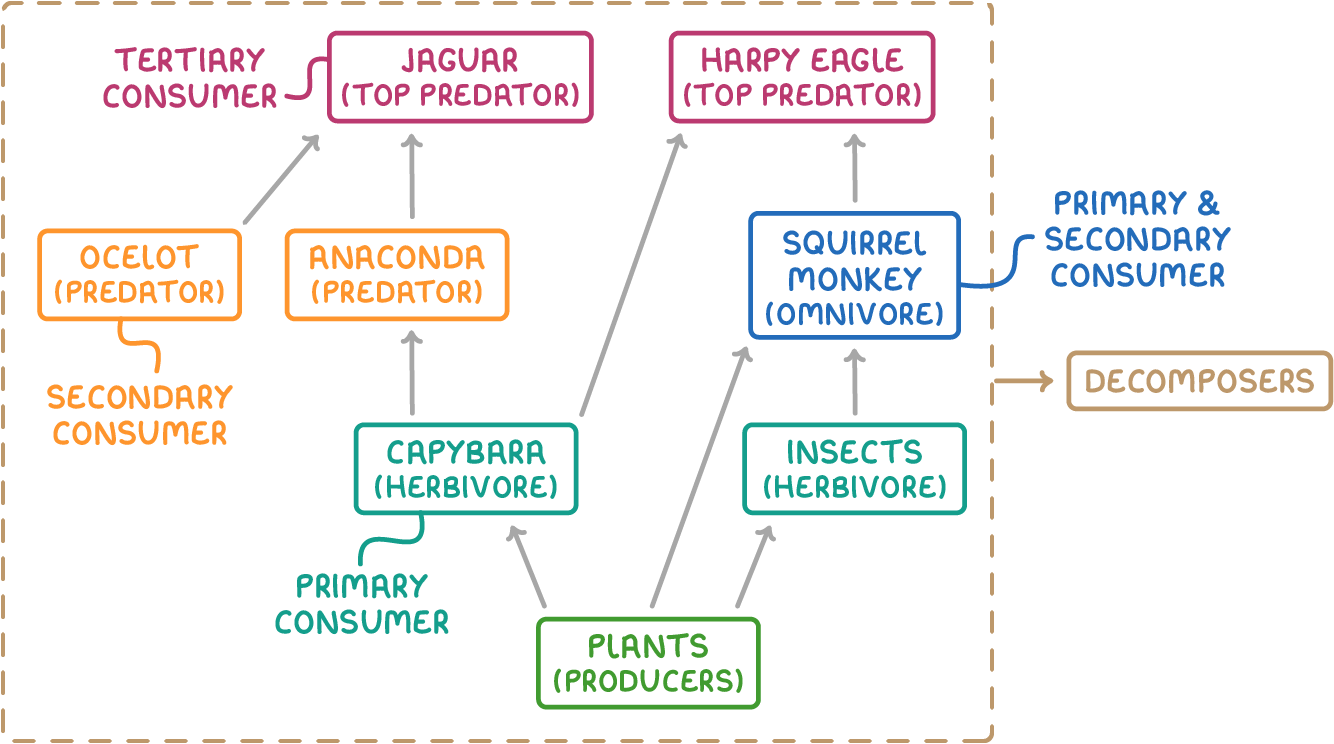
Structure of food chains and webs
- Food chain basics - A food chain begins with producers (plants that create their own food using sunlight), followed by primary consumers (herbivores), secondary consumers, and tertiary consumers (carnivores or omnivores). Decomposers break down dead organisms, recycling nutrients.
- Interconnected food webs - Rainforests feature numerous overlapping food chains, forming complex food webs with many feeding relationships.
- Dual roles - Some animals act as both primary and secondary consumers, depending on their food source at a given time.
Characteristics of rainforest food webs
- High complexity - The sheer diversity of species results in a web of interactions, with multiple pathways for energy transfer.
- Interdependence - The interconnected nature means that a change in one species' population can affect many others, highlighting the delicate balance within the ecosystem.