4.4 - Human Processes Shaping the Landscape
The influence of agriculture on UK landscapes
The UK, being a small and densely populated country, has seen significant changes to its natural landscapes due to human activities. Agriculture, in particular, has played a major role in shaping the countryside.
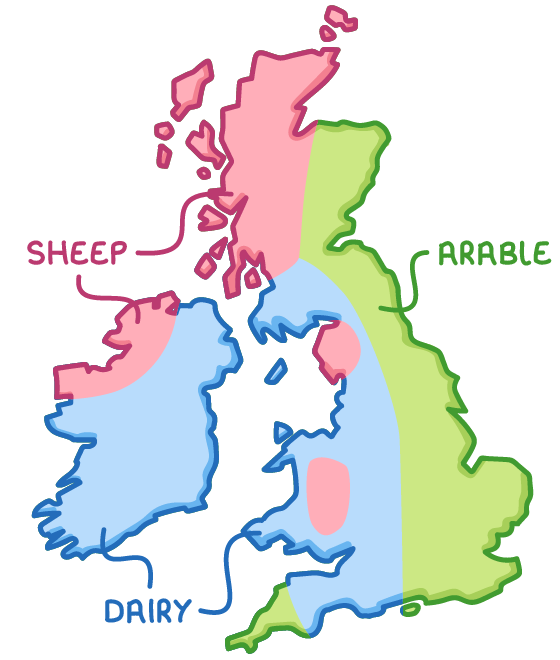
Agricultural practices altering landscapes
- Land clearance - Large areas of forested land have been removed to create space for farming.
- Field boundaries - Hedgerows and stone walls have been constructed to define fields.
- Types of farming based on landscape - Different regions support specific agricultural practices:
- Arable farming dominates in flat, fertile areas with rich soil, often found in the eastern parts of Britain.
- Dairy farming is prevalent in warmer, wetter regions with expansive grassy fields, such as in the southwest.
- Sheep farming occurs in rugged upland areas, where harsh conditions prevent tree growth as young saplings are grazed or trampled.
- Drainage modifications - Drainage ditches are dug to remove excess water from fields, making the land suitable for cultivation.
Effects of forestry on UK environments
Forestry, which involves the management of woodland for timber, recreation, or conservation, has left a distinct mark on UK landscapes. Historically covered by deciduous woodland, much of the original forest has been altered or replaced due to human intervention.
Forestry practices shaping landscapes
- Loss of natural woodland - Most of the UK's ancient deciduous forests have been cleared, leaving little of the original cover intact.
- Coniferous plantations - Evergreen forests, planted for timber production, often appear in uniform, straight lines, giving an unnatural look to the landscape.
- Impact of felling - When trees are harvested, the land is left bare, altering the landscape.
- Restoration efforts - In certain regions, deciduous woodlands are being replanted to recreate more natural environments.
Impact of settlements on UK landscapes
Settlements have profoundly modified the UK's natural landscapes. The location and growth of these settlements are influenced by specific geographical factors, leading to changes in the environment.
Factors influencing settlement locations
| Factor | Reason |
|---|---|
| Access to water | Proximity to a reliable water supply is crucial for sustaining communities. |
| Defensive positions | Sites offering natural protection, such as hilltops, were often chosen for safety. |
| Sheltered locations | Areas protected from harsh winds and rain provide more comfortable living conditions. |
| River crossing points | Bridging points over rivers facilitate transport and communication. |
| Resource availability | Access to materials like stone or timber for building influenced settlement placement. |
Landscape changes due to settlement growth
- Urban development - Concreting over land for roads, buildings, and other infrastructure alters natural drainage patterns.
- River modifications - Rivers are sometimes diverted through underground channels or straightened, with embankments built to prevent flooding.
- Urban characteristics - Major urban areas, often located at ports or industrial hubs, display a heavily built environment, contrasting with natural landscapes.
Identifying human impact using OS maps
Ordnance survey (OS) maps are valuable tools for recognising human modifications to the UK landscape. These maps highlight various features that indicate agricultural, forestry, and settlement influences.
Key features of human impact on OS maps
| Feature type | OS map indicators |
|---|---|
| Agricultural indicators | Field boundaries are shown as straight black lines, while man-made drainage ditches appear as straight blue lines. |
| Forestry markers | Coniferous forests are represented by distinct tree symbols, and forestry tracks are often visible as pathways through wooded areas. |
| Settlement features | Built-up areas are depicted with detailed markings of buildings, streets, and canals, while railway lines may include embankments for levelling the terrain. |
| Infrastructure signs | Embankments, railways, and other constructed features are clearly marked, distinguishing human-altered landscapes from natural ones. |