4.14 - How Erosion Creates River Landforms
Formation of waterfalls and gorges
In the upper course of a river, where the gradient is steep, distinctive landforms such as waterfalls and gorges are created through specific erosion processes.
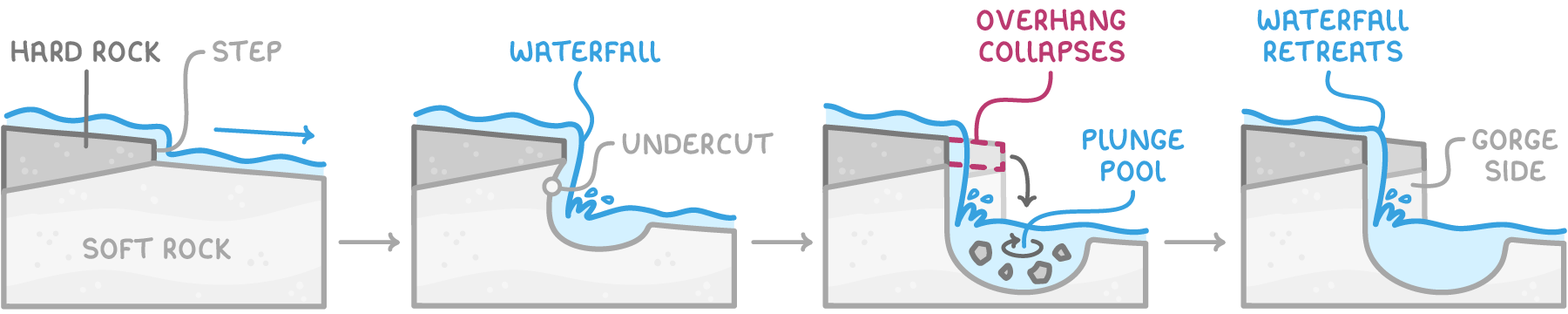
How waterfalls develop over time
- Differential erosion - Waterfalls begin to form when a river flows over an area with hard rock upstream and softer rock downstream. The softer rock erodes more quickly.
- Creation of a step - As the softer rock wears away faster than the hard rock, a noticeable 'step' emerges in the river's path.
- Formation of a steep drop - Over time, the continuous flow of water over this step deepens the erosion of the softer rock, resulting in a waterfall.
- Undercutting and collapse - The hard rock at the edge of the waterfall is gradually undercut by erosion at its base. Without support, sections of this hard rock eventually collapse.
- Development of a plunge pool - At the base of the waterfall, fallen rocks are swirled around by the water, abrading the softer rock further and creating a deep plunge pool.
- Retreat of the waterfall - As undercutting and collapse continue, the waterfall moves upstream over time.
- Formation of a gorge - The upstream retreat of the waterfall leaves behind a narrow, steep-sided gorge.
Development of interlocking spurs
Another characteristic feature of the upper course of a river is the presence of interlocking spurs.
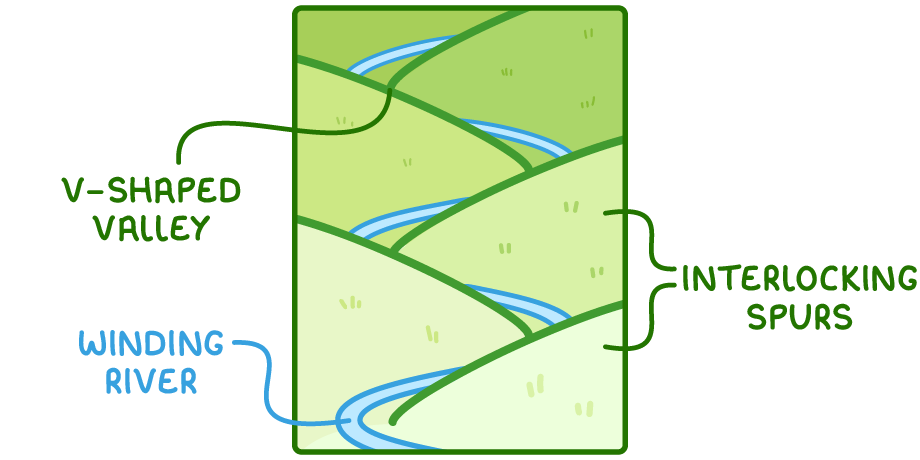
Process of interlocking spur formation
- Dominance of vertical erosion - In the upper course, the river's energy is primarily directed downwards, cutting vertically into the landscape rather than eroding laterally (sideways).
- Creation of V-shaped valleys - This vertical erosion results in steep-sided, V-shaped valleys, a hallmark of the upper course.
- Winding around obstacles - Due to the river's inability to erode laterally, it must navigate around protruding high hillsides or ridges that block its direct path.
- Interlocking pattern of hillsides - As the river winds through the landscape, the hillsides on either side appear to interlock with one another when viewed from above, much like the teeth of a zipper. These are known as interlocking spurs.
Key erosion processes shaping river landscapes
Erosion is the primary force at work in the upper course of a river, sculpting the land through various mechanisms.
Main types of erosion in rivers
- Hydraulic action - The force of moving water wears away rock and soil.
- Abrasion - Sediment and pebbles carried by the river act like sandpaper, grinding against the riverbed and banks.
- Undercutting - Erosion at the base of a rock layer removes supporting material.
- Collapse - When rock or soil is undercut and loses support, it falls into the river.
- Retreat - The upstream movement of features like waterfalls as erosion continuously undercuts and collapses rock.
- Vertical erosion - The downward cutting of the river into its bed, deepening the channel.
- Lateral erosion - The sideways wearing away of river banks, which is less significant in the upper course compared to vertical erosion.
TermDefinition
Differential erosionErosion that occurs at different rates, such as softer rock wearing away faster than harder rock.
Plunge poolA deep pool at the base of a waterfall, formed by the abrasive action of swirling water and fallen rocks.
GorgeA narrow, steep-sided valley left behind as a waterfall retreats upstream.
Interlocking spursProtruding hillsides or ridges that a river winds around in its upper course, appearing to interlock from above.
Vertical erosionThe downward cutting of a river into its bed, deepening the channel.
Hydraulic actionErosion caused by the sheer force of moving water wearing away rock and soil.
AbrasionErosion caused by sediment and pebbles carried by the river grinding against the riverbed and banks.
Key points to remember
4.15 - How Erosion & Deposition Create River LandformsNext up
How were these notes?