4.15 - How Erosion & Deposition Create River Landforms
Processes of erosion and deposition
River landforms are created through erosion and deposition processes.
Core processes shaping river landforms
- Erosion - This is the wearing away of material from the riverbed and banks. It occurs through various mechanisms, such as the force of water itself and the scraping action of carried particles.
- Deposition - This involves the laying down of material that the river has been carrying. It typically happens where the flow of water slows down, allowing sediments to settle.
The formation and characteristics of meanders
Meanders are large, looping bends in a river that typically develop in the middle and lower courses where the gradient is gentler.
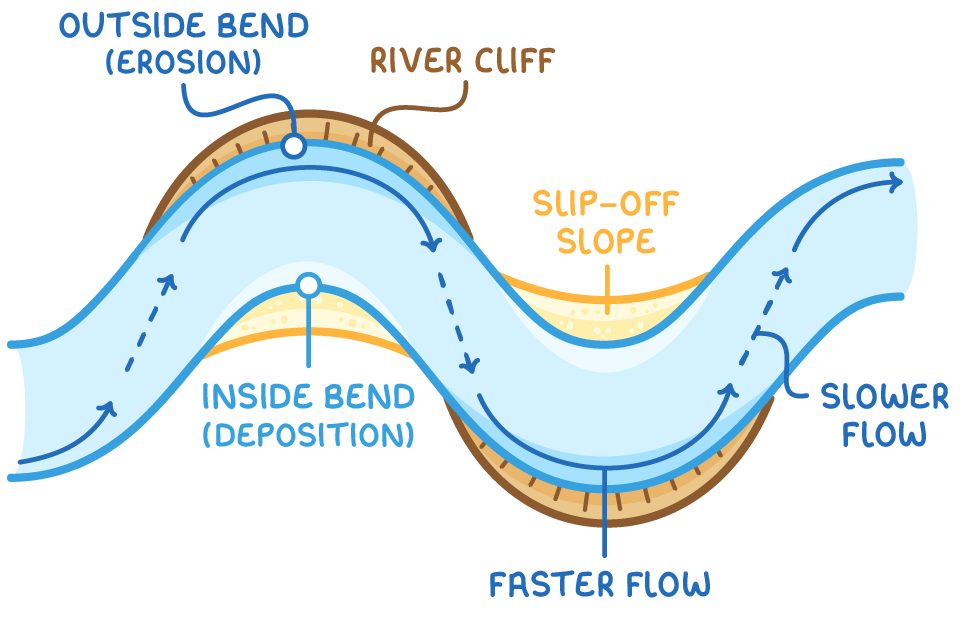
How meanders are formed
- Variation in channel depth - Meanders form in areas where there are both shallow and deep sections in the river channel, creating differences in water flow speed.
- Faster flow on the outside - On the outer bend of a meander, the river channel is deeper, resulting in less friction and a faster current. This leads to increased erosion through processes like abrasion (scraping by particles) and hydraulic action (force of water), forming steep river cliffs.
- Slower flow on the inside - On the inner bend, the channel is shallower, causing more friction and a slower current. Here, eroded material is deposited, creating gently sloping features known as slip-off slopes.
The development of ox-bow lakes from meanders
Ox-bow lakes are formed from meanders when the looping bends become so exaggerated that the river finds a shorter path.
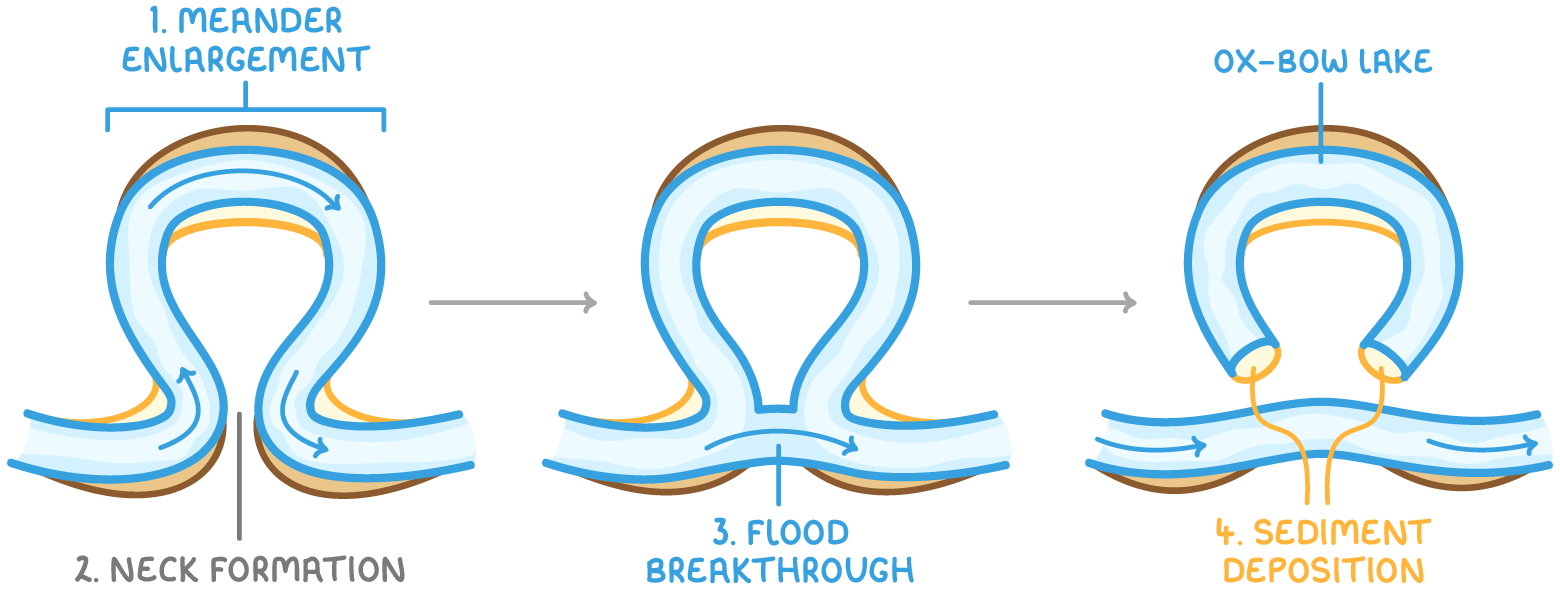
Stages in the formation of ox-bow lakes
- Growth of meanders - Meanders get larger over time and can eventually turn into an ox-bow lake.
- Narrowing of the neck - Erosion causes the outside bends to get closer together, eventually leaving only a small bit of land between the bends (called the neck).
- Breakthrough during floods - The river breaks through this land, usually during a flood, and then flows along the shortest course.
- Formation of the lake - Deposition eventually cuts off the meander, forming an ox-bow lake.
In some regions of North America, ox-bow lakes are known as "horseshoe lakes" due to their distinctive curved shape.
Key technical terms related to river landforms
Essential definitions for river processes and features
- Erosion - The wearing away of material from the riverbed and banks through natural processes.
- Deposition - The settling or laying down of material carried by the river when the flow slows.
- Abrasion - A type of erosion where particles carried by the river scrape and wear down surfaces.
- Hydraulic action - Erosion caused by the sheer force of moving water against the riverbed and banks.
- River cliffs - Steep, eroded banks found on the outside of meander bends where erosion is most intense.
- Slip-off slopes - Gently sloping areas of deposited material on the inside of meander bends where the current is slower.
- Neck - The narrow strip of land separating the closest parts of a meander loop before it is breached to form an ox-bow lake.
TermDefinition
ErosionThe wearing away of material from the riverbed and banks through natural processes.
DepositionThe settling or laying down of material carried by the river when the flow slows.
AbrasionA type of erosion where particles carried by the river scrape and wear down surfaces.
Hydraulic actionErosion caused by the sheer force of moving water against the riverbed and banks.
MeanderA large, looping bend in a river that typically develops in the middle and lower courses.
Ox-bow lakeA curved lake formed when a meander is cut off from the main river channel.