4.13 - How Rivers Shape the Land
The role of weathering in shaping river valleys
Weathering plays a crucial role in shaping river valleys by breaking down rocks along the valley sides, making them more susceptible to erosion and transport by the river.
Types of weathering affecting river valleys
- Freeze-thaw weathering - A mechanical process where temperature changes cause water in rock cracks to freeze and expand, exerting pressure on the rock. When the water thaws, the pressure releases, and repeated cycles of this process widen cracks, eventually causing the rock to fragment.
- Chemical weathering - Involves the breakdown of rocks through chemical reactions.
- Biological weathering - Occurs when plant roots or burrowing animals physically break apart rocks, or when organic acids from plants contribute to chemical breakdown.
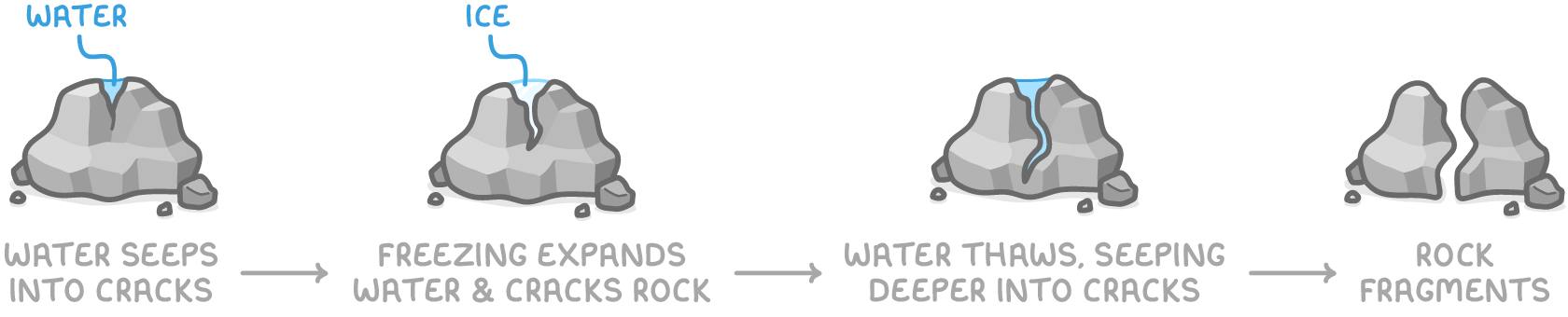
Process of freeze-thaw weathering
- Temperatures fluctuate above and below 0°C, the freezing point of water.
- Water seeps into cracks within rocks, such as limestone or granite.
- Freezing water expands, increasing pressure within the cracks.
- Thawing water contracts, relieving the pressure.
- Continuous freezing and thawing cycles enlarge the cracks, leading to rock disintegration.
The processes of erosion in river channels
Erosion is the wearing away of the river channel and surrounding landscape by the force of water and the materials it carries. Rivers employ several distinct processes to erode their beds and banks.
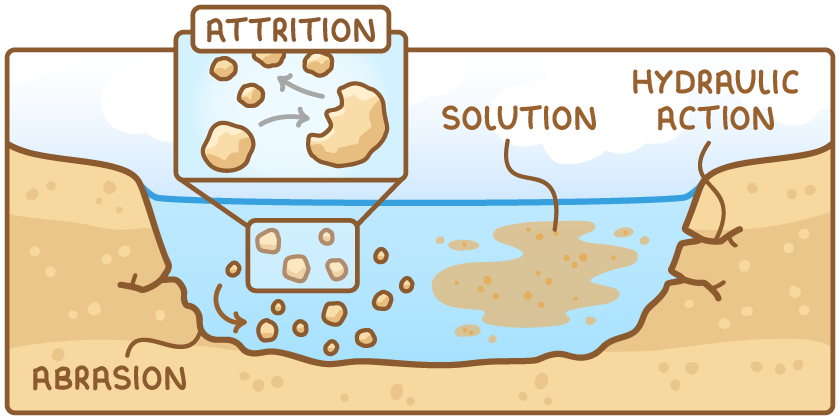
Mechanisms of river erosion
- Hydraulic action - The sheer power of flowing water dislodges rock particles from the riverbed and banks.
- Abrasion - Rocks and pebbles carried by the river scrape and grind against the channel surfaces, wearing them down.
- Attrition - Eroded particles collide with each other in the water, breaking into smaller, smoother pieces as they travel downstream, reducing particle size from source to mouth.
- Solution - Certain rocks dissolve in the river water through chemical reactions.
The speed of the river significantly influences erosion rates, with faster flows causing more intense wearing away of the landscape.
The transportation of eroded material in rivers
Once material is eroded from the river channel or valley sides, it is moved downstream through various transportation methods.
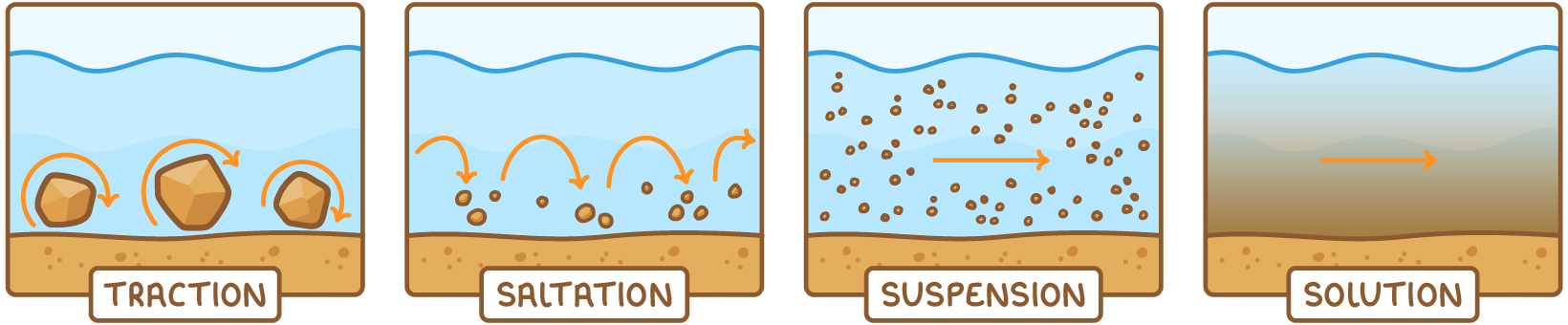
Methods of transportation in rivers
- Traction - Large, heavy particles such as boulders are rolled or pushed along the riverbed by the force of the current.
- Saltation - Medium-sized particles like gravel bounce along the riverbed, lifted briefly by the water flow before settling back down.
- Suspension - Fine particles, including sand and silt, are held within the water column and carried along.
- Solution - Dissolved materials, such as minerals from soluble rocks, are transported invisibly within the water itself.
The process of deposition and its causes
Deposition occurs when a river loses energy and can no longer carry the material it has eroded or transported. This results in the material being dropped.
Factors leading to deposition in rivers
- Reduced water volume - A decrease in the amount of water lowers the river's energy, causing it to deposit material.
- Increased load - When the amount of eroded material in the river becomes too much for its current speed to carry, heavier particles are dropped.
- Shallower water - In areas where the river becomes wider, such as on a floodplain, the water depth decreases, slowing the flow and prompting deposition.
- Reaching the mouth - At the river's end, where it meets a sea or lake, the flow slows significantly, leading to the deposition of sediments..