1.1 - Global Heat Transfers & Circulation Patterns
The basics of global atmospheric circulation
Global atmospheric circulation is the large-scale movement of air around the Earth, driven by differences in temperature and pressure. This system plays a crucial role in redistributing heat from the equator, where solar radiation is strongest, towards the cooler poles, helping to balance the planet's climate.
Key principles of atmospheric circulation
- Uneven heating by the Sun - The equator receives more direct sunlight (insolation) than the poles, creating significant temperature differences across the Earth's surface.
- Temperature and pressure relationship - Warmer air at the equator rises, forming areas of low pressure, while cooler air at higher latitudes sinks, creating high pressure zones.
- Wind movement - Winds blow from high pressure areas to low pressure areas, transferring heat away from the equator as part of this global system.
- Circulation cells - The atmosphere is divided into large loops called cells, with three main types in each hemisphere: Hadley, Ferrel, and Polar cells. These cells feature rising warm air (low pressure) and sinking cool air (high pressure).
The process of air movement in circulation cells
The movement of air within the Hadley, Ferrel, and Polar cells follows a distinct pattern, influenced by the heating and cooling of air masses at various latitudes.
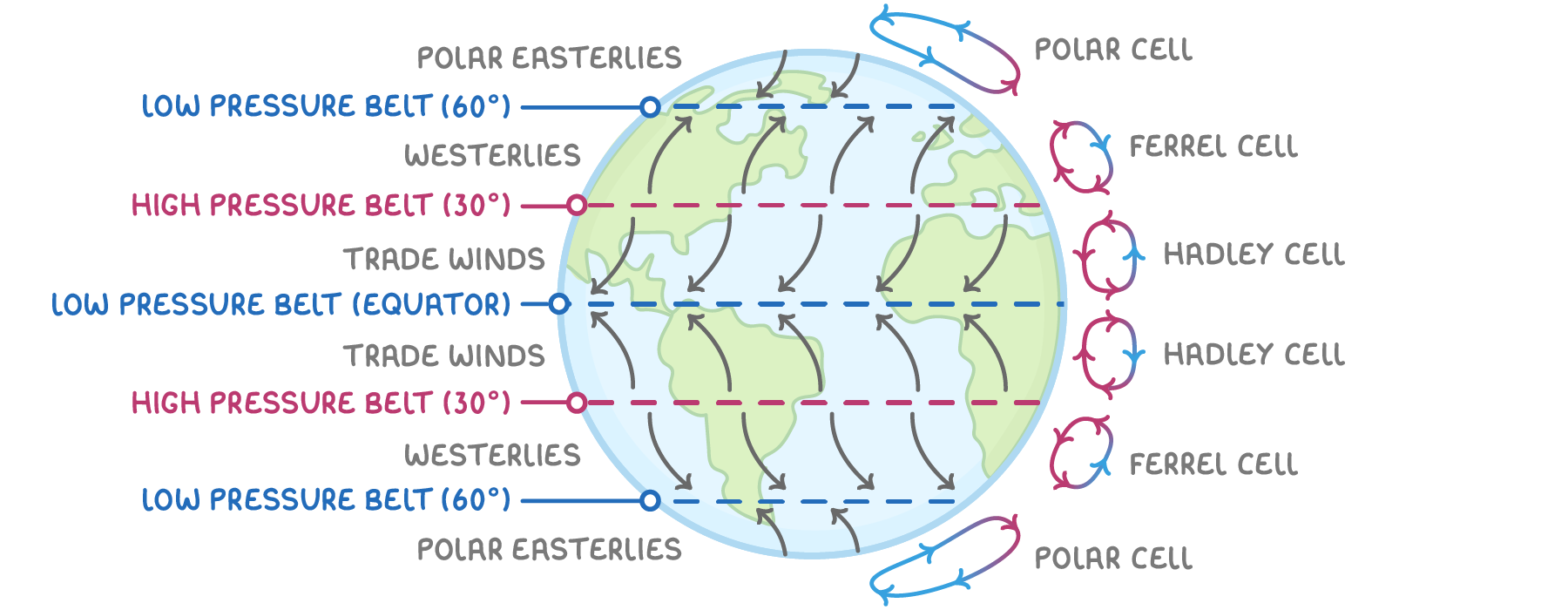
Air movement in the Hadley cell (0° to 30° latitude)
- Equatorial heating - Intense sunlight at the equator warms the air, causing it to rise and form a low pressure belt. As it rises, the air cools, condenses, and often produces rainfall.
- Air descent at 30° - The cooled, drier air moves outwards and sinks at around 30° north and south of the equator, creating a high pressure belt with clear skies and minimal rainfall.
- Surface winds (trade winds) - Once the air reaches the surface, it flows back towards the equator as trade winds, blowing from the northeast in the northern hemisphere and southeast in the southern hemisphere.
Air movement in the Ferrel cell (30° to 60° latitude)
- Surface winds (westerlies) - At 30° latitude, some sinking air moves polewards as surface winds known as westerlies, blowing from the southwest in the northern hemisphere and northwest in the southern hemisphere.
- Rising air at 60° - At around 60° north and south, these warmer westerlies meet colder air from the poles. Being less dense, the warmer air rises, creating a low pressure zone associated with frontal rain.
- Return flow - Some of the rising air loops back towards the equator, while the rest continues towards the poles, linking to the next cell.
Air movement in the Polar cell (60° to 90° latitude)
- Sinking at the poles - At the poles, extremely cold air sinks, forming a high pressure area with very dry conditions.
- Surface flow towards equator - The high pressure air moves towards lower latitudes as surface winds, meeting warmer air at around 60° to complete the cycle.
The role of ocean currents in heat transfer
Ocean currents are massive movements of water across the globe that play a vital role in redistributing heat energy, complementing the atmospheric circulation system.
Types of ocean currents and their mechanisms
- Surface currents - Driven by winds, these currents transfer heat from warmer equatorial regions to cooler areas. For instance, the Gulf Stream carries warm water from the Caribbean, keeping Western Europe warmer.
- Deep ocean currents - These are influenced by differences in water density. At the poles, water freezes, leaving behind saltier, denser water that sinks. This sinking draws in warmer surface water, which then cools and sinks, creating a continuous cycle.
- Thermohaline circulation - This is the global loop of deep ocean currents driven by temperature (thermo) and salinity (haline). It acts like a conveyor belt, moving water and heat around the planet.
The impact of pressure belts on climate zones
The pressure belts created by global atmospheric circulation cells directly influence the Earth's climate zones. These zones are defined by distinct patterns of temperature and precipitation.
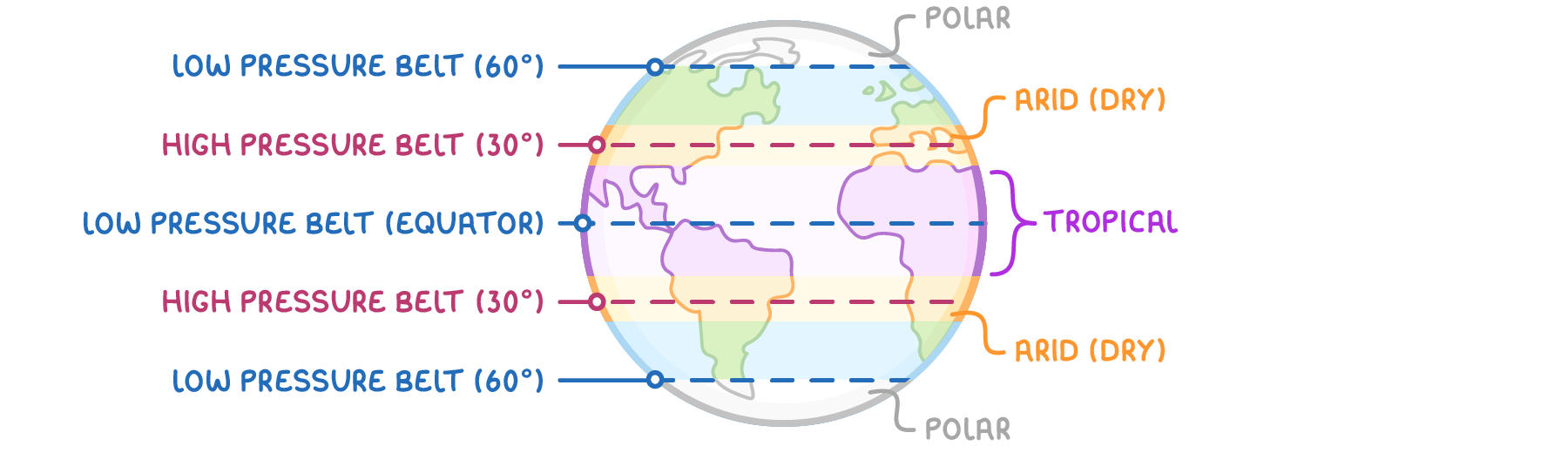
Characteristics of major climate zones
- Tropical - Located near the equator (0°-30°) with low pressure. Hot temperatures year-round with high rainfall due to rising air from Hadley cells meeting.
- Arid (Dry) - Found around 30° north and south with high pressure. Hot or warm temperatures with very low precipitation due to sinking air from Hadley and Ferrel cells.
- Polar - Located near the poles (60°-90°) with high pressure. Cold temperatures year-round with minimal rainfall due to sinking air in Polar cells.