4.12 - Types of River Landscapes
A river's long profile and cross profile
A river's journey from its source to its mouth is known as its course, and it can be described using two key profiles: the long profile and the cross profile.
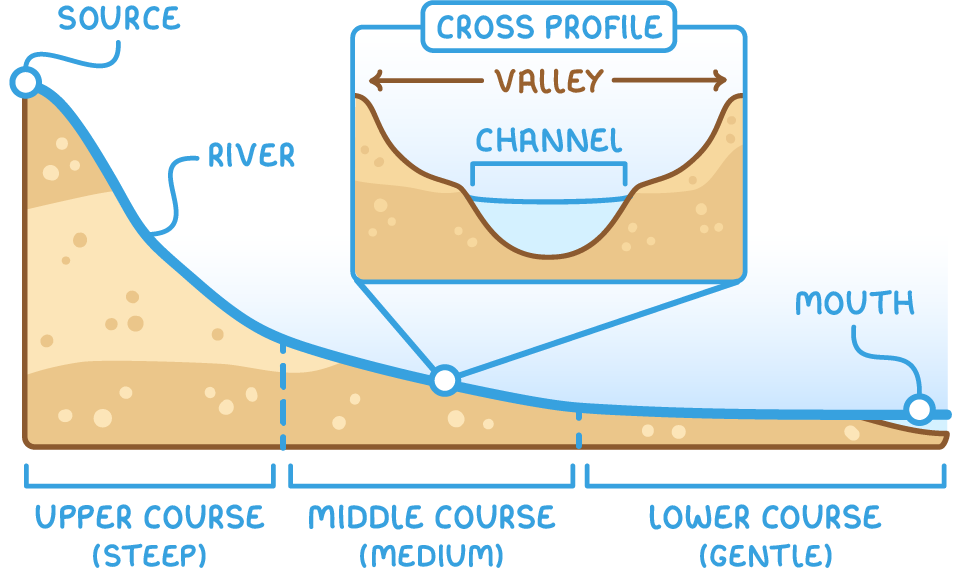
Defining river profiles
- Long profile - This illustrates the change in gradient (steepness) of a river from its source to its mouth. It shows a general trend of becoming less steep as the river progresses through its upper, middle, and lower courses.
- Cross profile - This represents a cross-section of the river valley and channel at a specific point, highlighting the shape and width of the valley and the depth of the channel.
Rivers carve out channels and valleys through processes of erosion, transportation, and deposition, with the dominant process at each stage influencing the shape of these profiles.
Upper, middle, and lower river courses
Rivers exhibit distinct features in their upper, middle, and lower courses due to varying influences of erosion and deposition.
Features of the river's courses
| Course | Gradient | Valley shape | Channel description |
|---|---|---|---|
| Upper course | Steep | V-shaped with steep sides | Narrow and shallow |
| Middle course | Medium | Gently sloping valley sides | Wider and deeper |
| Lower course | Gentle | Very wide, almost flat valley | Very wide and deep |
These differences arise from the changing balance between erosion and deposition, as well as the type of rock and the river's energy at each stage.
Vertical and lateral erosion
Erosion plays a crucial role in sculpting river valleys and channels, with two main types - vertical and lateral - having distinct impacts depending on the river's course. Both processes often occur simultaneously, but one tends to dominate at specific stages.
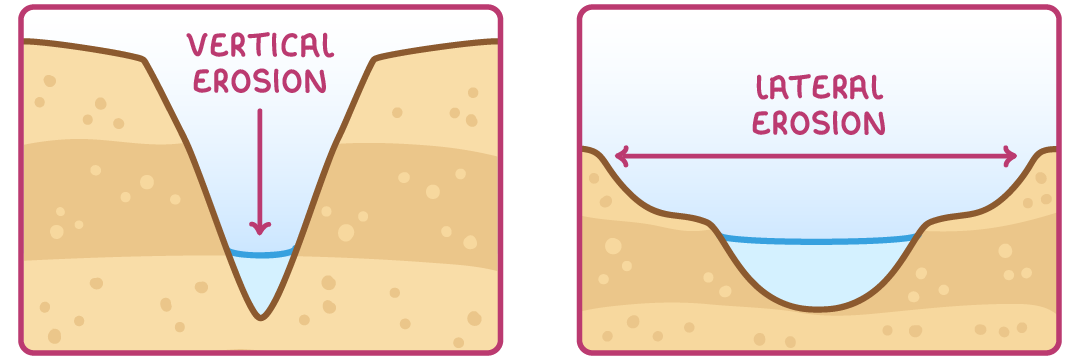
Types of erosion and their effects
- Vertical erosion - This process deepens the river valley and channel, creating a characteristic V-shape. It is most prominent in the upper course where the river's steep gradient and high turbulence allow rough, angular particles to scrape along the bed, intensifying downward erosion.
- Lateral erosion - This widens the river valley and channel, especially during the formation of meanders. It becomes dominant in the middle and lower courses where the river's energy is more focused on sideways erosion due to a gentler gradient.
These erosion types directly influence the cross profile of the river, altering the shape of the valley and channel as the river progresses downstream.
Changes in river characteristics
As a river flows from its source to its mouth, its physical characteristics evolve significantly due to variations in geology, erosion processes, and the accumulation of water from tributaries.
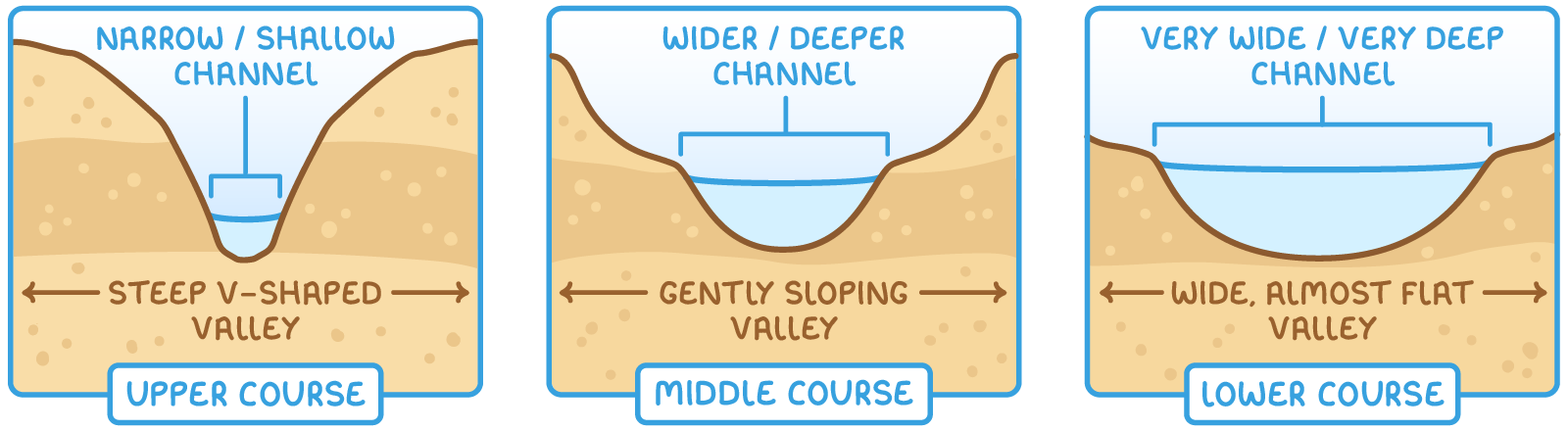
Characteristics across different river courses
- Upper course:
- Typically located in areas of hard, resistant rock near the source.
- Features a steep-sided valley due to dominant vertical erosion and a steep channel gradient.
- The channel is narrow and shallow, resulting in low discharge.
- Velocity is slow due to high friction from the rough bed and sides of the channel.
- Carries large, angular stones as part of its load.
- Middle course:
- Found in regions of softer, less resistant rock that erodes more easily.
- Valley widens due to increased lateral erosion, with gentler sloping sides.
- Channel gradient becomes less steep, and the channel itself is wider and deeper.
- Discharge increases as smaller streams and tributaries join the main river.
- Sediment load consists of smaller, more rounded rocks compared to the upper course.
- Lower course:
- Valley is extremely wide and flat, reflecting extensive lateral erosion.
- River velocity is high due to minimal friction from the smooth channel sides and bed.
- Discharge is significantly larger as many tributaries have joined the river.
- Channel is very wide and deep, sometimes exceeding 50 metres in width in large rivers.
- Material carried is fine and well-rounded, often transported in suspension or solution rather than as bedload.