4.11 - Managing Coastal Change
The purpose and challenges of coastal management
Coastal management involves strategies and actions designed to safeguard both people and the environment from the destructive forces of erosion and flooding. However, managing coastlines is not without its difficulties, as resources and funding are often limited, meaning not every coastal area can be protected or managed effectively.
Key objectives and limitations of coastal management
- Protection from erosion - Aims to prevent the loss of land and property due to the wearing away of the coastline by waves.
- Flood prevention - Seeks to reduce the risk of inundation in coastal communities.
- Financial constraints - Limited budgets mean prioritisation is necessary, leaving some areas unprotected due to the high costs of implementing and maintaining defences.
Hard engineering defences for coastal protection
Hard engineering involves the construction of man-made structures to control the sea's flow and minimise the impacts of flooding and erosion.
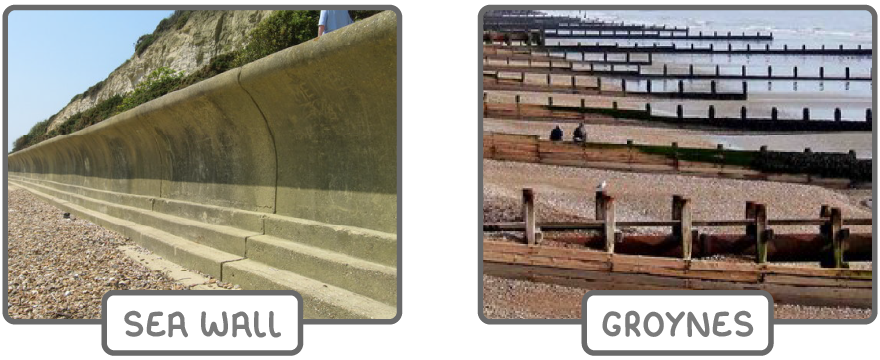
Types of hard engineering defences
| Defence | Description | Benefits | Drawbacks |
|---|---|---|---|
| Sea walls | These are sturdy barriers, typically concrete, built along the coast to reflect wave energy back to the sea | Effectively prevents coastal erosion and serves as a barrier against flooding | Generates powerful backwash that erodes the base of the wall; extremely costly to construct and maintain |
| Groynes | These are wooden or stone barriers built perpendicular to the shoreline to intercept material moved by longshore drift | Build up wider beaches that dissipate wave energy, offering better protection against flooding and erosion; relatively inexpensive compared to other hard engineering options | Disrupt sand supply to beaches further along the coast, resulting in narrower beaches that provide less protection and increase erosion and flood risks in those areas |
Soft engineering defences for coastal protection
Soft engineering focuses on working with natural processes of the sea to reduce the effects of flooding and erosion.
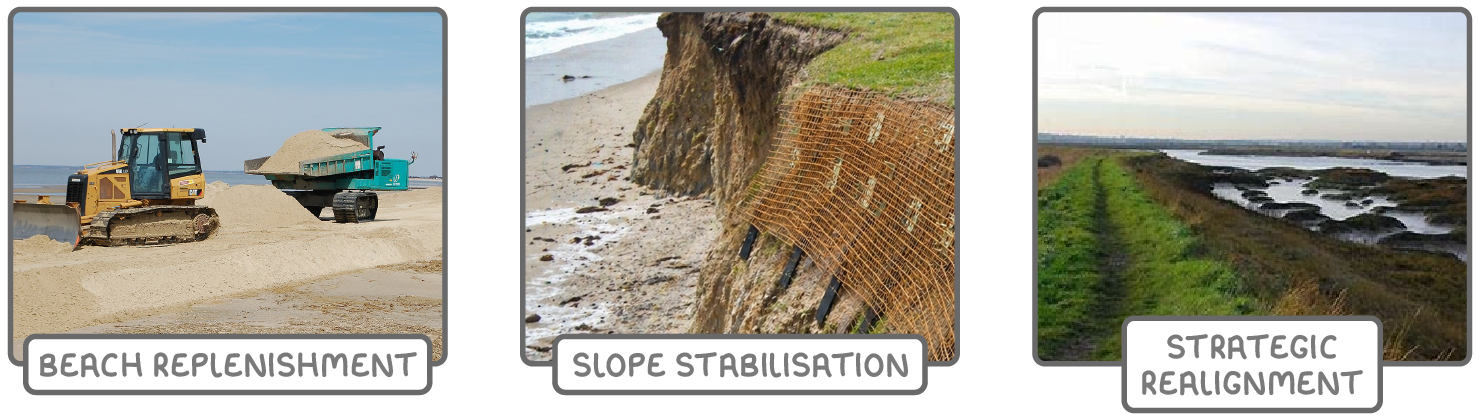
Types of soft engineering defences
| Defence | Description | Benefits | Drawbacks |
|---|---|---|---|
| Beach replenishment | Involves adding sand or shingle, sourced from locations like the seabed or lower beach areas, to the upper parts of beaches | Widens beaches, which slows down waves and enhances protection against flooding and erosion | Extracting material from the seabed can harm marine life such as corals and sponges; a costly method that needs regular repetition to remain effective |
| Slope stabilisation | Reinforces coastal slopes by driving concrete nails into the ground and covering them with metal netting to prevent collapse | Strengthens slopes to stop mass movement and land loss | High costs and installation challenges, especially in rugged or unstable terrains |
| Strategic realignment | Involves dismantling existing defences to allow flooding of the land behind, creating natural buffers over time | Transforms flooded areas into marshlands, fostering new habitats and reducing flooding and erosion in surrounding regions | Controversy over which areas should be sacrificed to flooding; impacts on agricultural land can threaten farmers' livelihoods |
Alternative approaches to coastal management
Beyond engineered solutions, some coastal areas adopt a more passive strategy to deal with the natural processes of erosion and flooding.
The 'do nothing' strategy
- Concept - No new coastal defences are constructed, allowing erosion and flooding to occur naturally while addressing impacts as they arise.
- Advantages - incurs no direct financial cost since the coastline is left to retreat on its own.
- Disadvantages - Risks the loss of valuable infrastructure, such as recreational facilities, and may force residents to relocate due to increased threats from erosion and flooding.
Sustainable strategies and ICZM
For coastal management to be effective in the long term, strategies must be sustainable, balancing the need to control erosion and flooding with minimal negative impact on other areas or communities. A key framework for achieving this is integrated coastal zone management (ICZM).
Principles of sustainable coastal management
- Conflict avoidance - Strategies should prevent issues in one area from causing problems elsewhere along the coast.
- Community consideration - Must account for the needs and concerns of coastal populations to avoid social or economic disruption.
- Cost-effectiveness - Solutions should be affordable to prevent disputes over the allocation of public funds.
Features of ICZM
- Inclusive approach - Takes into account the interests of all stakeholders, facilitating agreements on management solutions.
- Long-term perspective - Designed to be flexible, adapting to future changes and needs along the coastline.
- Sustainability focus - Aims to protect the coast in a way that preserves both the environment and human interests over time.