4.16 - How Deposition Creates River Landforms
The formation and characteristics of flood plains
Flood plains are broad, flat areas of land adjacent to a river that are prone to flooding during periods of high water flow. These landforms are created through the process of deposition.
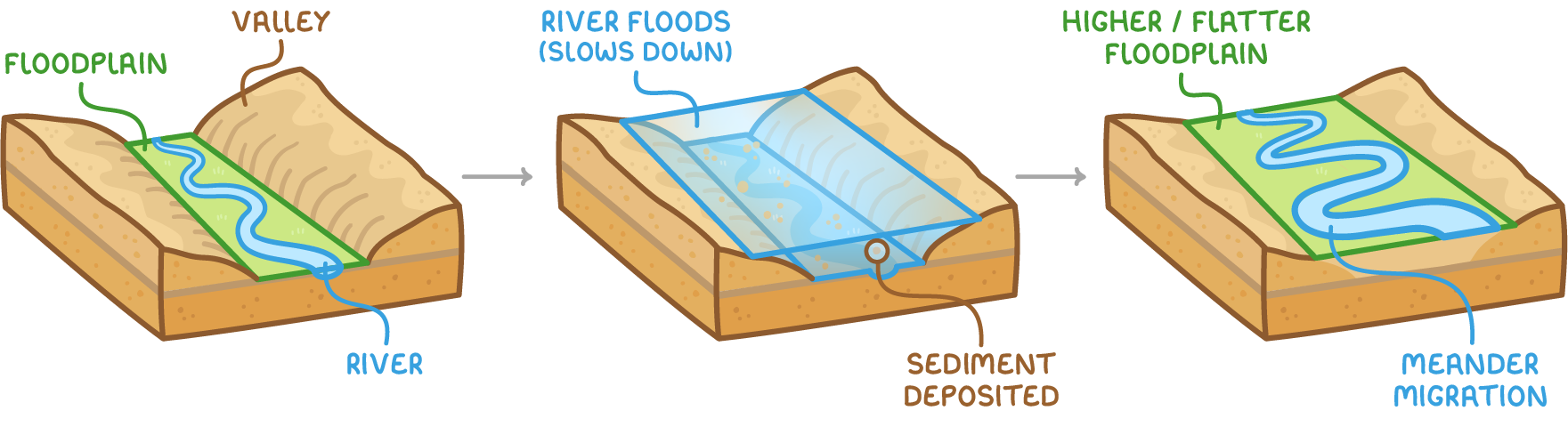
How flood plains are formed
- Flooding events - When a river overflows its banks, water spreads across the surrounding land, slowing down as it moves away from the main channel.
- Deposition of material - As the water loses energy, it deposits the sediment and eroded material it carries, gradually building up the height of the flood plain over time.
- Meander migration - The sideways movement of meanders across the valley widens the flood plain, as the river erodes one side and deposits material on the other.
- Downstream flattening - Meanders also shift downstream, smoothing out the valley floor and contributing to the flatness of the flood plain.
- Slip-off slope contribution - Deposition on the inner bends of meanders, known as slip-off slopes, adds further sediment to the flood plain, enhancing its development.
The development of natural levees
Levees are raised, natural embankments that form along the edges of a river channel. They are a result of repeated flooding and deposition.
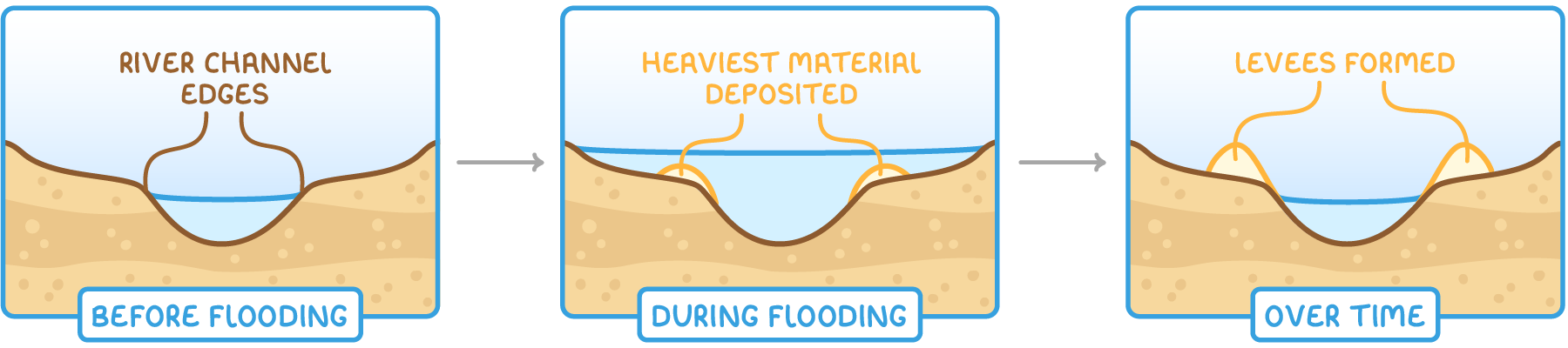
Process of levee formation
- Flood deposition - During a flood, the river spills over its banks, carrying sediment across the flood plain.
- Heaviest material first - The largest and heaviest particles are deposited nearest to the river channel as the water slows down, losing energy quickly.
- Build-up over time - Repeated flooding events lead to the accumulation of this material, forming raised ridges or levees along the river's edges.
The creation and features of deltas
Deltas are low-lying landforms that develop where a river meets a larger body of water, such as a sea or lake. They are formed by the deposition of sediment.
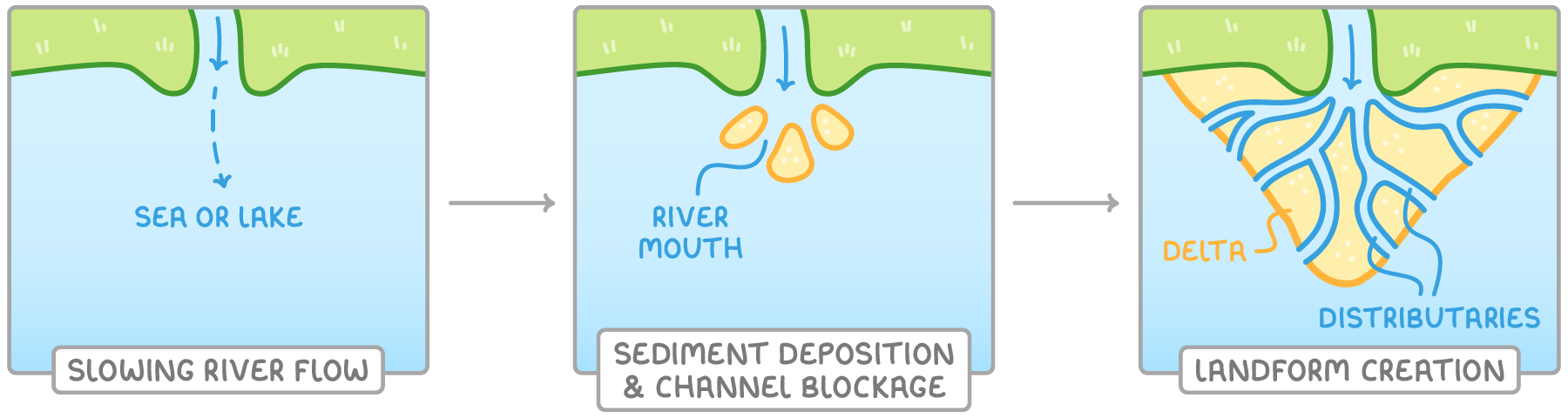
Formation and structure of deltas
- Slowing of river flow - When a river reaches a sea or lake, its velocity decreases.
- Sediment deposition - The loss of energy causes the river to drop the material it is carrying, leading to a build-up of sediment at the river mouth.
- Channel blockage - If the deposited material is not washed away by tides or currents, it can obstruct the main channel, forcing the river to split into smaller streams called distributaries.
- Landform creation - Over time, the accumulated sediment forms a delta, a flat, often triangular area of land extending into the body of water.
Deltas are commonly found at the mouths of large rivers, such as the Nile or Mississippi, where significant sediment loads are deposited into seas or lakes.
The role of sediment deposition in river landforms
Sediment deposition is a fundamental process in the creation of various river landforms. It occurs when a river loses energy and can no longer transport the material it carries.
Key mechanisms of depositional landforms
- Energy loss - Deposition happens when a river's flow slows down, often during floods, at bends, or when entering a larger water body, reducing its capacity to carry sediment.
- Material accumulation - The dropped sediment accumulates over time, forming landforms such as flood plains, levees, and deltas, each shaped by the specific conditions of deposition.