4.2 - UK Physical Landscape: Rocks
Igneous, sedimentary, and metamorphic rocks
Rocks are the building blocks of the Earth's crust, and they are categorised into three main types based on their formation processes. Each type has distinct characteristics that influence the landscapes they form.
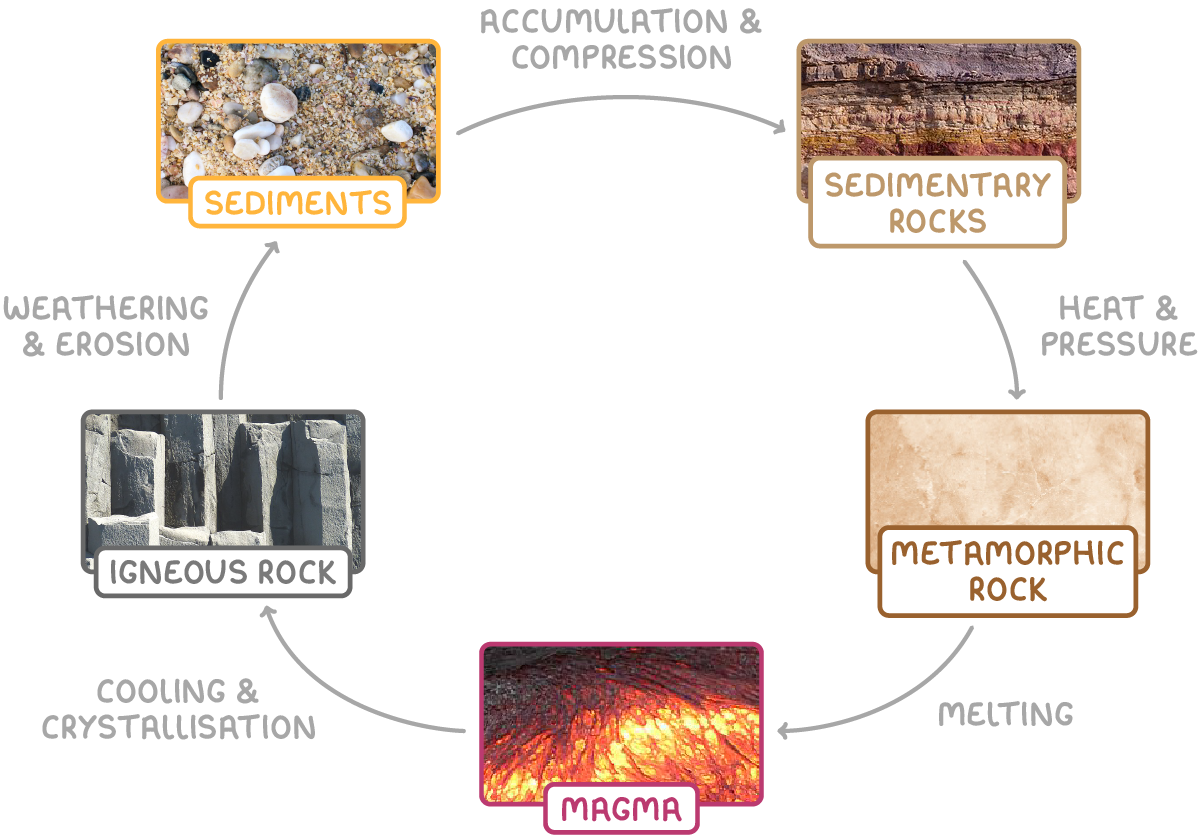
Different types of rock formation
- Igneous rocks:
- These rocks originate from molten rock, known as magma, which cools and solidifies either beneath the Earth's surface or on it after volcanic eruptions.
- As the magma cools, it forms crystals, resulting in hard rocks like granite.
- Sedimentary rocks:
- Formed over long periods from the accumulation and compression of sediments, these rocks develop in layers.
- They include carboniferous limestone and chalk, which are made from the remains of marine organisms, and clays or shales, which come from compacted mud and mineral particles.
- Their hardness varies, with limestone being relatively tough and chalk much softer.
- Metamorphic rocks:
- Created when existing rocks (igneous, sedimentary, or older metamorphic) are subjected to heat and pressure deep within the Earth, they transform into harder, denser forms.
- For instance, shale can turn into slate, and with further heat and pressure, slate may become schist.
Influence of past tectonic activity
Tectonic activity, driven by the movement of the Earth's plates over millions of years, has played a crucial role in shaping landscapes. These processes have determined the distribution and type of rocks found in different regions, which in turn affect the topography.
Key tectonic processes shaping landscapes
- Volcanic activity:
- Around 520 million years ago, some regions were near active plate boundaries where volcanoes erupted, pushing magma through the Earth's crust.
- As this magma cooled, it formed hard igneous rocks, contributing to the creation of rugged terrains.
- Plate collisions:
- When tectonic plates collided, the immense forces folded and uplifted rocks, forming mountain ranges.
- These collisions also generated heat and pressure, creating durable metamorphic rocks in certain areas, while hard igneous rocks like granite resisted erosion, maintaining elevated landscapes.
- Plate movements:
- Between 345 and 280 million years ago, some areas were positioned in tropical zones, often submerged under shallow seas.
- During this time, carboniferous limestone developed in warm marine environments, while younger sedimentary rocks like chalk and clay formed in swamps and shallow waters.
- These softer rocks are more prone to erosion, leading to the development of lowland areas.
Characteristics of specific rock types
Different rock types possess unique properties that influence how they weather and erode, ultimately determining the kind of landscapes they form. These characteristics include hardness, permeability, and structural features like joints or layers.
Properties and landscape impacts of key rock types
- Granite:
- Known for its exceptional resistance to erosion, granite often forms upland areas.
- It contains unevenly distributed joints or cracks, with areas having more joints eroding faster, while those with fewer joints form distinctive features called tors.
- Being impermeable, granite prevents water penetration, leading to waterlogged moorlands with acidic soils and sparse, low-growing vegetation.
- Carboniferous limestone:
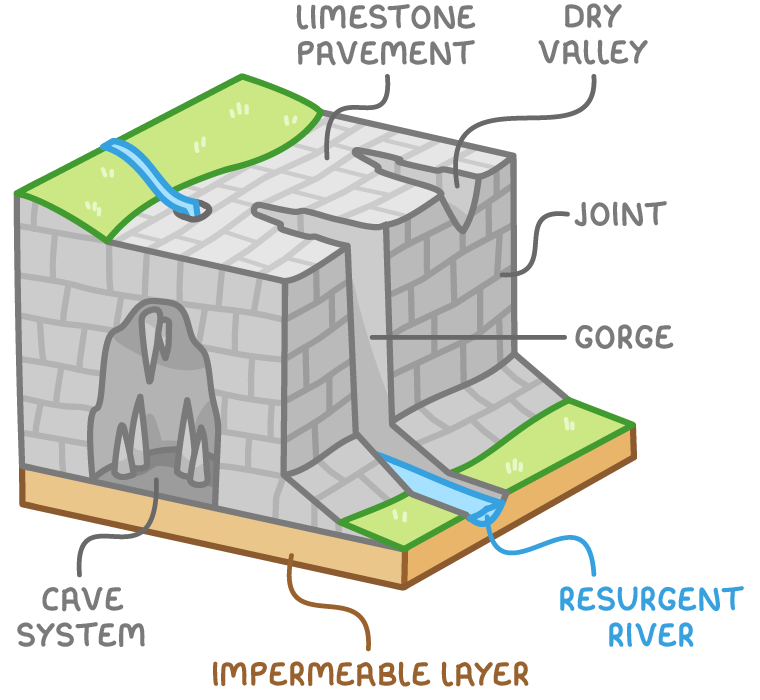
- This rock is susceptible to carbonation weathering, where rainwater dissolves it along joints, creating unique features such as limestone pavements, cave systems, and gorges.
- Its permeability results in dry valleys and resurgent rivers, which reappear on the surface when they encounter impermeable layers.
- Slate and schist:
- Slate forms in thin layers, making it prone to splitting into slabs, while schist, with larger crystals, breaks into small flakes.
- Both are hard and resistant but create rugged upland landscapes.
- Their impermeability leads to waterlogged, acidic soils in these areas.
- Chalk and clay:
- Chalk, being harder than clay, shapes lowlands with escarpments (hills with one steep and one gentle slope) and coastal cliffs. Its permeability allows water to flow through, emerging as springs at impermeable boundaries.
- Clay, on the other hand, is soft and easily eroded, forming broad, flat valleys. Its impermeability causes water to flow over the surface, creating streams, rivers, and lakes.
Impact of glaciation on landscape development
Glaciation, occurring over the past 2.6 million years, has significantly altered landscapes through the action of massive ice sheets. These ice masses have both eroded existing features and deposited new materials as they melted.
Effects of glacial activity on landscapes
- Erosion by ice - During glacial periods, huge ice sheets covered vast areas, exerting immense power to erode landscapes. This process carved out distinctive U-shaped valleys, particularly in upland regions, reshaping the terrain dramatically.
- Deposition by glaciers - As glaciers retreated, they left behind a variety of materials, including till, which is an unsorted mix of clay, sand, and rocks. Glacial meltwater also contributed to the formation of new landscape features by redistributing sediments and shaping river valleys and plains..