10.1 - Processes Shaping the Coast
Weathering of coastal rocks
Weathering plays a crucial role in shaping coastal environments by breaking down rocks in their original location without moving them. This process weakens coastal cliffs and structures, making them more susceptible to further erosion by waves and other forces.
There are two main types of weathering affecting coastal areas:
- Mechanical weathering
- Chemical weathering
Mechanical weathering
This involves the physical breakdown of rocks without altering their chemical makeup.
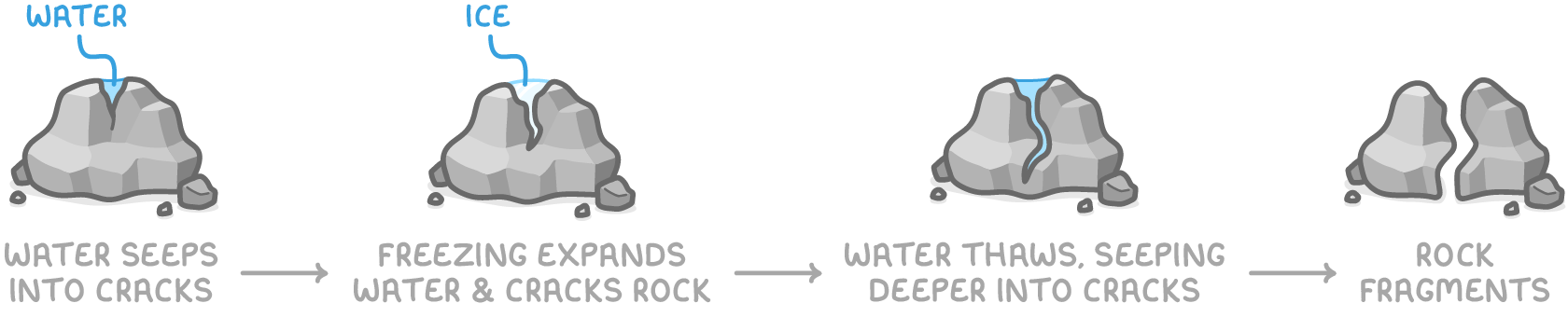
A key example is freeze-thaw weathering:
- Occurs in areas where temperatures fluctuate around 0°C.
- Water seeps into cracks in rocks like sandstone.
- Freezing causes the water to expand, exerting pressure on the rock.
- Thawing releases this pressure as water contracts.
- Repeated cycles of freezing and thawing enlarge cracks, eventually causing the rock to fragment.
Chemical weathering
This process changes the chemical composition of rocks through reactions.
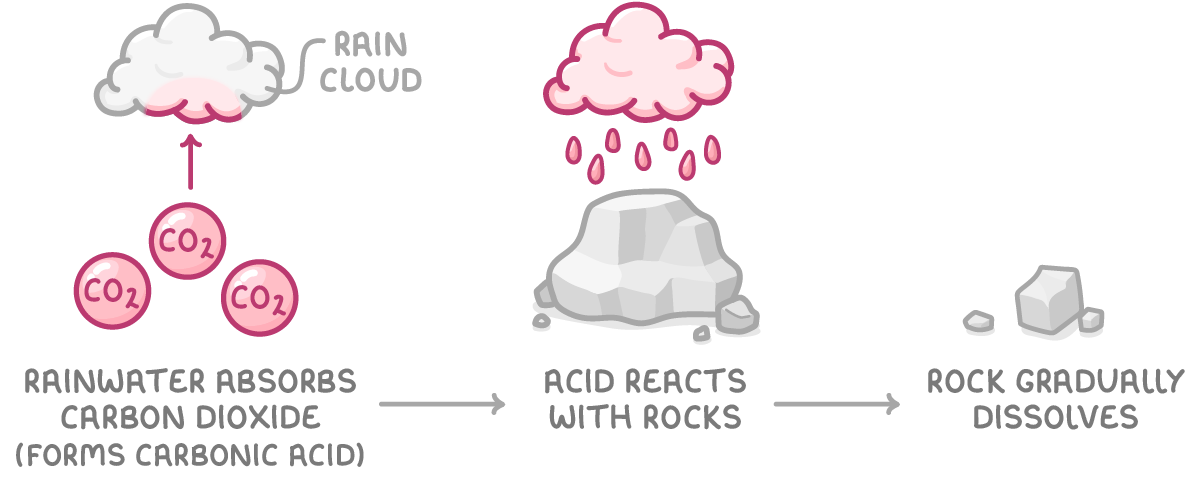
A prominent type is carbonation:
- Rainwater absorbs carbon dioxide, forming a mild carbonic acid.
- This acid reacts with rocks containing calcium carbonate, such as chalk.
- Over time, the rock is gradually dissolved by the acidic rainwater.
The impact of mass movement on coastal landscapes
Mass movement refers to the downward shift of rocks and loose material along slopes, such as coastal cliffs. This process significantly contributes to coastal retreat and alters the shape of the coastline.
Mechanisms and types of mass movement
- Driving forces - Mass movement occurs when gravity overcomes the forces holding material on a slope, leading to rapid coastal retreat.
- Influence of water - Saturated material is more prone to movement as water acts as a lubricant and adds weight, increasing the likelihood of sliding or falling.
- Formation of features - Mass movement can result in a scarp, a steep cut or slope in the cliff face.
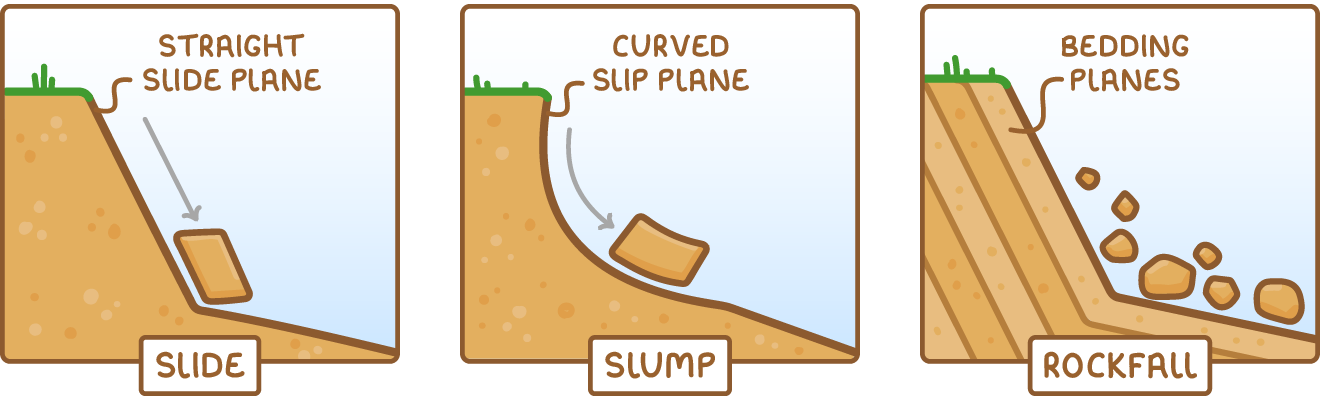
- Variations of mass movement:
- Slides - Material moves in a straight line along a defined slide plane.
- Slumps - Material shifts along a curved slip plane, often rotating as it descends.
- Rockfalls - Rocks break apart, typically along natural weaknesses like bedding planes, and tumble down the slope.
Destructive and constructive waves
Waves are fundamental to coastal processes, formed by wind blowing over the sea surface. Their nature determines whether they erode or build up the coastline, influenced by factors such as wind strength and distance.
Formation and types of waves
- Wave creation - Waves form as wind transfers energy to the sea surface. The fetch, or the distance over which wind blows, determines wave power; a longer fetch results in stronger waves.
- Storm surges - These are short-term rises in sea level caused by strong winds pushing water towards the shore, often exacerbating coastal erosion.
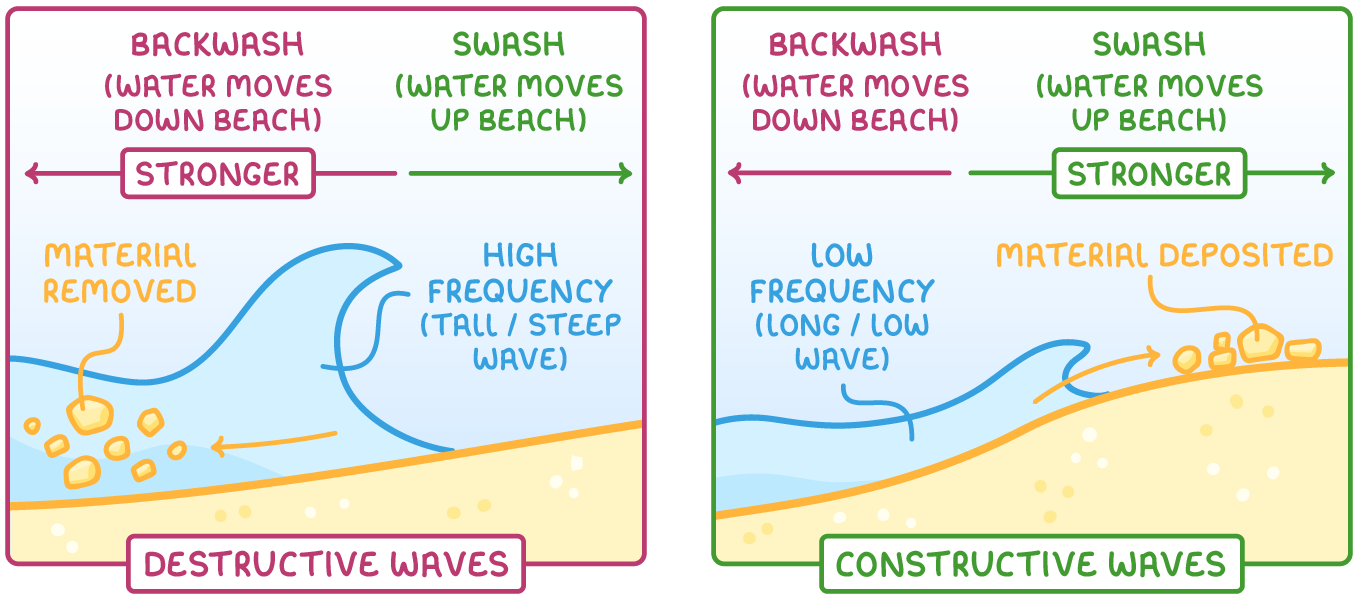
- Destructive waves - These waves actively erode the coast:
- Characterised by high frequency, appearing tall and steep.
- The backwash (water retreating down the beach) is stronger than the swash (water advancing up the beach), leading to material removal.
- Constructive waves - These waves contribute to coastal growth:
- Have a lower frequency, appearing long and low.
- The swash is more powerful than the backwash, resulting in material deposition on the beach.
Coastal erosion and transportation
Erosion and transportation are key processes through which waves shape coastlines by wearing away rocks and moving sediment. These actions continuously reshape coastal landscapes, creating distinctive features over time.
Processes of coastal erosion
- Hydraulic power - Waves strike rocks, compressing air within cracks. This repeated pressure widens fissures, eventually causing fragments to break off.
- Abrasion - Sediments carried by waves scrape and grind against coastal rocks, wearing away small pieces over time.
- Attrition - Particles in the water collide with each other, breaking into smaller, smoother pieces through constant impact.
Mechanisms of coastal transportation
- Longshore drift - This process moves material along the coast:
- Waves approach the shore at an oblique angle, influenced by the prevailing wind direction.
- The swash pushes material up the beach in the direction of the wave.
- The backwash pulls material back down at a right angle towards the sea.
- This creates a zigzag pattern of movement along the coastline over time.
- Other transportation methods - The mode of transport depends on water energy and particle size:
- Traction - Large particles, such as boulders, are rolled along the seabed.
- Saltation - Medium-sized particles, like pebbles, bounce along the seabed.
- Suspension - Fine particles, such as silt, are carried within the water column.
- Solution - Dissolvable materials, like limestone, are carried in dissolved form within the water.
Coastal erosion and transportation
Erosion and transportation are key processes through which waves shape coastlines by wearing away rocks and moving sediment. These actions continuously reshape coastal landscapes, creating distinctive features over time.
Processes of coastal erosion
- Hydraulic power - Waves strike rocks, compressing air within cracks. This repeated pressure widens fissures, eventually causing fragments to break off.
- Abrasion - Sediments carried by waves scrape and grind against coastal rocks, wearing away small pieces over time.
- Attrition - Particles in the water collide with each other, breaking into smaller, smoother pieces through constant impact.
Mechanisms of coastal transportation

- Longshore drift - This process moves material along the coast:
- Waves approach the shore at an oblique angle, influenced by the prevailing wind direction.
- The swash pushes material up the beach in the direction of the wave.
- The backwash pulls material back down at a right angle towards the sea.
- This creates a zigzag pattern of movement along the coastline over time.

- Other transportation methods - The mode of transport depends on water energy and particle size:
- Traction - Large particles, such as boulders, are rolled along the seabed.
- Saltation - Medium-sized particles, like pebbles, bounce along the seabed.
- Suspension - Fine particles, such as silt, are carried within the water column.
- Solution - Dissolvable materials, like limestone, are carried in dissolved form within the water.
The factors influencing coastal deposition
Deposition occurs when sediment-laden water loses energy and slows down, dropping its load. This process builds up coastal features and is essential for the formation of beaches and other landforms.
Conditions leading to deposition
- Energy loss - Deposition happens when waves or currents slow down, lacking the energy to carry sediment further.
- Balance with erosion - Coastal areas grow when deposition exceeds erosion, leading to landform development.
- Factors increasing deposition:
- High erosion rates nearby, providing a large supply of sediment.
- Significant transportation of material into the area from other coastal regions.
- Role of constructive waves - These waves deposit more material than they remove, promoting the build-up of beaches and coastal features.