15.3 - Resources in the UK: Water
Imbalance between UK water supply and demand
The United Kingdom faces a significant challenge in balancing water supply with demand across its regions.
Regional disparities in water availability
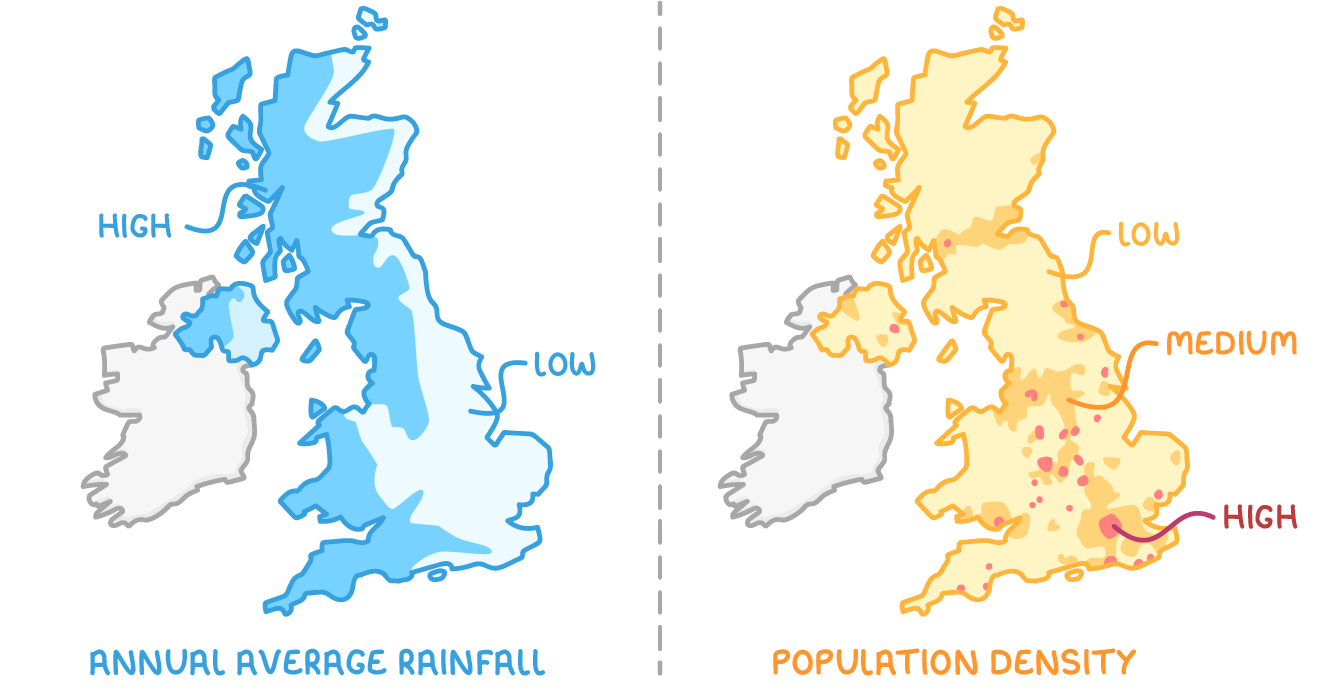
- Rainfall distribution - The north and west of the UK receive high rainfall, resulting in a water surplus where supply exceeds local demand.
- Population density impact - The south east and the Midlands, with denser populations, experience a water deficit as demand outstrips the available supply.
- Geographical mismatch - Areas with abundant water resources are often far from regions with the greatest need.
Factors contributing to increasing water demand
Water demand in the UK has been rising steadily, driven by lifestyle changes and population growth.
Reasons for rising water consumption
- Household usage growth - Since 1975, domestic water use has surged by approximately 70%, largely due to the widespread adoption of water-intensive appliances like washing machines and dishwashers.
- Population projections - The UK population is expected to grow by more than 6.5 million by 2040, reaching around 73 million, increasing overall water needs.
- Development in deficit areas - Planned urban expansion in the south east, an area already facing water shortages, exacerbates the demand-supply gap.
Water pollution and its impact on supply
Water pollution poses a serious threat to the availability of clean water in the UK, reducing usable supply.
Sources and effects of water pollution
- Agricultural runoff - Nitrates and phosphates from fertilisers used in farming wash into rivers and groundwater, contaminating water sources.
- Urban pollutants - Vehicle emissions and other contaminants are carried into water bodies through rainfall runoff, affecting quality.
- Industrial spills - Chemical and oil discharges from factories pollute local rivers and groundwater.
- Groundwater vulnerability - In southern England, up to 80% of water supply comes from groundwater, with nearly 50% of it impacted by pollution, leading to closures of sources or expensive purification measures.
Strategies for managing UK water resources
To address water shortages and quality issues, various management strategies have been implemented across the UK.
Approaches to sustainable water management
- Enhanced drainage systems - Upgrading infrastructure to prevent loss of water and reduce pollution.
- Regulations on chemicals - Stricter controls on the use of fertilisers and pesticides to minimise agricultural pollution of water sources.
- Water transfer initiatives - Moving water from regions with surplus, such as rural reservoir areas, to urban centres facing deficits.
Challenges of water transfer projects
While transferring water from surplus to deficit areas offers a potential solution, it comes with significant obstacles.
Obstacles in water transfer schemes
- High financial costs - Building necessary infrastructure like dams and aqueducts is expensive, with major projects to supply water to large cities estimated at around £300 million.
- Environmental disruption - Construction and operation of transfer systems can harm ecosystems, notably by interfering with fish migration routes.
- Community resistance - Political and social tensions emerge when local communities oppose the redirection of their water resources to other regions.
TermDefinition
Water surplusA situation where the supply of water is greater than the local demand for it.
Water deficitA situation where the local demand for water is greater than the available supply.
GroundwaterFresh water held underground in the soil or within the pores and crevices of rock.
Water transfer schemeA large-scale engineering project that moves water from an area of surplus to an area of deficit.
Water pollutionThe contamination of water sources by substances that make the water unusable or require expensive purification.