4.1 - Evidence of Climate Change
The concept of climate change and global warming
Climate change refers to any significant alteration in the Earth's climate over an extended period. The Earth's climate has always been in a state of flux and will continue to change. A specific type of climate change, known as global warming, describes the rapid increase in global temperatures observed over the last century, marking a distinct and accelerated shift in the planet's climatic patterns.
Temperature fluctuations in the Quaternary period
The Quaternary period, spanning from approximately 2.6 million years ago to the present, represents the most recent geological era and encompasses the entirety of human history. This period is characterised by significant temperature variations that have shaped the Earth's climate.
Patterns of temperature change in the Quaternary period
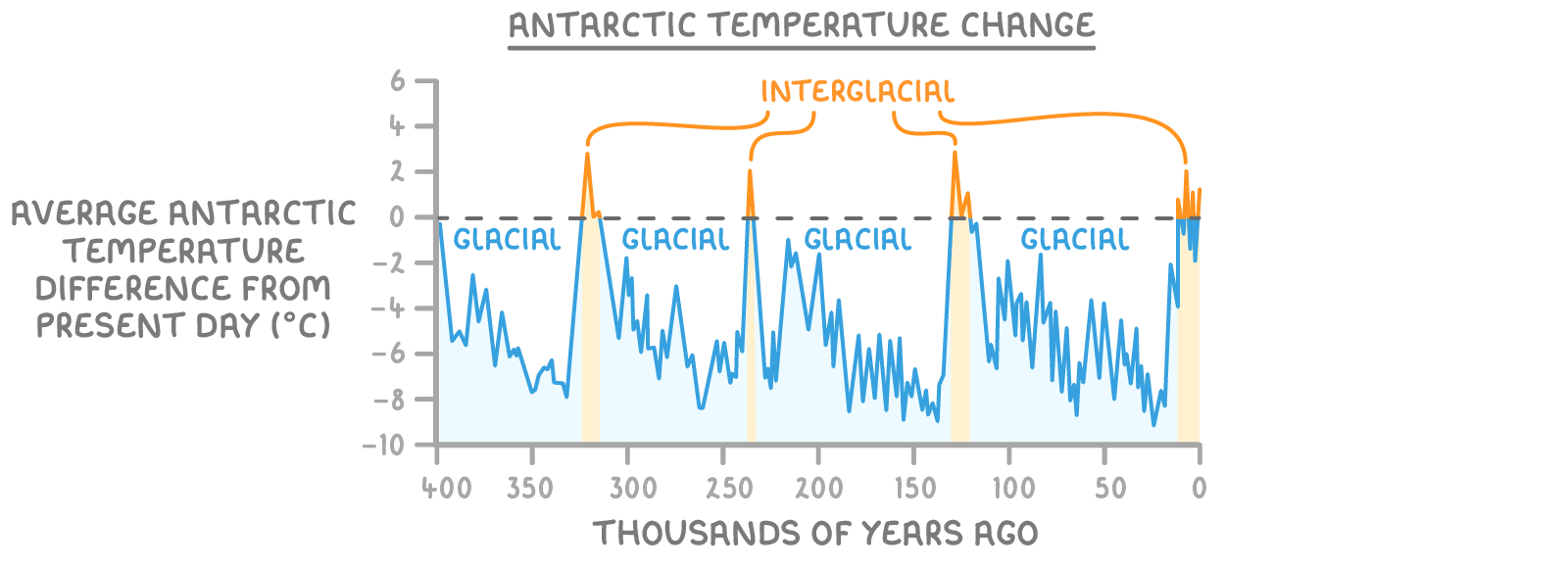
- Glacial and interglacial cycles - The Quaternary period has seen repeated cycles of cold glacial periods, lasting around 100,000 years, and warmer interglacial periods, lasting about 10,000 years.
- Historical context - Prior to the Quaternary, the Earth's climate was relatively warmer and more stable, but it underwent dramatic shifts during this period.
- Recent trends - The last glacial period concluded roughly 15,000 years ago, after which the Earth entered a warming interglacial phase that continues today.
- Cycle frequency - Over the Quaternary, there have been at least 20 cycles of glacial and interglacial periods, with the last 400,000 years showing distinct peaks (interglacials) and troughs (glacials) in temperature records.
Evidence from ice and sediment cores
Ice and sediment cores provide a window into the Earth's climatic past, offering detailed records of temperature changes over vast timescales.
Insights from ice cores
- Layered formation - Ice sheets consist of annual layers of ice, with each layer representing a year of accumulation.
- Extraction process - Scientists extract long cylindrical samples, or cores, by drilling deep into ice sheets.
- Temperature analysis - Trapped gases within these ice layers are analysed to determine past temperatures, providing a record that extends back over 400,000 years in some Antarctic cores.
Insights from sediment cores
- Ocean sediment records - Cores taken from ocean floor sediments contain remains of ancient organisms, which can be studied to infer past climate conditions.
- Extended timescale - These sediment cores push the climate record back further, offering evidence of temperature changes dating back at least 5 million years.
Evidence from tree rings and pollen analysis
Natural archives such as tree rings and preserved pollen offer indirect but valuable evidence of past climates, reflecting environmental conditions through biological responses over thousands of years.
Climate evidence from tree rings
- Annual growth markers - Trees develop a new ring each year, with the thickness of the ring indicating the climate conditions during that period.
- Core sampling - Scientists extract cores from trees to count rings and assess their thickness, revealing the tree's age and past weather patterns.
- Reliability and range - Tree ring data provide a trustworthy record of climate variations for up to 10,000 years, with thicker rings typically indicating warmer, wetter conditions.
Climate evidence from pollen analysis
- Preservation in sediments - Pollen grains from plants are often preserved in lake beds or peat bogs, capturing a snapshot of past vegetation.
- Identification and dating - By identifying and dating this pollen, scientists can determine which plant species thrived at specific times.
- Climatic inference - Since current plant species are associated with specific climate conditions, similar preserved pollen suggests comparable past climates, helping to reconstruct historical weather patterns.
Evidence from temperature and historical records
Direct measurements and documented records provide a more recent but highly accurate account of climate change, complementing the longer-term evidence from natural archives.
Modern temperature measurements
- Instrumental data - Since the mid-19th century, global temperatures have been recorded using thermometers, offering a precise but relatively short-term dataset.
- Trend observation - These records show a clear upward trend in global temperatures, with a particularly steep increase noted from the late 20th century onwards.
Historical documentation
- Extended records - Historical sources, such as records of harvest times or weather descriptions in old newspapers, allow the climate record to be extended further back in time.
- Complementary evidence - While less precise than instrumental data, these accounts provide valuable context and support for understanding climate trends prior to systematic measurements.