4.2 - Causes of Climate Change
Natural factors contributing to climate change
Climate change is not a new phenomenon and has occurred throughout Earth's history due to various natural processes. These factors influence the planet's climate by altering the amount of solar energy received or retained by the Earth.
Key natural causes of climate change
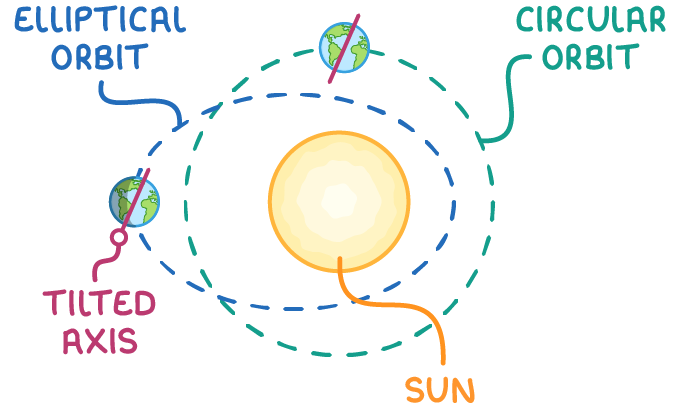
- Orbital variations - Changes in the Earth's orbit around the Sun impact the amount of solar radiation reaching the planet. These variations include:
- Eccentricity, where the orbit shifts between circular and elliptical shapes.
- Tilt, referring to the angle of the Earth's axis during its orbit.
- Precession, a wobble in the Earth's axis similar to a spinning top. These shifts are believed to contribute to the glacial and interglacial cycles observed during the Quaternary period.
- Volcanic eruptions - Large-scale volcanic activity releases significant amounts of particles into the atmosphere. These particles can reflect sunlight back into space, leading to a temporary cooling effect on the Earth's surface.
- Solar output fluctuations - The Sun's energy output varies over cycles, typically every 11 years, with possible longer cycles spanning centuries. A decrease in solar output can result in cooler regional climates, though its impact on global climate change is considered minimal.
Human activities driving climate change
In the past century and a half, human actions have significantly accelerated climate change, particularly through the phenomenon known as global warming. This rapid increase in global temperatures is largely attributed to anthropogenic influences.
Overview of human-induced climate change
Human activities have intensified the warming of the planet by increasing the concentration of greenhouse gases in the atmosphere. This process, linked to industrialisation and modern lifestyles, has led to a sharp rise in global temperatures, altering climate patterns worldwide.
The greenhouse effect and global warming
The greenhouse effect is a natural process essential for maintaining Earth's temperature, but human activities have enhanced it, leading to excessive warming.
Mechanism of the greenhouse effect
- Heat trapping - Greenhouse gases such as carbon dioxide (CO2) and methane absorb heat radiated from the Earth's surface, preventing it from escaping into space. This trapped heat keeps the planet warm enough to support life.
- Enhanced warming - Increased levels of these gases due to human activity result in more heat being retained, causing the Earth's average temperature to rise beyond natural levels, a process known as global warming.
- Scientific consensus - There is widespread agreement among scientists that the recent acceleration of global warming is primarily driven by human contributions to the greenhouse effect.
Sources of greenhouse gas emissions
Various human activities release significant amounts of greenhouse gases into the atmosphere, exacerbating climate change. These practices are often tied to energy production, industrial processes, and land use changes.
Major sources of greenhouse gas emissions
- Burning fossil fuels - The combustion of coal, oil, natural gas, and petrol in power plants, vehicles, and industries releases large quantities of CO2 into the atmosphere, contributing heavily to global warming.
- Cement production - Manufacturing cement involves processing limestone, which contains carbon. This process emits substantial amounts of CO2 as a by-product, adding to atmospheric greenhouse gas levels.
- Agricultural practices - Farming activities contribute to climate change in several ways:
- Livestock farming, particularly of cattle, produces methane, a potent greenhouse gas, through digestive processes.
- Rice cultivation in flooded paddies also emits methane due to the anaerobic conditions in waterlogged soils.
- Deforestation - The removal of trees reduces the Earth's capacity to absorb CO2 through photosynthesis. Additionally, when forests are burned for fuel or to clear land for agriculture, stored carbon is released as CO2 into the atmosphere, further intensifying the greenhouse effect.