11.3 - River Landforms from Erosion
Formation of waterfalls and gorges
In the upper course of a river, where the gradient is steep and the river's energy is high, distinct landforms such as waterfalls and gorges are created through specific erosional processes.
How waterfalls are formed
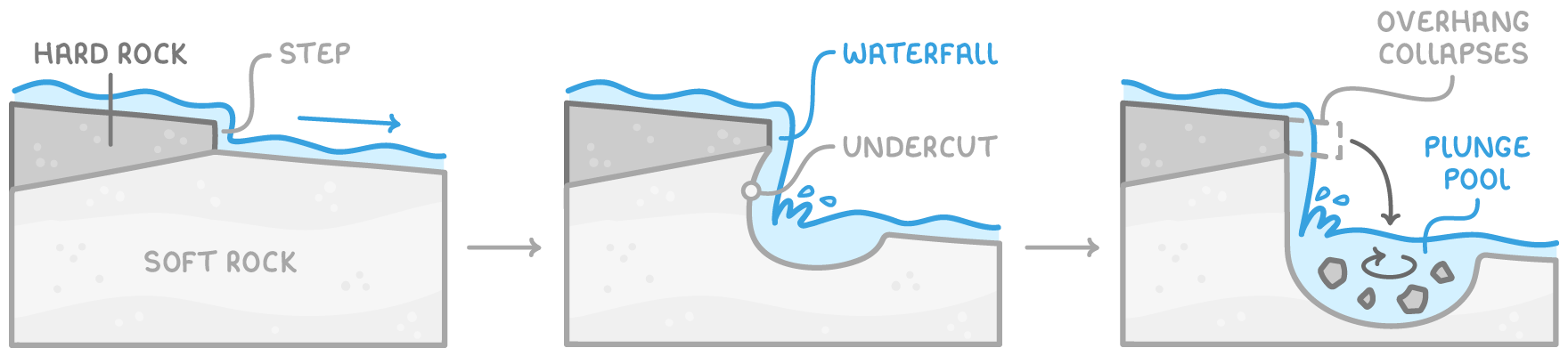
- Differential erosion - Waterfalls develop where a river flows over a band of hard rock followed by softer rock. The softer rock erodes more quickly due to the river's force.
- Creation of a step - As the softer rock wears away through processes like hydraulic action (the force of moving water) and abrasion (rocks scraping against the riverbed), a noticeable step forms in the river's profile.
- Steep drop formation - Over time, the continuous flow of water over this step deepens the erosion of the softer rock, resulting in a steep drop known as a waterfall.
- Undercutting and collapse - The hard rock above the softer rock becomes undercut as erosion continues. Without support, it eventually collapses into the river below.
- Formation of a plunge pool - The fallen rocks are swirled around by the water at the base of the waterfall, eroding the softer rock further through abrasion and creating a deep depression called a plunge pool.
How gorges are formed from waterfalls
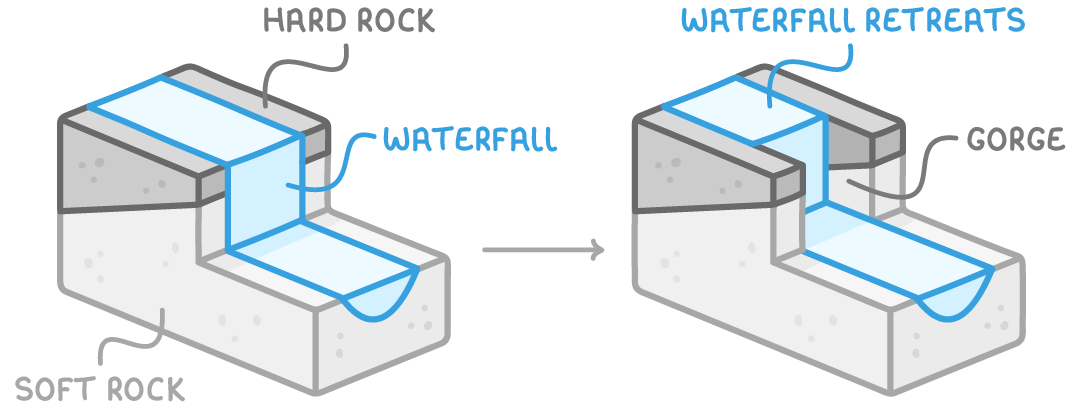
- Retreat of the waterfall - Repeated undercutting and collapsing of the hard rock cause the waterfall to move upstream over time, a process known as retreat.
- Creation of a gorge - As the waterfall retreats, it leaves behind a steep-sided, narrow valley known as a gorge.
Interlocking spurs in V-shaped valleys
Another prominent feature of the upper course of a river is the presence of interlocking spurs, which contribute to the distinctive shape of the valley in this section of the river's journey.
Formation of V-shaped valleys and interlocking spurs
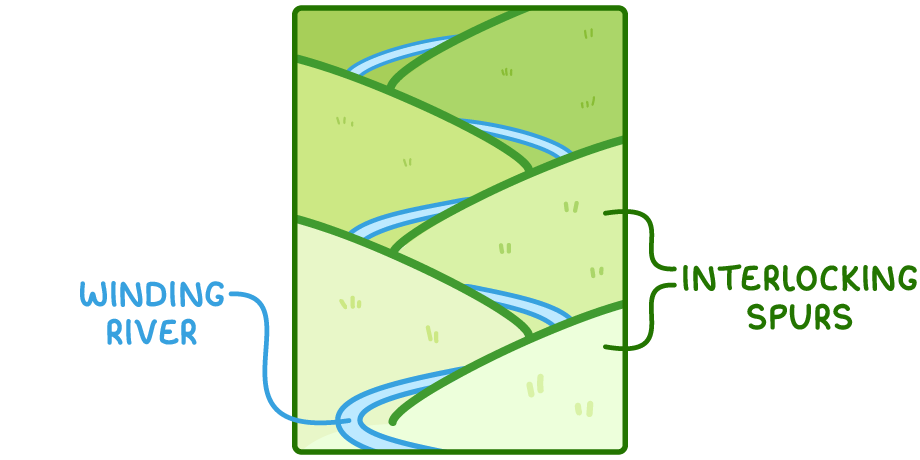
- Vertical erosion dominance - In the upper course, the river's energy is mainly directed downwards, leading to deep, vertical erosion. This results in steep-sided valleys with a characteristic V-shape.
- Limited lateral erosion - The river lacks the power to erode sideways significantly, so it cannot cut through the high hillsides that protrude into its path on either side.
- Winding river path - Instead, the river meanders around these obstacles, creating a zig-zag pattern as it flows.
- Interlocking spurs appearance - The hillsides on either side of the river interlock with each other, resembling the teeth of a zip when viewed from above. These are known as interlocking spurs, formed as the river winds through the valley.
Key processes of erosion
The formation of fluvial landforms, which are features created by river processes, relies heavily on specific types of erosion.
Main erosional processes in river landform development
| Process | Description |
|---|---|
| Hydraulic action | This is the force exerted by moving water, which dislodges material from the riverbed and banks. |
| Abrasion | Rocks and sediment carried by the river scrape and wear down the riverbed and banks, particularly effective in deepening plunge pools. |
| Differential erosion | The varying resistance of rock types to erosion leads to uneven wearing away of the riverbed, crucial for forming features like waterfalls where hard and soft rocks meet.. |
TermDefinition
Differential erosionErosion that occurs at varying rates due to the different resistances of rock types.
Plunge poolA deep depression at the base of a waterfall formed by the erosive force of falling water and swirling rocks.
GorgeA steep-sided, narrow valley left behind as a waterfall retreats upstream.
Vertical erosionDownward erosion that deepens the river channel, dominant in the upper course.
Lateral erosionSideways erosion that widens the river valley, which is limited in the upper course.
Interlocking spursProtruding hillsides that overlap each other as a river winds through a V-shaped valley.
Hydraulic actionThe sheer force of moving water trapping air in cracks and dislodging material from the riverbed and banks.
AbrasionThe scraping and wearing away of the riverbed and banks by rocks and sediment carried by the water.