11.4 - River Landforms from Erosion & Deposition
Meander formation through erosion and deposition
Meanders are large, sweeping bends that form in the middle and lower courses of a river. These distinctive curves are the result of natural processes that shape the river channel over time through a combination of erosion and deposition.
Processes shaping meanders
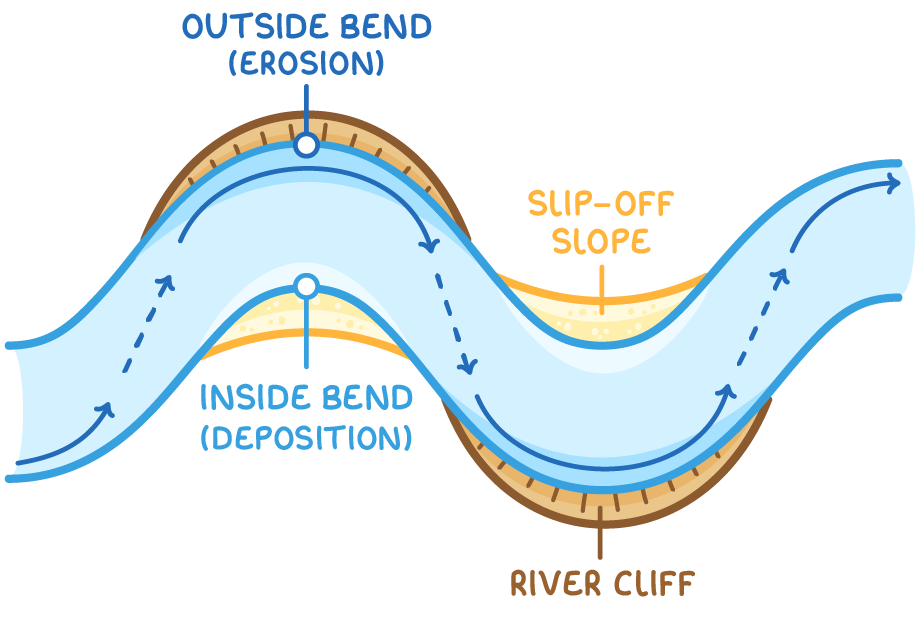
- Erosion on the outside bend - The river erodes the outer bank of a bend where the water flows fastest, carving out steep features known as river cliffs.
- Deposition on the inside bend - Slower-moving water on the inner bank leads to the buildup of sediment, creating gently sloping areas called slip-off slopes.
- Types of erosion - The outer bend experiences erosion through abrasion, where sediment scrapes against the bank, and hydraulic action, where the sheer force of water wears away material.
The role of river current and channel depth
The way water flows through a river channel plays a crucial role in the development of meanders. Differences in speed and depth across the river create the conditions for these bends to form and grow.
Factors influencing meander formation
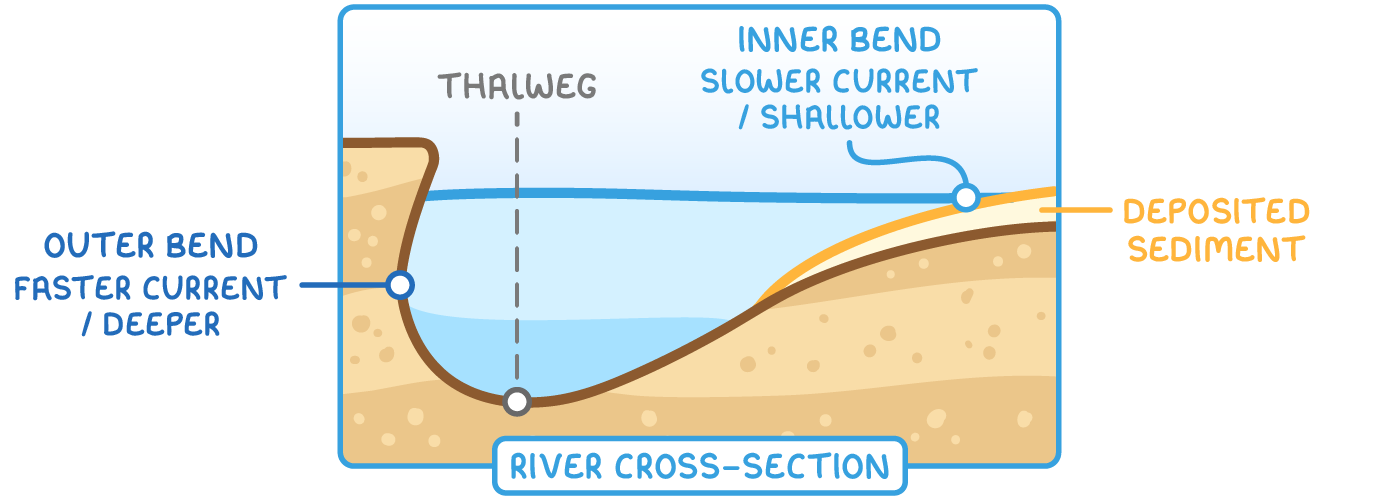
- Faster current on the outside - The river channel is deeper on the outer bend, reducing friction and allowing water to flow more quickly, which increases erosion.
- Slower current on the inside - The channel is shallower on the inner bend, increasing friction and slowing the water, which encourages deposition of sediment.
- Thalweg definition - The thalweg is the line of deepest water and fastest flow within the river channel.
The creation of ox-bow lakes
Ox-bow lakes are isolated bodies of water that form as a result of the evolution of meanders. They are a striking example of how rivers can dramatically alter their course over time.
Stages of ox-bow lake formation
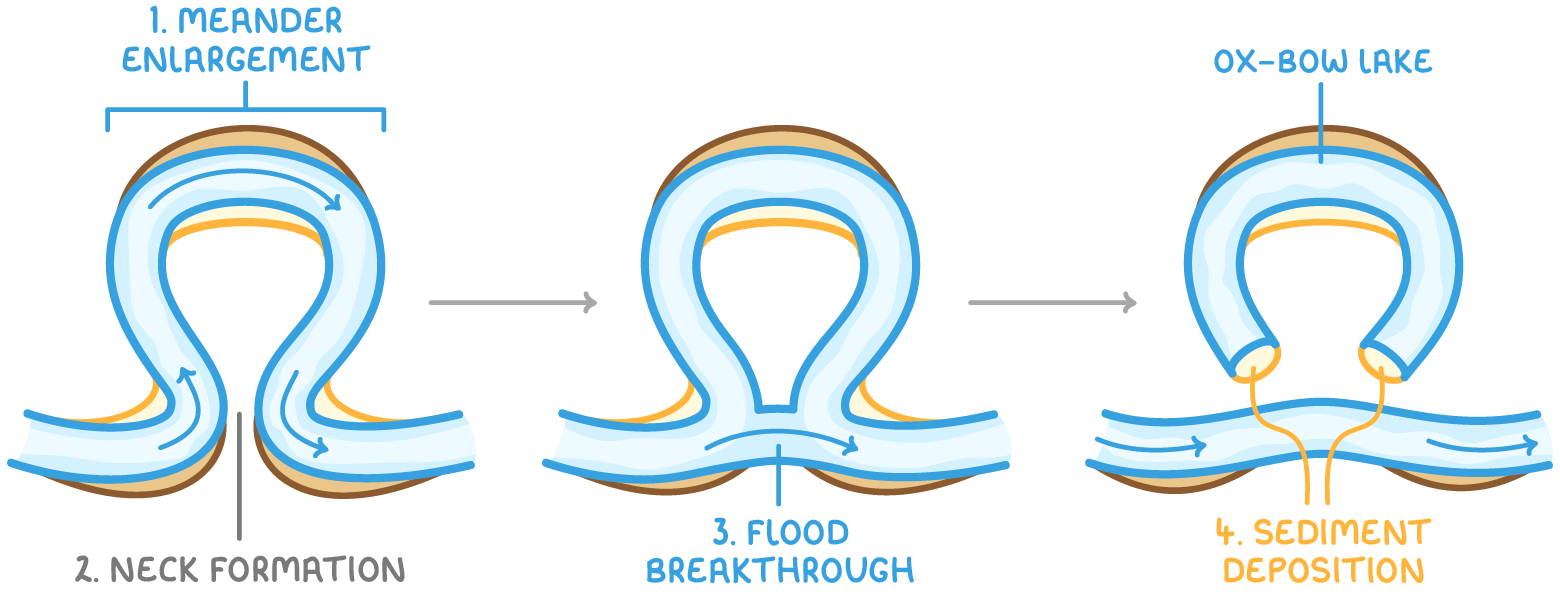
- Meander enlargement - Over time, erosion causes the bends of a meander to grow larger, bringing the outer banks of adjacent bends closer together.
- Neck formation - Eventually, only a narrow strip of land, known as the neck, remains between the two bends.
- Breakthrough during floods - During high water events like floods, the river may breach this neck, taking the shortest path and creating a new channel.
- Deposition and isolation - Sediment deposition seals off the old meander loop from the main river channel, forming a crescent-shaped ox-bow lake.
TermDefinition
MeanderA pronounced bend or loop in the course of a river.
Slip-off slopeA gently sloping area of land formed by deposition on the inside of a river bend.
River cliffA steep bank on the outside of a river bend caused by rapid erosion.
ThalwegThe line of fastest flow and deepest water within a river channel.
Ox-bow lakeA crescent-shaped lake formed when a meander is cut off from the main river channel.