12.1 - Glacial Processes
The formation and movement of glaciers
Glaciers are large masses of ice that occupy valleys and hollows in the landscape. They form in areas where snow accumulates over time, compressing into ice under its own weight. This weight drives their slow movement downhill, shaping the surrounding terrain through various processes.
How glaciers form and move
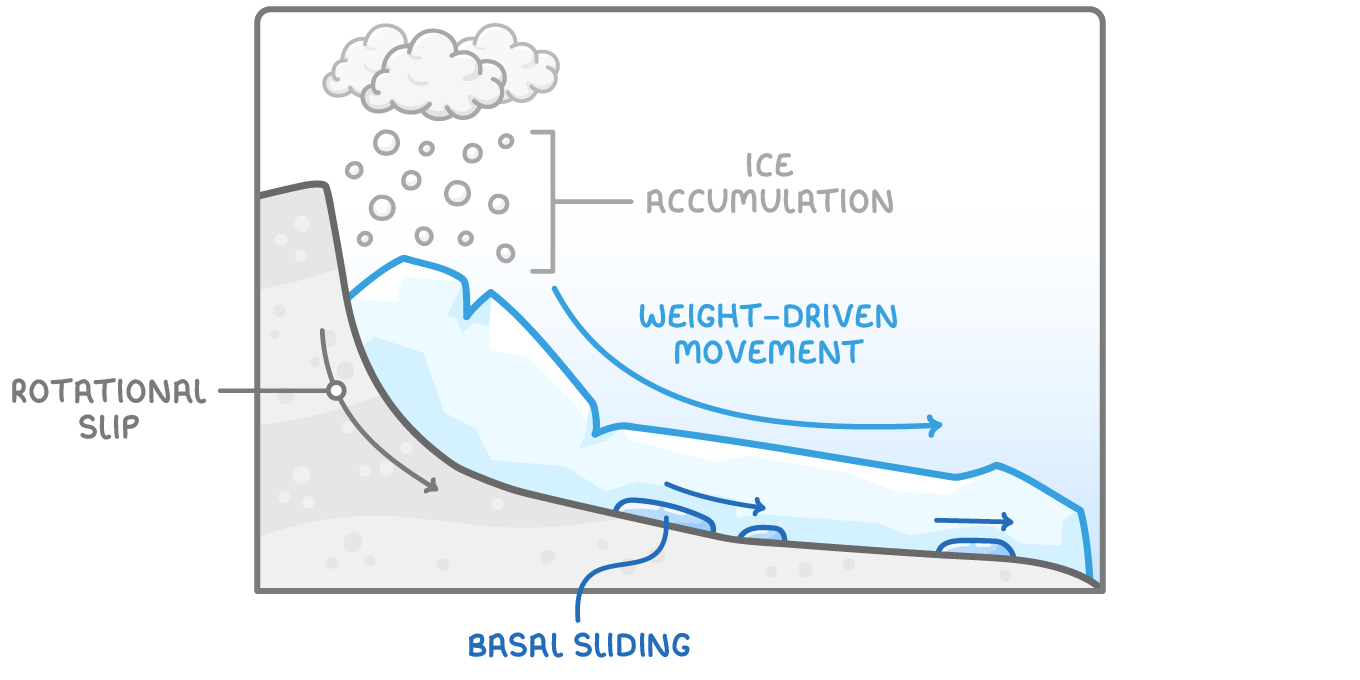
- Ice accumulation - Glaciers develop from layers of snow that build up, compact, and transform into dense ice over many years.
- Weight-driven movement - The immense mass of ice causes glaciers to flow downhill, following the slope of the land.
- Basal sliding - A thin layer of meltwater beneath the glacier acts as a lubricant, reducing friction and allowing the ice to slide over the underlying surface.
- Rotational slip - At the upper end of a glacier, ice moves in a circular motion rather than a straight line, carving out and deepening hollows into bowl-shaped features in the landscape.
Erosional processes associated with glaciers
As glaciers advance, they significantly alter the landscape through erosion. This process wears away the underlying rock and reshapes the terrain using distinct mechanisms driven by the ice's movement and the materials it carries.
Mechanisms of glacial erosion
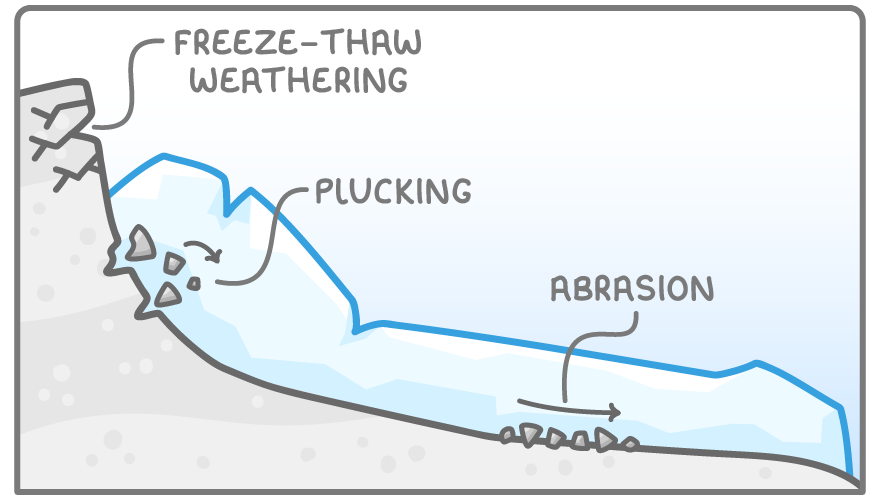
- Abrasion - Fragments of rock embedded within the ice scrape and grind against the bedrock beneath the glacier, smoothing and wearing it down over time.
- Plucking - Meltwater around the base, sides, or back of a glacier freezes onto the rock. As the glacier moves forward, it tears away pieces of rock, pulling them out of the bedrock.
- Freeze-thaw weathering - Water seeps into cracks in rocks above the glacier. When it freezes, the water expands, exerting pressure on the rock. As it thaws, the pressure is released. Repeated cycles weaken the rock, making it more susceptible to further erosion.
Transportation of materials by glaciers
Glaciers act as powerful agents of transportation, carrying a variety of materials over vast distances. These materials, ranging from fine particles to large boulders, are moved in different ways depending on their position relative to the glacier.
Methods of material transportation by glaciers
- Embedded in ice - Materials such as sand, clay, and rocks become frozen within the glacier and are carried along as it moves.
- Surface transport - Debris falls onto the glacier's surface from surrounding slopes and is transported on top of the ice.
- Bulldozing - Loose material is pushed ahead of the glacier as it advances, accumulating at the front.
- Till formation - The unsorted mixture of transported materials, including particles of varying sizes, is collectively known as till.
Deposition processes and resulting landforms
When a glacier melts or becomes overloaded with material, it deposits the debris it has been carrying. This deposition creates distinctive landforms and features in the landscape, reflecting the glacier's past activity.
Processes and outcomes of glacial deposition
- Material release - Deposition occurs when the ice melts or when the glacier can no longer carry its load, leaving materials on the valley floor.
- Unsorted deposits - Most glacial deposits, such as till, are a chaotic mix of rocks and particles of all shapes and sizes, lacking any organisation by weight or dimension.
- Formation of landforms - Deposited materials form specific features like moraines (ridges of debris) and drumlins (elongated hills of till).
- Sorted outwash - Fine materials like sand and gravel are often washed away from the glacier's front by meltwater streams. These streams sort the debris by size, depositing it in layered formations known as outwash beyond the glacier's edge.