11.1 - The Shape of River Valleys
The concept of a river's course and its sections
A river's journey from its starting point to its end is known as its course. This path is divided into three distinct sections based on the landscape it flows through and the gradient of the terrain.
Divisions of a river's course
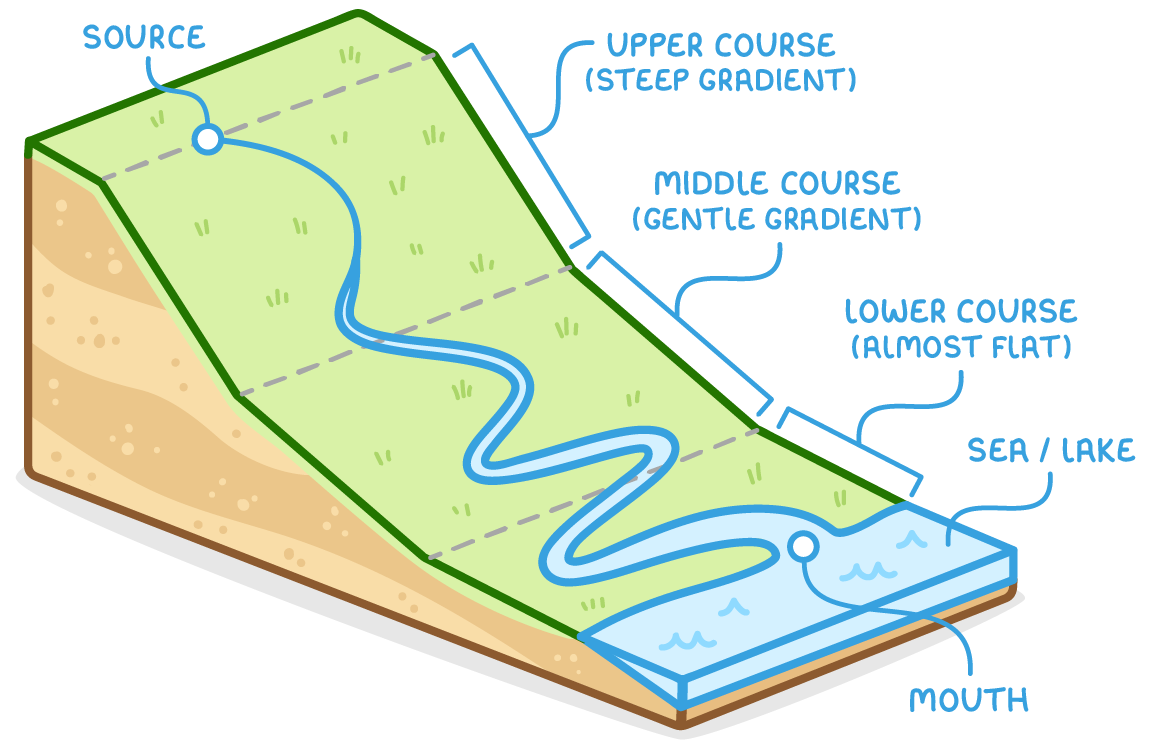
- Upper course - Located near the river's source, this section has a steep gradient, resulting in fast-flowing water.
- Middle course - As the river progresses, the gradient becomes gentler, and the river starts to widen.
- Lower course - Nearing the river's mouth, the gradient is almost flat.
The long profile and gradient changes
The long profile of a river is a visual representation of how its gradient, or slope, changes from source to mouth.
Features of the long profile
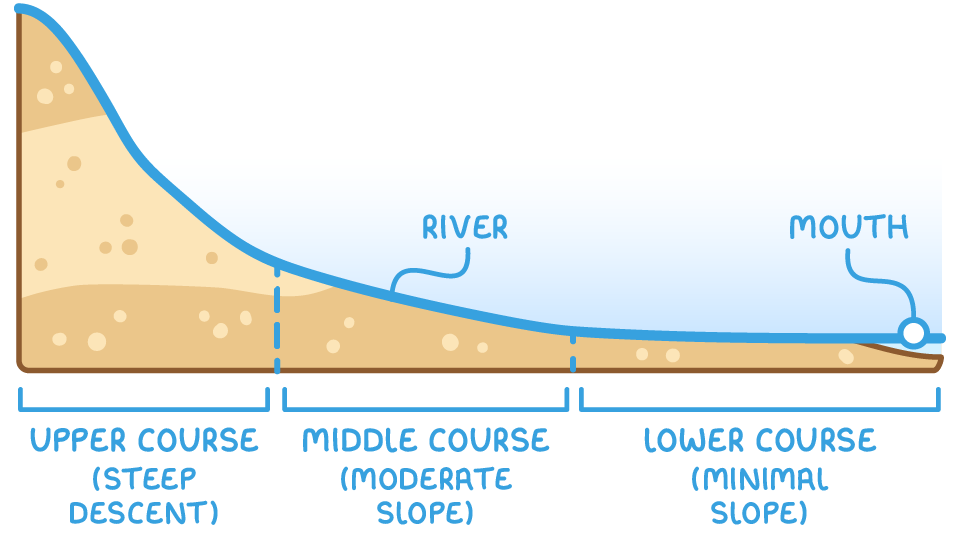
- Steep descent in the upper course - The river drops quickly over a short distance.
- Moderate slope in the middle course - The gradient eases, showing a more gradual decline.
- Minimal slope in the lower course - The river levels out, with a very gentle gradient as it approaches its destination.
Formation of channels and valleys
As rivers flow downhill, they actively shape the landscape by creating channels and valleys through erosion and deposition.
Processes shaping river landscapes
- Channel formation - The river cuts a path through the land, forming a channel.
- Valley creation - Over time, the river carves out larger valleys by eroding the surrounding land.
- Erosion's role - The river wears down rocks and soil, removing material from the banks and bed.
- Deposition's impact - Material eroded upstream is carried along and eventually dropped further downstream.
- Dominant process variation - The shape of the valley and channel changes along the river depending on whether erosion or deposition is the dominant process.
The cross profile of river sections
The cross profile of a river shows a cross-section of the river channel and valley at a specific point along its course.
Characteristics across river sections
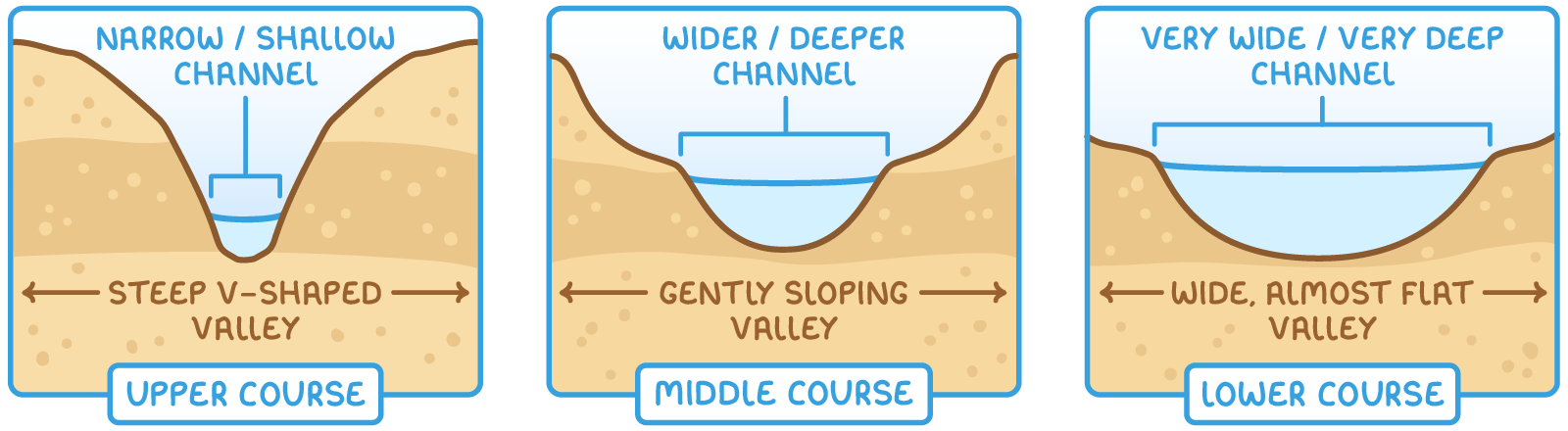
| Section | Gradient and valley characteristics | Channel characteristics |
|---|---|---|
| Upper course | Steep gradient with V-shaped valley having steep sides | Narrow and shallow channel |
| Middle course | Medium gradient with gently sloping valley sides | Wider and deeper channel |
| Lower course | Gentle gradient with very wide, almost flat valley | Very wide and deep channel |
The processes of vertical and lateral erosion
Erosion occurs in two main forms: vertical and lateral. Both types work simultaneously, but one tends to dominate depending on the river's stage.
Types of erosion in river systems
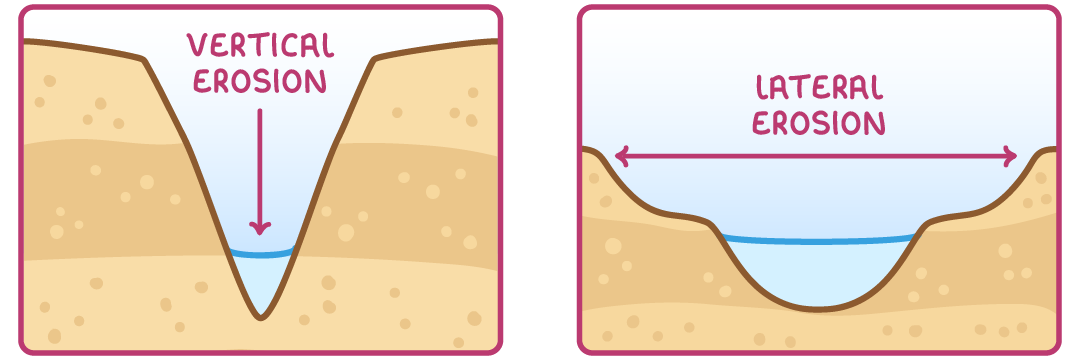
- Vertical erosion - This process deepens the river valley and channel, creating a distinct V-shape, and is most active in the upper course. The high energy and turbulence of the water drive rough, jagged particles to scrape along the river bed, causing significant downward cutting.
- Lateral erosion - This type widens the river valley and channel, often through the formation of meanders, and is more prominent in the middle and lower courses.
- Simultaneous action - Both vertical and lateral erosion occur along the entire river, but one is usually dominant at different points along the river.
TermDefinition
GradientThe steepness or slope of the land.
Long profileA visual representation showing how a river's gradient changes from source to mouth.
Cross profileA cross-section view of the river channel and its surrounding valley at a specific point.
ErosionThe wearing away and removal of rock and soil by the river's flow.
DepositionThe dropping of material that was being carried by the river, usually when the water slows down.
Vertical erosionDownward erosion that deepens the river channel and valley, creating a distinct V-shape.
Lateral erosionSideways erosion that widens the river channel and valley.