11.2 - Erosion, Transportation & Deposition
The key processes of river erosion
Rivers shape the landscape through various processes of erosion, which break down and wear away the rocks and materials in their path.
Types of erosion processes in rivers
- Hydraulic action - The sheer power of moving water strikes against rocks in the river channel, dislodging particles and causing them to break away.
- Abrasion - Rocks and debris carried by the river act like sandpaper, grinding and scraping against the channel bed and banks, wearing them down. This is often the most significant form of erosion.
- Attrition - Rocks and particles transported by the river collide with each other, breaking into smaller pieces and becoming smoother and rounder over time. This process reduces particle size as materials travel from the river's source to its mouth.
- Solution - Certain rocks, such as limestone or chalk, dissolve in the river water, especially if the water is slightly acidic.
Transportation of eroded material
Once material is eroded, rivers carry it downstream through various transportation methods. The method used depends on factors like the speed of the water and the size of the particles being moved.
Ways rivers transport eroded material
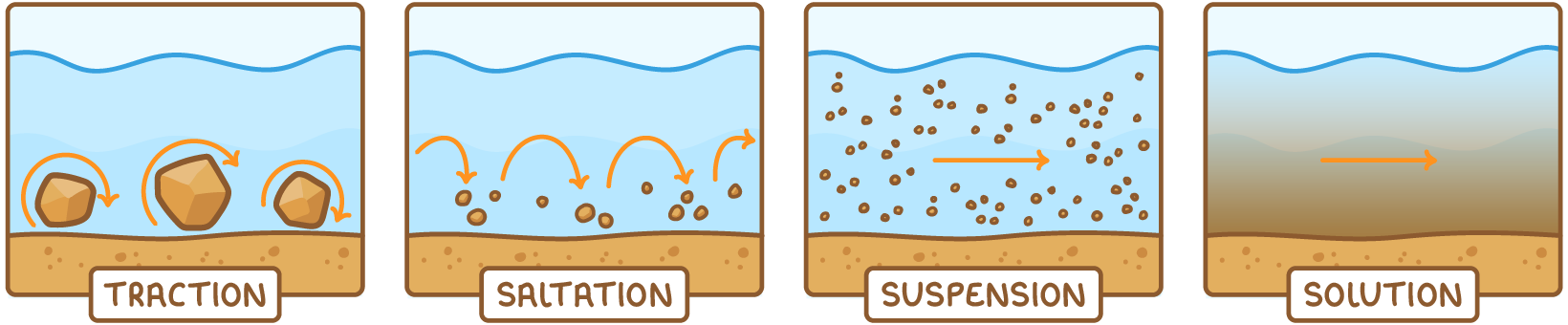
- Traction - Large, heavy particles such as boulders are rolled or pushed along the river bed by the force of the flowing water.
- Saltation - Medium-sized particles, like pebbles, bounce along the river bed, being lifted briefly by the water's force before falling back down.
- Suspension - Fine particles, including silt and clay, are carried within the water itself.
- Solution - Dissolved materials, such as certain minerals or salts, are carried invisibly within the water as they have fully dissolved.
The process of deposition and its causes
Deposition occurs when a river loses the energy needed to carry its load and drops the material it has been transporting.
Factors leading to deposition in rivers
- Reduced water volume - When the amount of water in the river decreases, the river's ability to carry material diminishes, leading to deposition.
- Increased load - If the river is carrying a large amount of eroded material, it may become overloaded and deposit some of this load.
- Shallower water - In areas where the water is less deep, such as on the inside of a river bend, the reduced speed causes material to be dropped.
- Reaching the mouth - As the river approaches its mouth, its speed often slows significantly, resulting in the deposition of much of its load.
Role of particle size in deposition
- Distance travelled - Smaller particles, being lighter, are typically carried further downstream and are often deposited near the river's mouth.
- Larger particles - Heavier materials, like boulders, are deposited earlier in the river's course as they require more energy to be transported.
Distribution of erosion and deposition
The dominance of erosion and deposition varies along the length of a river, influenced by factors such as the river's speed and gradient.
Patterns of river processes along the course
- Upper course dominance - Erosion is the primary process in the upper reaches of a river.
- Lower course dominance - Deposition becomes more prominent in the lower course.
- Impact of river speed - The faster a river flows, typically in the upper course, the more erosion occurs due to greater energy. Conversely, slower flow in the lower course results in increased deposition.
TermDefinition
Hydraulic actionThe force of moving water dislodging particles from the river bed and banks.
AbrasionThe wearing away of the river bed and banks by rocks and debris carried in the water.
AttritionThe process of rocks and pebbles colliding with each other and breaking into smaller, smoother pieces.
SolutionThe dissolving of certain rocks in river water, and the invisible transport of these dissolved minerals.
TractionThe transportation of large, heavy rocks by rolling them along the river bed.
SaltationThe transportation of medium-sized particles by bouncing them along the river bed.
SuspensionThe transportation of fine particles carried within the water.
DepositionThe dropping of eroded material by a river when it loses energy.