10.3 - Management of Coastal Landscapes
The purpose and challenges of coastal management
Coastal management aims to safeguard both communities and the environment from the destructive forces of erosion and flooding. These natural processes can threaten homes, infrastructure, and ecosystems along coastlines, making effective strategies essential for protection.
Objectives and limitations of coastal management
- Protecting populations - Shields residents and their properties from the impacts of rising sea levels and storm surges.
- Preserving environments - Maintains natural coastal features and habitats that can be damaged by erosion or flooding.
- Economic constraints - Limited funding means not all coastal regions can be protected, requiring prioritisation of certain areas over others.
- Balancing priorities - Decisions often involve weighing the needs of human settlements against environmental conservation and financial resources.
Hard engineering for coastal protection
Hard engineering involves the construction of man-made structures designed to control the flow of the sea and minimise flooding and erosion. These methods are often robust but can come with significant costs and drawbacks.
Types of hard engineering defences
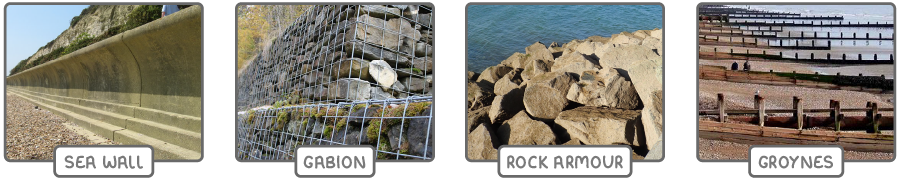
- Sea walls - Solid barriers made of materials like concrete, built along the coast to reflect wave energy back to the sea.
- Benefits - Effectively prevents coastal erosion and acts as a barrier against flooding.
- Drawbacks - Causes strong backwash that can erode the base of the wall, and is costly to construct and maintain.
- Gabions - Wire cages filled with rocks, often placed at the base of cliffs to absorb wave impact.
- Benefits - Reduces erosion by dissipating wave energy, and is relatively cheap and simple to install.
- Drawbacks - Visually unappealing and prone to corrosion of wire cages over time.
- Rock armour (Rip-rap) - Large boulders stacked along the shoreline to break up wave energy.
- Benefits - Absorbs wave energy, reducing both erosion and flooding, and is generally cost-effective.
- Drawbacks - Strong waves can displace boulders, necessitating frequent repositioning or replacement.
- Groynes - Structures made of wood or stone, built perpendicular to the coast to trap sediment and build up beaches.
- Benefits - Creates wider beaches that slow down waves, offering enhanced protection to the coastline.
- Drawbacks - Disrupts sediment flow, leading to narrower beaches downstream and reduced protection in those areas.
Soft engineering approaches
Soft engineering focuses on working with natural processes to mitigate the effects of flooding and erosion. These methods are often more environmentally friendly but may require ongoing effort and investment.
Key soft engineering strategies
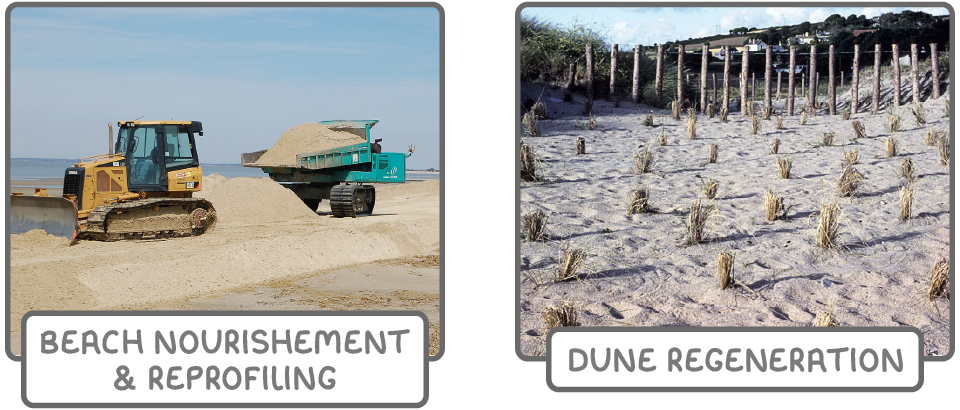
- Beach nourishment and reprofiling - Involves adding sand or shingle from other locations to widen existing beaches.
- Benefits - Wider beaches slow incoming waves, providing better protection against flooding and erosion.
- Drawbacks - Can harm seabed ecosystems during material extraction and is expensive due to the need for repeated applications.
- Dune regeneration - Restoring or creating sand dunes by adding sediment or planting vegetation to stabilise them.
- Benefits - Forms a natural barrier that absorbs wave energy, helping to prevent flooding and erosion.
- Drawbacks - Effective only in limited areas, with nourishment being costly, though stabilisation through planting is more affordable.
The concept and implications of managed retreat
Managed retreat is a strategy where existing coastal defences are deliberately removed, allowing the sea to flood specific areas. This approach transforms the land into marshland, which can offer natural protection to inland areas.
Features and consequences of managed retreat
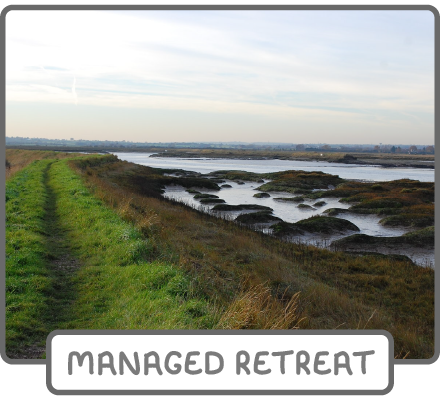
- Natural flooding - Permits the sea to inundate low-lying areas, creating marshland that acts as a buffer against flooding and erosion.
- Cost-effectiveness - Requires minimal investment and no ongoing maintenance, making it a low-cost option.
- Habitat creation - Supports biodiversity by forming new environments for various plant and animal species, such as birds and fish.
- Agricultural conflicts - Flooding can impact farmland, affecting farmers' livelihoods and causing economic hardship.
- Ecosystem challenges - Saltwater intrusion may harm existing freshwater ecosystems, altering local biodiversity.
- Real-world application - In some coastal regions, breaching flood walls has successfully created new habitats while protecting nearby homes from floods.