3.1 - Global Atmospheric Circulation
Global circulation and heat transfer
Global atmospheric circulation is a vast system that redistributes heat across the Earth's surface by moving air from the equator towards the poles. This process is driven by differences in temperature and pressure, playing a crucial role in balancing the planet's climate.
Key features of heat transfer through air movement
- Heat distribution - The equator receives intense solar radiation, warming the air above it. This hot air rises and moves towards cooler regions at the poles, transferring heat in the process.
- Pressure differences - Air flows from areas of high pressure to areas of low pressure, driving the circulation system.
- Global impact - This circulation helps regulate temperature disparities between the equator and poles.
Atmospheric circulation cells and pressure belts
The global atmospheric circulation system is organised into distinct loops known as cells, with each hemisphere containing three primary cells. These cells create alternating belts of high and low pressure that influence weather patterns worldwide.
The three-cell model in each hemisphere
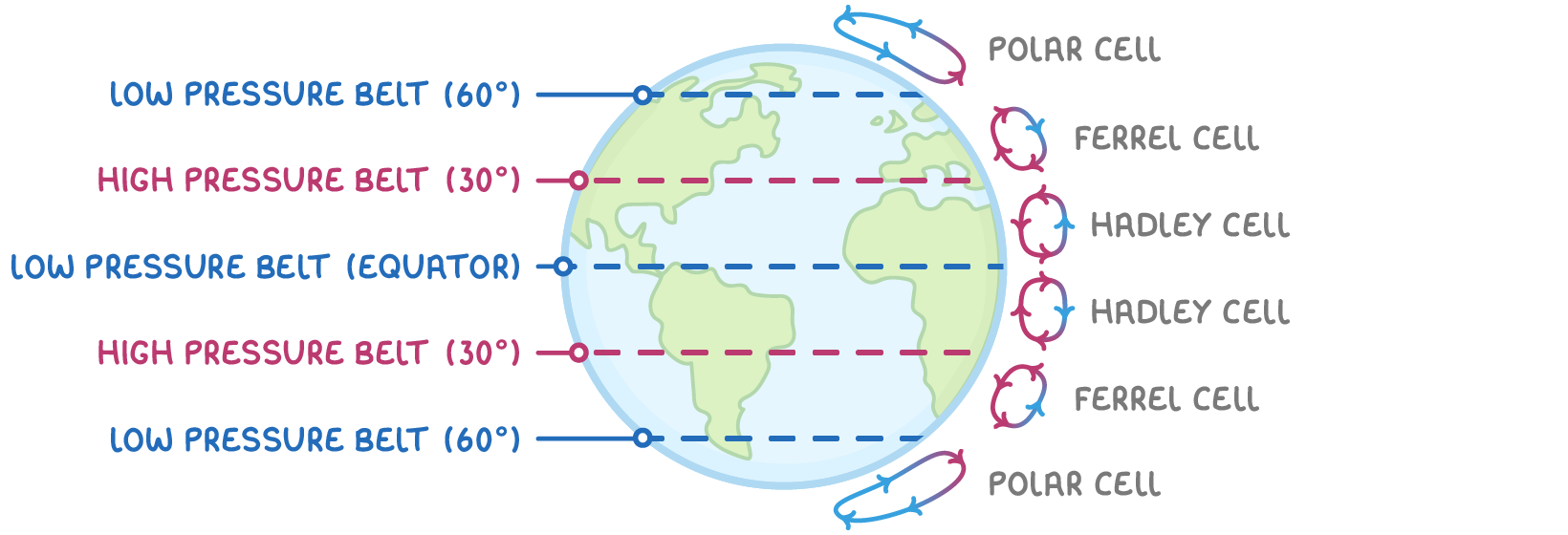
- Hadley Cell - Located near the equator, this cell features warm air rising at 0° latitude, creating a low pressure belt. The air cools as it moves poleward and sinks around 30° north and south, forming a high pressure belt.
- Ferrel Cell - Found in the mid-latitudes between 30° and 60° north and south, this cell has air rising at 60°, creating low pressure, and sinking at 30°, reinforcing the high pressure belt.
- Polar Cell - Situated near the poles, this cell involves cold air sinking at the poles, creating high pressure, and moving towards 60° latitudes, where it rises with warmer air to form a low pressure zone.
Surface winds and the Coriolis effect
Surface winds are a critical component of global atmospheric circulation, driven by pressure differences within the cells. Their paths are influenced by the Earth's rotation, resulting in distinct wind patterns.
Patterns of surface winds
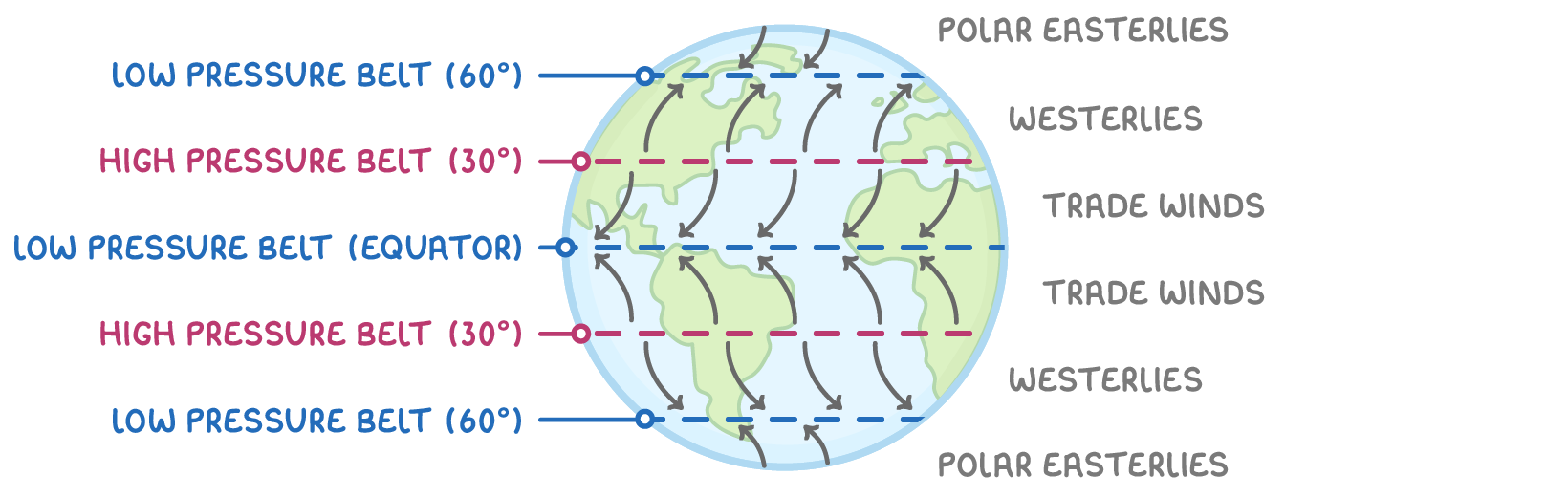
- Trade Winds - Blow from the high pressure at 30° north and south towards the low pressure at the equator.
- Westerlies - Move from the high pressure at 30° towards the low pressure at 60° in both hemispheres.
- Polar Easterlies - Flow from the high pressure at the poles towards the low pressure at 60°.
Influence of the Coriolis effect
- Earth's rotation - As the Earth spins, moving air is deflected due to the difference in rotational speed between the equator and the poles.
- Deflection pattern - In the northern hemisphere, winds are deflected to the right, while in the southern hemisphere, they are deflected to the left.
- Impact on winds - This effect causes the curving of trade winds, westerlies, and polar easterlies, shaping their paths across the Earth's surface.
Impact of atmospheric circulation on weather
Global atmospheric circulation significantly influences climate and weather conditions around the world by determining temperature, moisture, and precipitation patterns at different latitudes.
Weather characteristics at specific latitudes
- Equatorial region (0°) - Intense solar heating causes warm, moist air to rise, forming clouds and resulting in heavy rainfall.
- Subtropical region (30° N and S) - Sinking air, having lost most of its moisture near the equator, leads to dry conditions with minimal cloud cover. This is why many deserts are located at these latitudes.
- Mid-latitude region (60° N and S) - Rising warm air meets cold polar air, creating low pressure systems that bring cloudy skies and rainfall. For instance, the UK, positioned near 60° north, experiences frequent rain due to westerly winds carrying moist air from the Atlantic.
Regional climate variations
- Tropical climates - Near the equator, consistent warmth and moisture support lush rainforests due to continuous low pressure and rising air.
- Arid climates - Around 30° north and south, high pressure and descending dry air result in arid conditions, fostering desert environments.
- Temperate climates - At 60° latitudes, the interaction of air masses in the Ferrel Cell leads to variable weather, with frequent low pressure systems bringing rain and wind.