3.2 - Tropical Storms
The formation and development of tropical storms
Tropical storms are powerful low-pressure weather systems characterised by intense rainfall and strong winds. They are known by different names depending on their location: hurricanes in the North Atlantic and Northeast Pacific, typhoons in the Northwest Pacific, and cyclones in the South Pacific and Indian Ocean. Their formation is driven by specific environmental conditions in tropical regions.
Conditions necessary for tropical storm formation
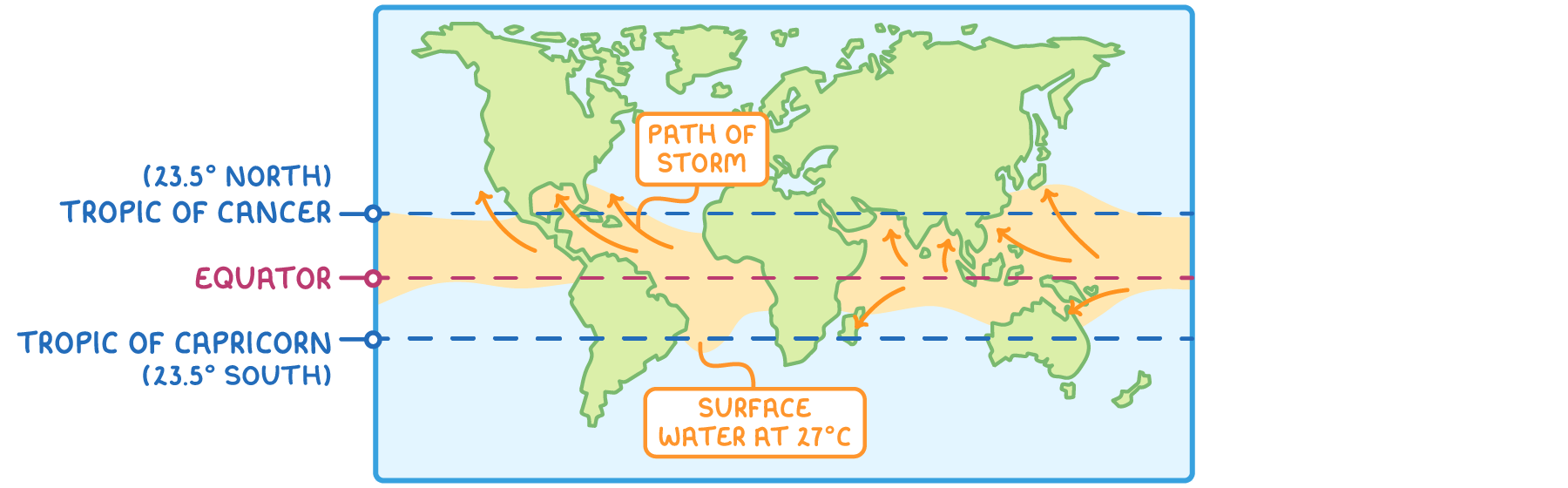
- Warm sea temperatures - Surface water must be at least 27°C to provide the energy needed through evaporation.
- Low wind shear - Minimal difference in wind speed between upper and lower atmosphere layers prevents the storm from breaking apart as clouds rise.
- Evaporation and condensation - Warm water evaporates, rises, and condenses into clouds, releasing vast amounts of energy that fuel the storm.
- Low-pressure creation - Rising air forms an area of low pressure at the surface, which draws in stronger winds.
- Energy reinforcement - Continuous energy from warm water intensifies the storm, increasing wind speeds.
- Loss of strength - Storms weaken over land or cooler water as the energy supply from warm seas diminishes.
The structural features of tropical storms
Tropical storms have a distinct structure with specific zones that vary in weather conditions and intensity. These storms are circular, often spanning hundreds of kilometres, and can persist for 7 to 14 days.
Key components of a tropical storm's structure
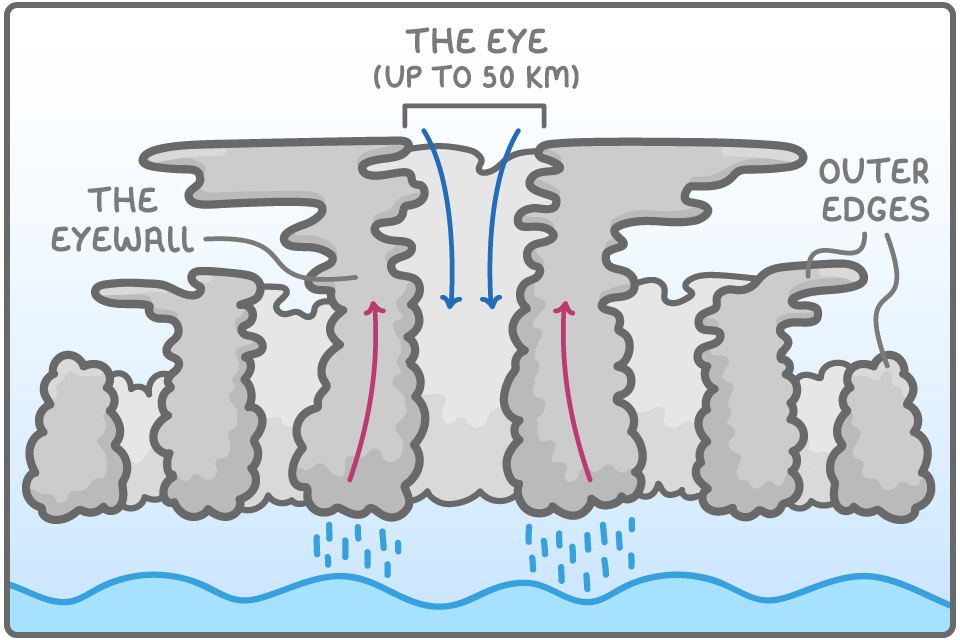
- The eye - The central zone, up to 50 km wide, marked by very low pressure, light winds, clear skies, no rain, and high temperatures due to descending air.
- The eyewall - Surrounding the eye, this area features spiralling, rising air with extremely strong winds (often around 160 km/hour), dense storm clouds, torrential rain, and lower temperatures.
- Outer edges - Beyond the eyewall, wind speeds decrease, clouds become smaller and more scattered, rainfall lessens, and temperatures begin to rise.
Directional spin of tropical storms
- Northern hemisphere - Storms spin anticlockwise due to the Coriolis effect, a force caused by the Earth's rotation.
- Southern hemisphere - Storms spin clockwise, also influenced by the Coriolis effect.
Global distribution and seasonal patterns
Tropical storms occur in specific regions of the world, driven by climatic and geographical factors. Their distribution and timing are influenced by seasonal changes in ocean temperatures and atmospheric conditions.
Where and when tropical storms form
- Geographical range - Develop between 5° and 30° north and south of the equator, where sea temperatures are sufficiently warm.
- Movement direction - Easterly winds near the equator push tropical storms westward.
- Seasonal occurrence in the northern hemisphere - Most frequent from August to October, when ocean temperatures peak.
- Seasonal occurrence in the southern hemisphere - Most common from December to April, aligning with warmer sea conditions in that region..