17.4 - How to Make Water Supply Sustainable
Sustainable water supply and conservation
Sustainable water supply focuses on managing water resources responsibly to meet the needs of both current and future generations. Rather than relying solely on large-scale engineering projects, which may not always address water insecurity effectively, conservation plays a vital role in reducing demand and ensuring long-term availability.
Strategies for water conservation
- Fixing infrastructure leaks - Around 20% of water in distribution systems is lost due to leaks. Repairing pipes and other infrastructure can significantly reduce this wastage.
- Installing water-saving devices - Dual-flush toilets and cistern devices can save up to 3.5 litres per flush, cutting down household water use.
- Using efficient appliances - Operating dishwashers and washing machines only with full loads maximises efficiency and minimises water consumption.
- Adopting precise irrigation techniques - Methods like drip irrigation or targeted sprays are far more efficient than traditional flood irrigation, ensuring water reaches plants directly with minimal loss.
- Implementing water meters - Homes with meters often use 10-15% less water as they increase awareness and encourage mindful usage.
- Educating for behavioural change - Promoting habits such as taking shorter showers and turning off taps when not in use helps reduce unnecessary water waste.
Effective groundwater management practices
Groundwater is a critical resource that must be managed carefully to prevent depletion and contamination. Sustainable practices ensure that extraction does not outpace natural replenishment and that water quality remains high.
Key approaches to groundwater management
- Preventing over-abstraction - Monitoring and controlling extraction rates ensures water is not removed faster than it can be naturally replaced.
- Reducing pollution risks - Limiting the use of agricultural chemicals on farmland helps protect groundwater from contamination.
- Establishing legal regulations - Frameworks such as requiring licences for withdrawals exceeding 20 m³ per day can control overuse.
- Promoting international cooperation - When aquifers span multiple countries, agreements are essential for fair distribution, joint research, and environmental protection. An example is the Guarani Aquifer Agreement (2010) among South American nations, which fosters sustainable sharing of this vital resource.
The role of water recycling in increasing supply
Water recycling involves treating and reusing water from residential and industrial sources, offering a sustainable way to boost water availability without relying on fresh extraction.
Benefits and applications of water recycling
- Enhancing water availability - Recycling can increase urban water supplies by around 27%, reducing pressure on natural resources.
- Diverse uses of recycled water - After treatment, it can be used for:
- Irrigation of crops and landscapes.
- Industrial processes and cooling systems.
- Power generation operations.
- Toilet flushing in households and public facilities.
- Potential for potable use - With advanced treatment processes, recycled water can be made safe for drinking, further expanding its utility.
The use of grey water systems for sustainability
Grey water systems provide an immediate way to reuse water from household sources, contributing to conservation efforts by reducing the demand for treated water.
Features and considerations of grey water systems
Grey water is wastewater from showers, washing machines, and sinks, excluding contaminated toilet water. It conserves energy by reducing the need for extensive water treatment processes.
Common applications of grey water:
- Garden and agricultural irrigation.
- Car washing.
- Toilet flushing.
Limitations of grey water:
- Grey water is not safe for human consumption or hand washing due to potential contaminants.
- Installation costs can be high.
- Grey water must be used quickly to avoid bacterial growth, which poses health risks if stored improperly.
Sand dams as a solution in arid regions
Sand dams offer a sustainable water solution in arid areas with limited and seasonal rainfall, providing communities with accessible water storage using simple, local resources.
How sand dams function and their benefits
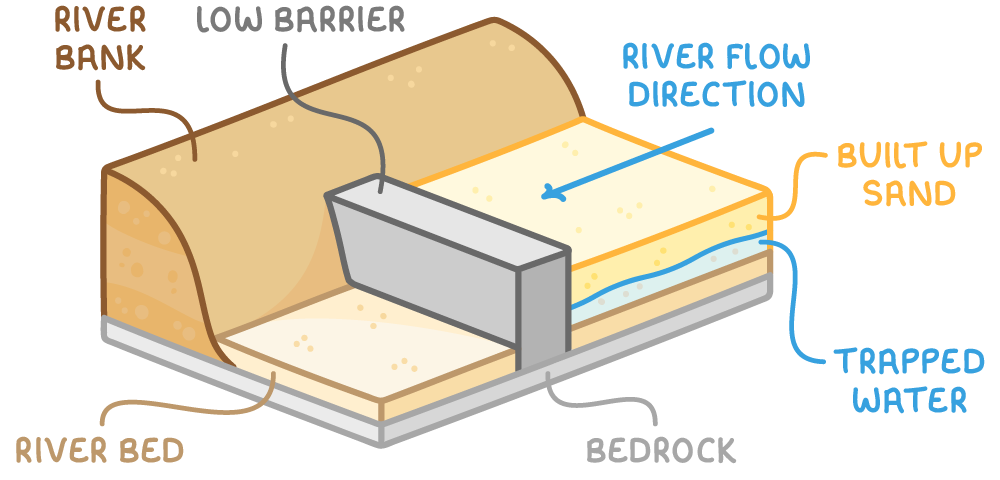
- Construction and design - A low barrier (around 1 m high) is built across seasonal riverbeds. During rainy periods, sand builds up behind the dam, trapping water within it, which accounts for roughly one-third of the dam's volume.
- Protection from evaporation - The sand layer covering the trapped water prevents loss through evaporation during dry spells.
- Water extraction methods - Communities can access the stored water via wells, pipes, or manual collection.
- Advantages of sand dams - They are low-cost, constructed with local materials, and require minimal maintenance. Their height can be incrementally increased to store more water over time.
- Community impact - Sand dams provide water for irrigation and reduce the distance people must travel to access water, improving quality of life in remote, dry regions.