3.1 - LANs & WANs
What networks are and their purpose
Networks form when devices connect to each other, enabling them to communicate and share resources. This connection allows information to flow between devices, such as computers, tablets, or printers. By linking devices, networks make it possible to transfer data, access shared files, and use common hardware efficiently. There are different types of networks based on their size and scope, with the two main ones being Local Area Networks (LANs) and Wide Area Networks (WANs).
Characteristics of Local Area Networks (LANs)
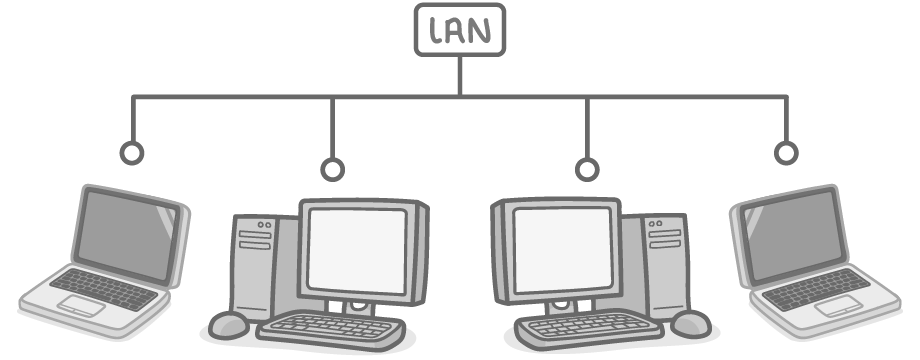
A Local Area Network (LAN) is a network that connects devices within a limited geographical area, typically on a single site like a building or campus.
Key features of LANs
- Geographical coverage - LANs operate over a small area, such as a home, school, office, or university, where all devices are close together.
- Ownership and hardware - The organisation or individual using the LAN owns all the equipment, including cables, routers, and switches, giving them full control.
- Connection types - LANs can be wired, using cables like Ethernet for direct connections, or wireless, relying on technologies such as Wi-Fi to link devices without physical cables.
- Common uses - You will often see LANs in everyday settings, for example, connecting computers, printers, smart TVs, and tablets in a household or linking workstations and servers in a business.
Characteristics of Wide Area Networks (WANs)
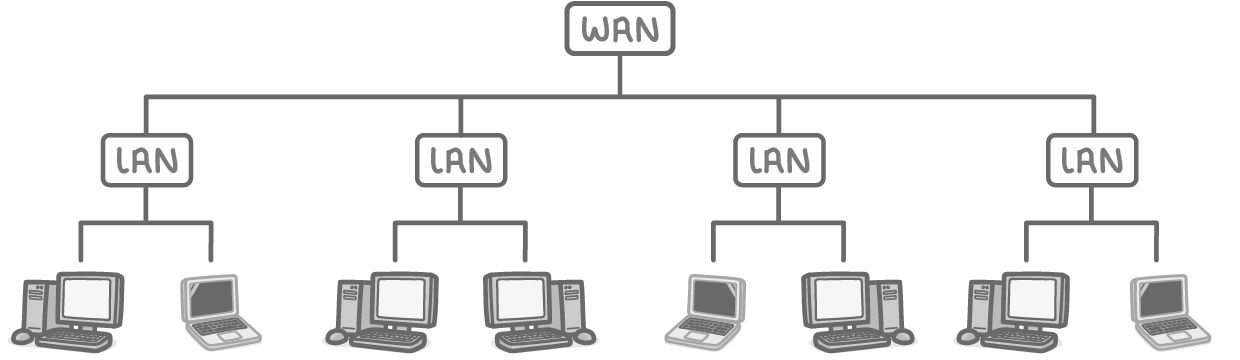
A Wide Area Network (WAN) is a larger network that links multiple LANs across different geographical locations, allowing devices in separate areas to communicate.
Key features of WANs
- Geographical coverage - WANs span large distances, connecting LANs in different cities, countries, or even continents, such as a company's branches worldwide.
- Ownership and infrastructure - Unlike LANs, organisations do not own the WAN infrastructure; they hire it from telecommunications companies that manage and maintain the connections, making WANs more costly to set up.
- Connection methods - WANs use various technologies for linking sites, including fibre optic cables or copper telephone lines for high-speed data transfer, satellite links for remote areas, or radio links for wireless options.
- Common examples - The internet is the largest WAN, connecting billions of devices globally; businesses might use a WAN to link offices in multiple countries for seamless data sharing.
Benefits of using LANs and WANs
Networks like LANs and WANs offer many advantages by enabling devices to work together efficiently. These benefits apply to both types of networks, though WANs extend them across greater distances.
Main advantages of networks
- File sharing and collaboration - Users can easily access and edit the same files from different devices, allowing multiple people to work on documents simultaneously and transfer files without physical media.
- Hardware sharing - Devices on the network can use shared equipment, such as printers or scanners, reducing the need for each device to have its own.
- Internet access - A single internet connection can be distributed to all connected devices, making it cost-effective and convenient for everyone on the network.
- Software management - Administrators can install, update, or distribute software across all devices at once, saving time compared to updating each one individually.
- Communication - Networks enable low-cost ways to interact, such as instant messaging or email, helping users stay connected without additional expenses.
- Centralised user accounts - Login details and user profiles can be stored in one place, so people can access their accounts from any device on the network, improving flexibility and security.
Factors that affect network performance
Network performance refers to how quickly and reliably data moves between devices. Several elements influence this, and understanding them helps in optimising networks for better speed and efficiency.
Key factors influencing performance
- Bandwidth - This is the maximum amount of data that can be transferred per second, measured in units like megabits per second (Mbps). Higher bandwidth allows faster data transfer and better overall performance.
- Bandwidth sharing and congestion - On a shared network, devices compete for available bandwidth; too many users or data-heavy activities, such as video streaming, can cause slowdowns. Limiting bandwidth per user can help manage this.
- Wired vs wireless connections - Wired links, often using Ethernet cables, are typically faster and more stable than wireless ones. Fibre optic cables provide superior performance over traditional copper cables due to their higher data capacity.
- Wireless signal quality - For wireless networks, performance depends on signal strength, which can be reduced by distance from the access point, interference from other networks, or physical barriers like thick walls.
- Hardware and topology choices - The quality of routers, switches, and other equipment affects speed, as does the network topology (the layout of connections), which determines how efficiently data travels between devices.