7.11 - Preparing an Ester
The technique
Aim
To prepare a small sample of an ester, ethyl ethanoate, from ethanol and ethanoic acid, and to identify it by its layer and its smell.
Background
- An ester forms when a carboxylic acid reacts with an alcohol, with an acid catalyst. The other product is water.
- Ethanoic acid and ethanol make the ester ethyl ethanoate, which has a sweet smell like pear drops.
- You can't see the ester forming, because the liquids are all colourless, but you can smell it, and see it separate as a layer on a watery solution.
- So in this practical you warm ethanoic acid and ethanol with a catalyst, remove the acid left over, and check for the ester's layer and smell.
Method
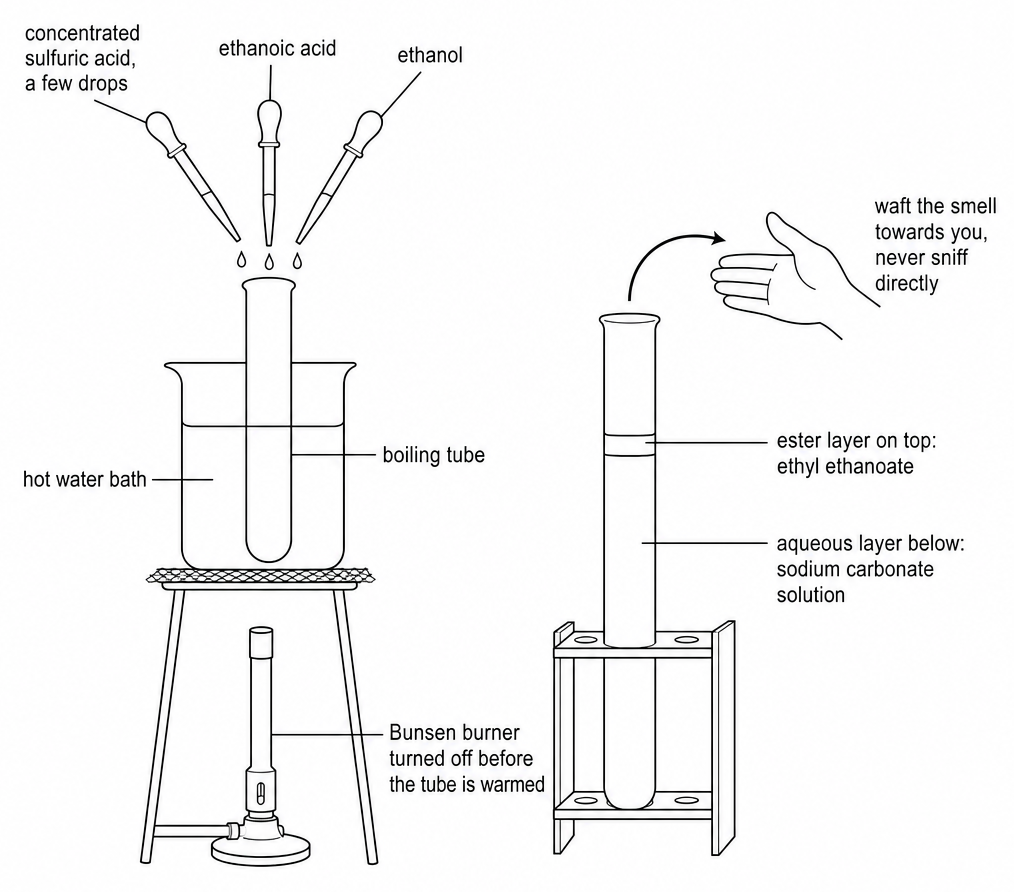
- Add the catalyst - Use a dropping pipette to put a few drops of concentrated sulfuric acid into a boiling tube.
- Add the reactants - Add about ten drops of ethanoic acid, then the same volume of ethanol.
- Heat a water bath - Heat a beaker of water on a tripod and gauze until it starts to boil, then turn the Bunsen burner off.
- Warm the mixture - Stand the boiling tube in the hot water for about a minute, then take it out and let it cool.
- Remove the acid - Pour the cooled mixture into a test tube of sodium carbonate solution and mix. The ester forms a layer on top.
- Smell the ester - Waft the smell towards you, and check for the sweet pear-drop smell of ethyl ethanoate.
Safety
- Eye protection - Concentrated sulfuric acid is corrosive and causes serious burns, so add it carefully and wipe up any spill straight away.
- No naked flames - Ethanol and the ester are flammable, so turn the Bunsen burner off before the tube goes into the water, and keep other flames away.
- Never sniff directly - Always waft the vapour towards you.
- Cool the mixture first - A hot mixture makes the sodium carbonate solution fizz more vigorously and spit.
Common exam questions
Question 1
Why is the reaction tube heated in a water bath rather than directly with a Bunsen burner?
Ethanol and the ester are both flammable, so heating them over a naked flame risks their vapours catching fire. A water bath also gives a gentler, more even heat.
Question 2
Why is the cooled mixture poured into sodium carbonate solution?
To neutralise the sulfuric acid catalyst and any ethanoic acid left over. The ester doesn't dissolve well in the solution and doesn't react with the carbonate, so it separates out as a layer on top, where it can be smelled.
Question 3
How do you know the sodium carbonate solution is neutralising acid?
It fizzes, giving off carbon dioxide. The fizzing stops once all the acid has been neutralised.
Question 4
Name the ester formed when ethanoic acid reacts with ethanol, and give its structural formula.
Ethyl ethanoate, CH3COOCH2CH3.
Question 5
State one property of esters, other than their smell, and one use that depends on it.
Esters are volatile, which means they evaporate easily. That's why they're used in perfumes, because the evaporated molecules reach your nose.