7.12 - Percentage of Oxygen in Air
The experiment
Aim
To find the approximate percentage by volume of oxygen in a sample of air, by letting a metal or a non-metal react with all of the oxygen present and measuring how far the trapped volume of air falls.
Background
- About one-fifth of the air is oxygen.
- Iron, copper, and phosphorus each react with oxygen to form a solid oxide, which takes up almost no space.
- You can't measure the oxygen in air on its own, but you can measure the volume of a trapped sample of air before and after the oxygen has reacted.
- So in this practical you trap a measured volume of air, let a substance react with all of its oxygen, and use the fall in volume to work out the percentage of oxygen.
Variables
- Independent variable - The substance that reacts with the oxygen, which is iron, copper, or phosphorus.
- Dependent variable - The volume of air left once the reaction is complete, compared with the starting volume.
- Control variables - The starting volume of air, and having the reacting substance in excess.
Method
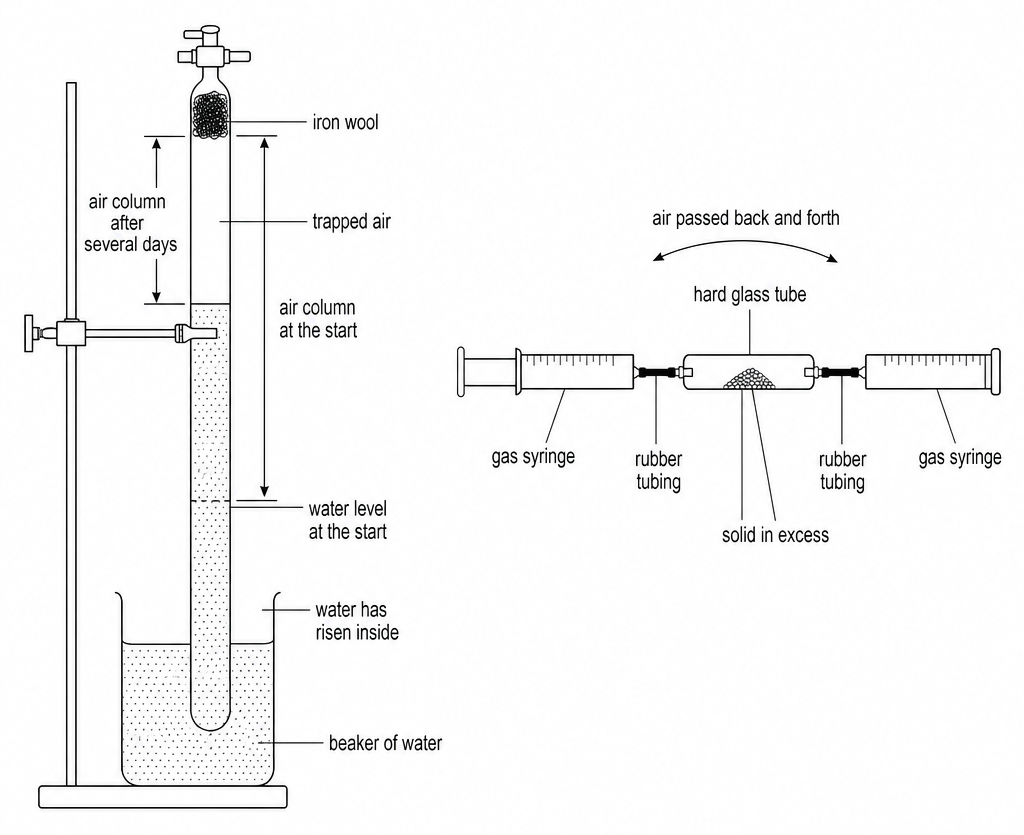
- Trap air over iron - Push wet iron wool into the closed end of a measuring cylinder or burette, stand it upside down in a beaker of water, clamp it, and read the volume of trapped air.
- Leave it for several days - The iron rusts as it uses up the oxygen, and water rises into the tube. When the water level stops rising, read the final volume.
- Set up the gas syringes - Pack copper into a hard glass tube, and connect a gas syringe to each end, one holding a known volume of air and the other empty.
- Pass the air over hot copper - Heat the copper strongly and push each plunger in turn, so the air passes back and forth. The copper turns black as it forms copper(II) oxide.
- Stop when the volume stops falling - Keep going until two readings in a row agree, then let the apparatus cool to room temperature and read the final volume.
- Use phosphorus instead of copper - Your teacher puts a small piece of phosphorus in the tube and heats it gently. It reacts with the oxygen, forming a white solid, phosphorus pentoxide. Pass the air back and forth and let the apparatus cool, as with copper.
Safety
- Eye protection - Wear it throughout.
- Hot glass tube - Let it cool on a heatproof mat before you touch or disconnect it.
- Phosphorus - It can catch fire in air, so it's kept under water, handled only by your teacher, and never touched.
- Gas syringes - Point them away from people, since hot gas can push a plunger out suddenly.
Worked example - Percentage of oxygen in air
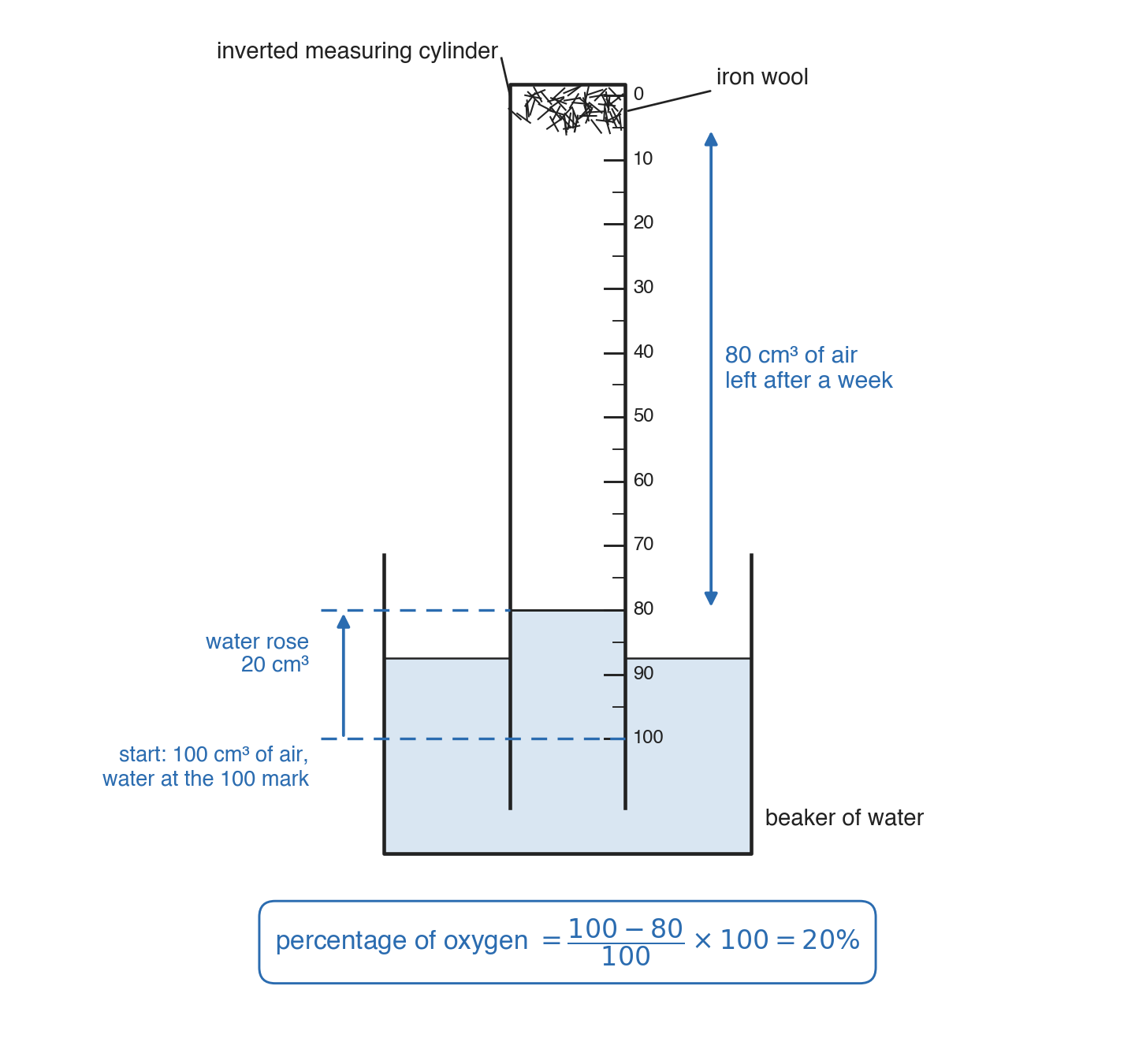
A student trapped 100 cm3 of air with wet iron wool inside an upside-down measuring cylinder standing in water, and left it for a week. The volume of air left at the end was 80 cm3.
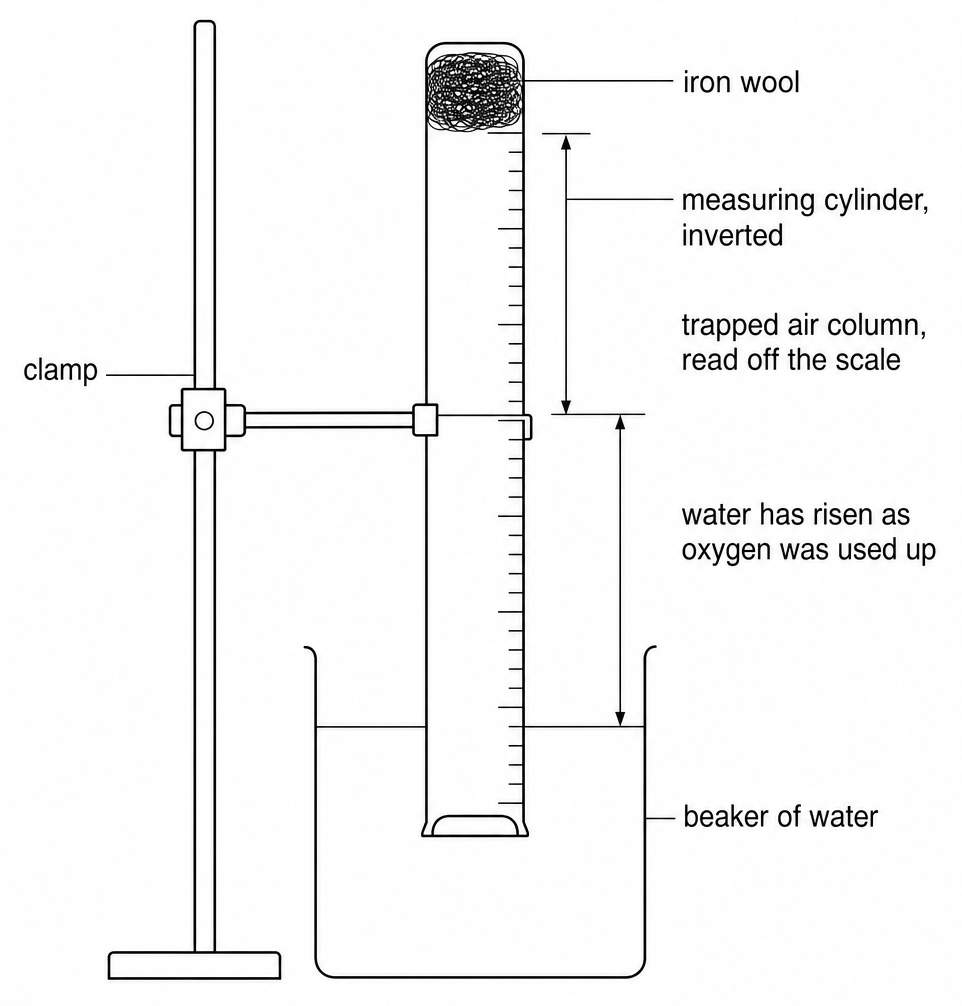
Water rises as oxygen is used up, and the air column left is read off.
Calculate the percentage of oxygen in the air, and explain why a result like this usually comes out a little below the true value.
Step 1 - Find the fall in volume
Subtract the final volume from the start volume.
100 - 80 = 20 cm3
Step 2 - Calculate the percentage of oxygen
Step 3 - Compare with the accepted value
Air is about 21% oxygen by volume, so a result of 20% is slightly below the true value.
Step 4 - Explain why the result is slightly low
- The iron wasn't left long enough, so some oxygen hadn't reacted.
- A small leak in the apparatus let air in.
Common exam questions
Question 1
Why must the reacting substance be in excess?
So there's enough of it to react with all the oxygen. If it ran out first, some oxygen would be left, and the percentage would come out too low.
Question 2
Why must the apparatus cool to room temperature before the final reading?
A gas takes up more space hot than cold, so a warm reading gives too large a volume, and the percentage comes out too low.
Question 3
Why is the air passed back and forth between the two syringes several times, rather than just once?
So as much of the air as possible meets the hot copper or the phosphorus, giving all the oxygen the chance to react.
Question 4
State what happens to the iron wool after several days.
It turns orange-brown, as it rusts to form iron oxide.
Question 5
Which gases in air don't react with the substance in this practical, and why not?
Nitrogen and the noble gases. They are very unreactive, and the noble gases have a full outer shell of electrons.