6.7 - The Contact Process
Making sulfur trioxide
Sulfuric acid is manufactured by the Contact process. The key reaction turns sulfur dioxide into sulfur trioxide.
Making the sulfur dioxide
Sulfur dioxide is made first, in one of two ways:
- Burning sulfur in air
- Roasting a sulfide ore in air
Oxidising it to sulfur trioxide
- The sulfur dioxide is mixed with oxygen from the air and passed over a catalyst, oxidising it to sulfur trioxide.
- The reaction is reversible:
- 2SO2(g) + O2(g) ⇌ 2SO3(g)
Conditions used
- Temperature - About 450 °C
- Pressure - 200 kPa (2 atmospheres, just above atmospheric pressure)
- Catalyst - Vanadium(V) oxide
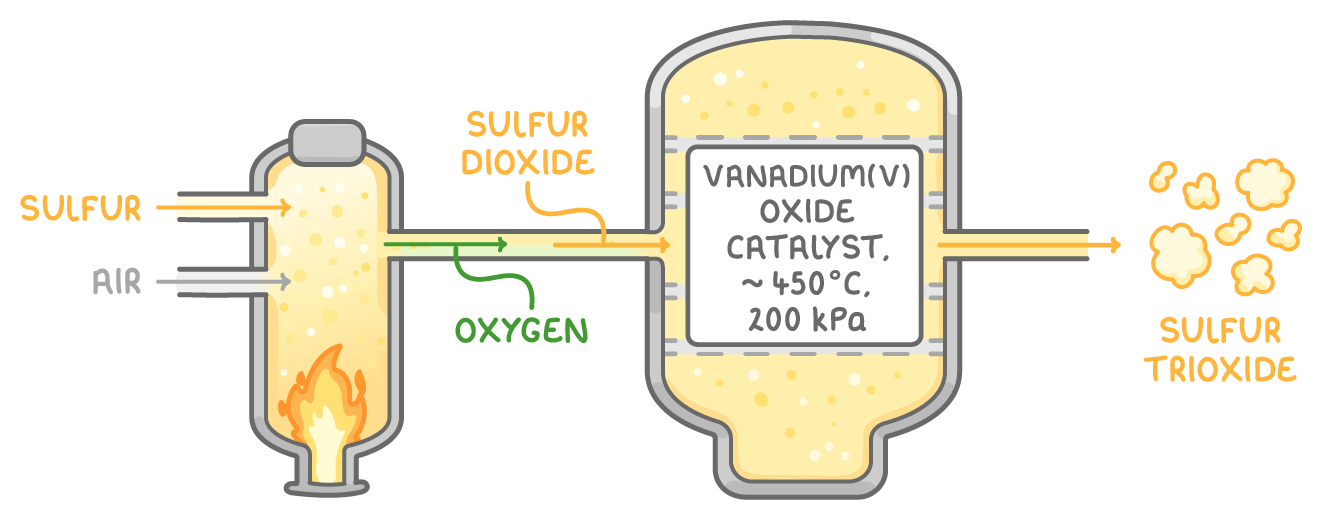
Contact process conditions
The reaction to make sulfur trioxide is reversible:
2SO2(g) + O2(g) ⇌ 2SO3(g)
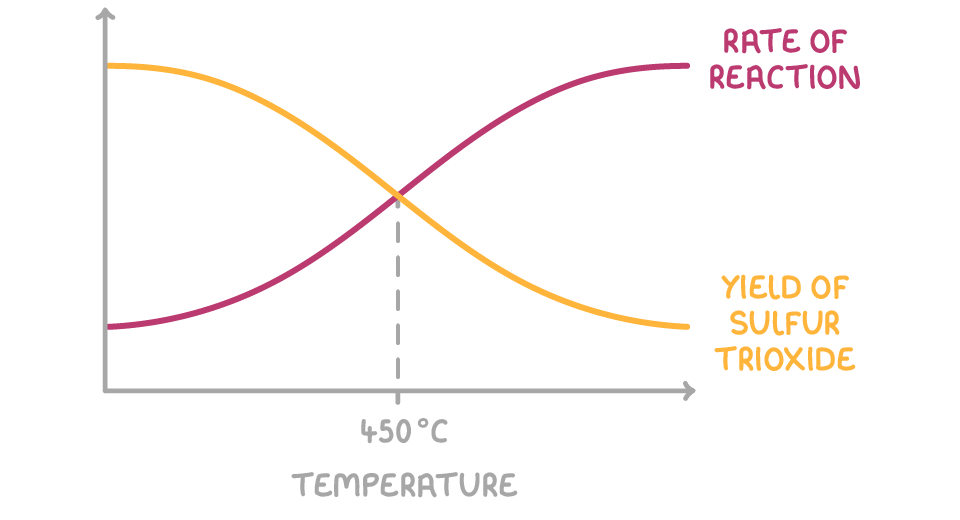
Temperature - About 450 °C
- The forward reaction is exothermic, so a lower temperature gives a higher yield of sulfur trioxide at equilibrium, but makes the reaction too slow.
- A higher temperature increases the rate, but reduces the yield.
- 450 °C is an optimum temperature that gives an acceptable yield at a reasonable rate.
Pressure - At or just above atmospheric
- An increase in pressure favours the forward reaction because there are 3 moles of gas on the left and only 2 moles on the right.
- However, the yield is already high (around 98%) at atmospheric pressure, so high-pressure equipment is not worth the extra cost.
Catalyst - Vanadium(V) oxide
- Speeds up the reaction without being used up.
- Increases the rate at 450 °C without affecting the position of equilibrium or yield.
TermDefinition
Contact processThe industrial process used to manufacture sulfuric acid.