6.8 - Redox
Oxidation and reduction as oxygen transfer
- Oxidation is the gain of oxygen by a substance.
- Reduction is the loss of oxygen from a substance.
Examples
- When magnesium burns in oxygen to form magnesium oxide, the magnesium gains oxygen, so it has been oxidised:
- 2Mg + O2 → 2MgO
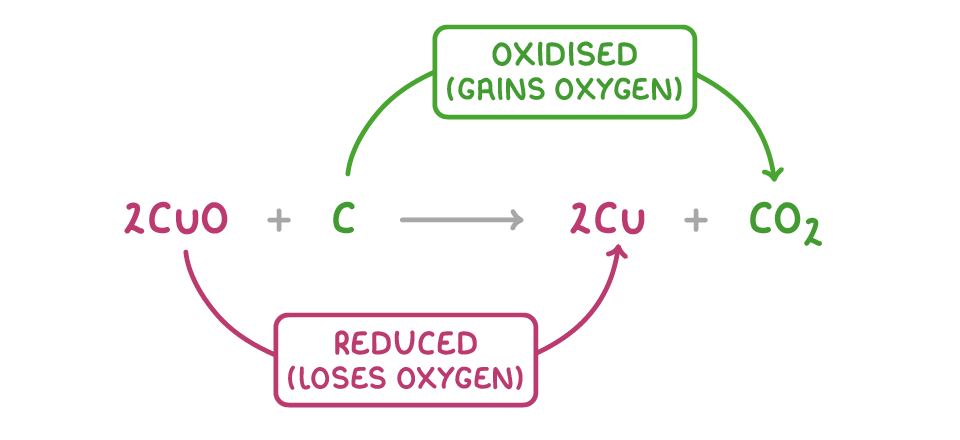
- When copper(II) oxide reacts with carbon, the copper(II) oxide loses oxygen and is reduced, while the carbon gains oxygen and is oxidised:
- 2CuO + C → 2Cu + CO2
- A reaction where oxidation and reduction happen together is a redox reaction.
Following hydrogen instead
- Losing hydrogen is oxidation, gaining hydrogen is reduction.
- When hydrogen and chlorine react, the chlorine gains hydrogen, so it has been reduced:
- H2 + Cl2 → 2HCl
Oxidising and reducing agents
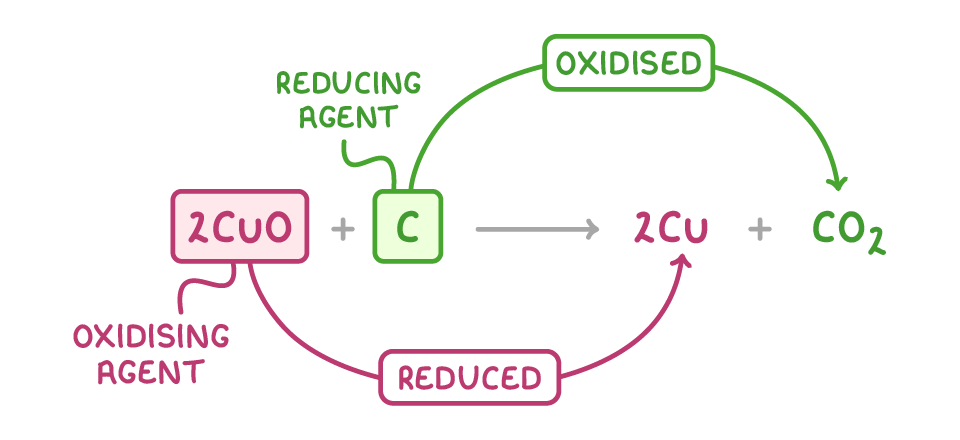
- Oxidising agent - A substance that oxidises another substance, and is itself reduced.
- Reducing agent - A substance that reduces another substance, and is itself oxidised.
- In summary:
- The substance that is reduced is the oxidising agent.
- The substance that is oxidised is the reducing agent.
Worked example - Copper(II) oxide and carbon
2CuO + C → 2Cu + CO2
- Copper(II) oxide loses oxygen, so it is reduced; the carbon took its oxygen away, so carbon is the reducing agent.
- Carbon gains oxygen, so it is oxidised; the copper(II) oxide supplied that oxygen, so copper(II) oxide is the oxidising agent.
Testing for oxidising and reducing agents
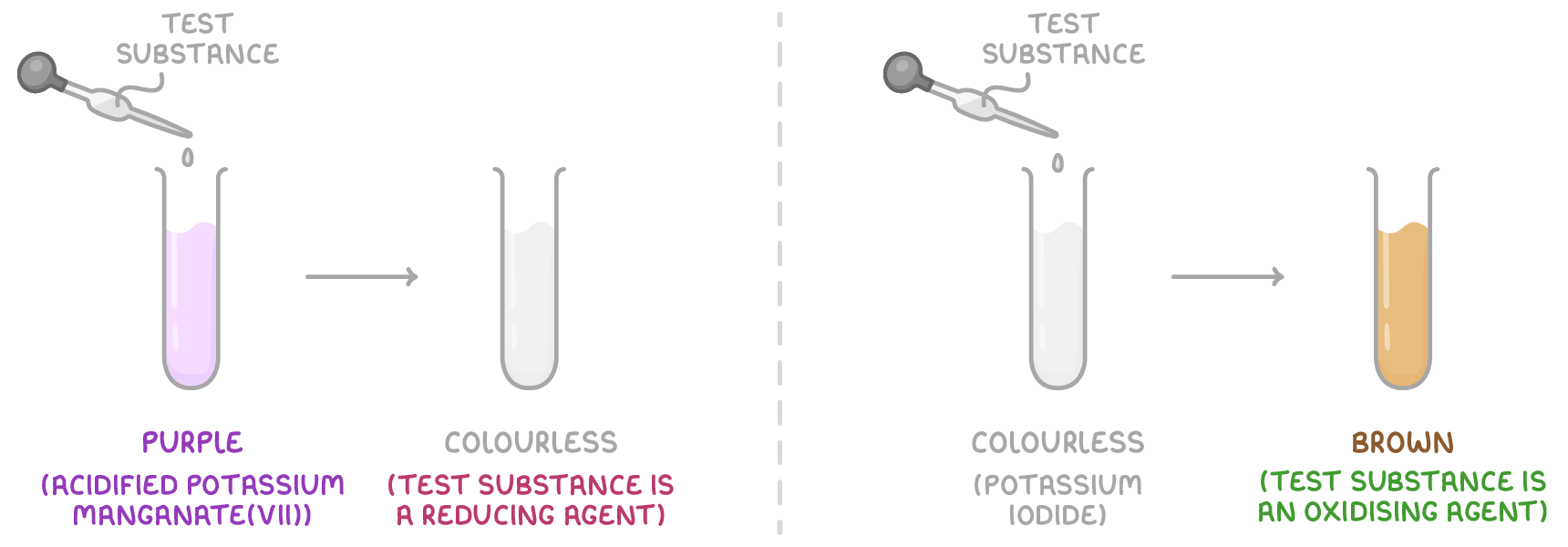
- Acidified aqueous potassium manganate(VII) is an oxidising agent (starts purple). If it turns colourless, it has been reduced, showing that the tested substance is a reducing agent.
- Aqueous potassium iodide is a reducing agent (starts colourless). If it turns brown, iodine has formed and the iodide has been oxidised, showing that the tested substance is an oxidising agent.
- A colour change in either test confirms that a redox reaction has occurred.
The Roman numeral in a name
- A Roman numeral in a compound's name gives the oxidation number of the element it follows. For a simple metal ion this is the same as the charge on the ion, so iron is +3 in iron(III) oxide and +2 in iron(II) oxide.
- Oxidation is an increase in oxidation number, and reduction is a decrease in it. An iron atom (0) that becomes an Fe2+ ion (+2) has been oxidised, and an Fe3+ ion that becomes an Fe2+ ion has been reduced.
Oxidation and reduction as electron transfer
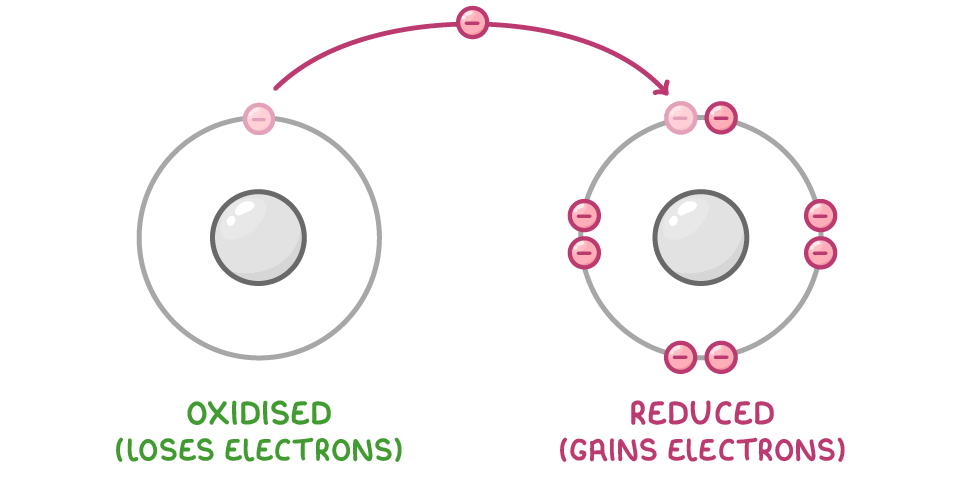
- Oxidation is the loss of electrons.
- Reduction is the gain of electrons.
- Remember: OIL RIG (Oxidation Is Loss, Reduction Is Gain).
- Electrons are transferred from one substance to another, so oxidation and reduction always occur together in a redox reaction.
Worked example - Sodium and chlorine
2Na + Cl2 → 2NaCl
- Each sodium atom starts neutral and becomes Na+ (loses one electron), so sodium is oxidised.
- Each chlorine atom starts neutral and becomes Cl- (gains one electron), so chlorine is reduced.
Identifying oxidation and reduction from charges
- An atom that becomes a positive ion loses electrons: oxidised.
- An atom that becomes a negative ion gains electrons: reduced.
- A positive ion that becomes an atom gains electrons: reduced.
Oxidation numbers
- The oxidation number shows how many electrons an atom has lost or gained, written with a sign (+ or −).
- In terms of oxidation numbers:
- Oxidation is an increase in oxidation number.
- Reduction is a decrease in oxidation number.
Rules for assigning oxidation numbers
- An uncombined element has an oxidation number of 0 (e.g. He, O2, H2).
- A monatomic ion has an oxidation number equal to its charge (e.g. Na+ is +1, O2- is −2).
- The sum of oxidation numbers in a neutral compound is 0.
- The sum of oxidation numbers in a polyatomic ion equals the charge on the ion.
In compounds, oxygen is almost always −2 and hydrogen is +1.
Identifying redox from oxidation numbers
- If an element's oxidation number increases, it has been oxidised (it is the reducing agent).
- If an element's oxidation number decreases, it has been reduced (it is the oxidising agent).
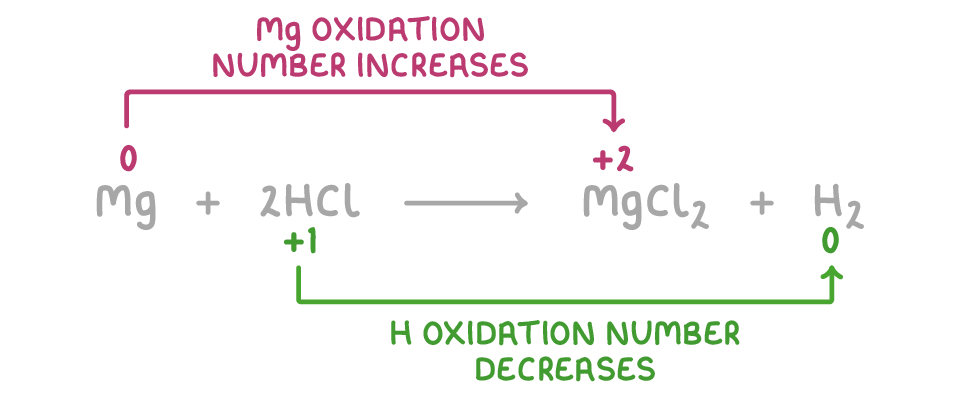
- For example, in Mg + 2HCl → MgCl2 + H2, the oxidation number of magnesium increases from 0 to +2, so it has been oxidised, and the oxidation number of hydrogen decreases from +1 to 0, so it has been reduced.
Worked example - Oxidation number of manganese
Find the oxidation number of the manganese atom in the manganate(VII) ion, MnO4-.
Step 1 - Decide what the numbers add up to
MnO4- is a polyatomic ion with a 1− charge, so by rule 4 all its oxidation numbers add up to −1.
Step 2 - Fill in the fixed values
Four combined oxygen atoms, each −2: 4 × −2 = −8.
Step 3 - Solve for the manganese
- The manganese makes up the difference between −8 and the −1 total:
oxidation number of Mn = −1 − (−8) = +7
- This matches the Roman numeral in the ion's name.
- The same working finds an oxidation number inside a neutral compound - the only change is that the total must come to 0 (rule 3) instead of the charge on an ion.
TermDefinition
OxidationThe gain of oxygen by a substance. In terms of electrons, it is the loss of electrons.
Redox reactionA reaction where oxidation and reduction happen together.
ReductionThe loss of oxygen by a substance. In terms of electrons, it is the gain of electrons.
Oxidising agentA substance that oxidises another substance, and is itself reduced.
Reducing agentA substance that reduces another substance, and is itself oxidised.
Oxidation numberA number (positive, negative or zero) that shows how many electrons an atom has lost or gained. For a simple ion it is the same as the charge on the ion.