19.6 - The Nitrogen Cycle
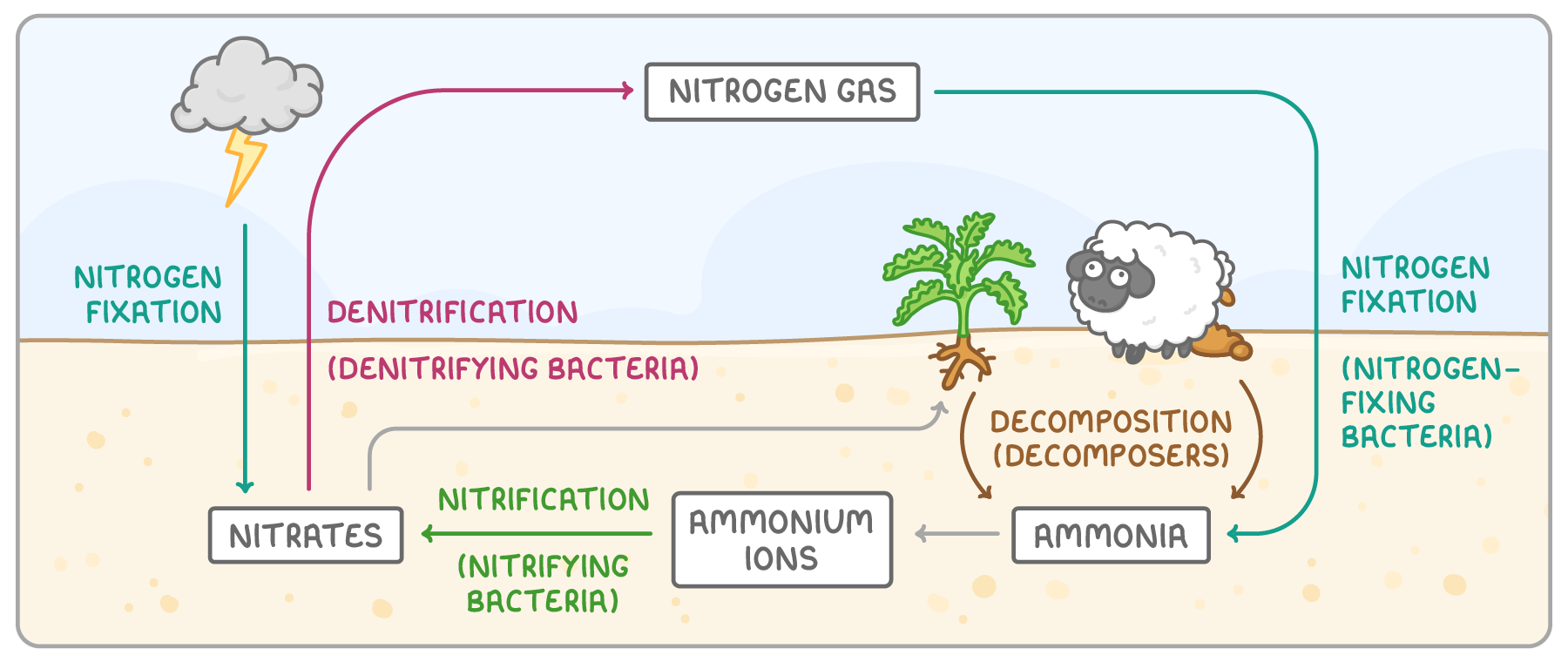
The nitrogen cycle
- Air is about 78% nitrogen gas (N2), but this gas is very unreactive, so plants and animals cannot use it directly.
- Living things need nitrogen to make proteins for growth, so atmospheric nitrogen must be changed into a usable form.
- Before plants can take up nitrogen, it must become mineral ions such as nitrate ions in the soil.
- Plants absorb these ions through their roots and use the nitrogen to make amino acids, which join to form proteins.
How nitrogen moves through living things
- Nitrogen passes along food chains as protein: animals get their nitrogen by eating plants (and one another).
- When proteins are digested, they are broken back down into amino acids.
- Excess amino acids cannot be stored, so they are broken down in the liver by deamination.
- This produces ammonia as a waste product, which is converted into urea and excreted.
- The urea is decomposed in the soil, so its nitrogen is returned and recycled.
The bacteria and processes that recycle nitrogen
- Decomposers - Break down proteins in dead organisms and urea in animal waste into ammonia, forming ammonium ions in the soil.
- Nitrifying bacteria - Convert ammonium ions into nitrates (a process called nitrification), which plants can absorb.
- Nitrogen-fixing bacteria - Carry out nitrogen fixation, turning atmospheric N2 into nitrogen compounds plants can use. They live freely in the soil or in nodules on the roots of some plants.
- Denitrifying bacteria - Turn nitrates back into N2 gas (denitrification), which is of no benefit to other living organisms.
Nitrogen fixation without bacteria
Nitrogen is also added to the soil by lightning, which has enough energy to make nitrogen react with oxygen.
TermDefinition
NitrificationThe process of converting ammonium compounds or ions into nitrates.
Nitrogen fixationThe process of turning atmospheric nitrogen gas into nitrogen-containing compounds.
DenitrificationThe process of turning nitrates back into nitrogen gas.
DeaminationThe removal of the nitrogen-containing part of excess amino acids in the liver. This forms ammonia, which is then converted into urea.