20.1 - Food Production
Fertilisers
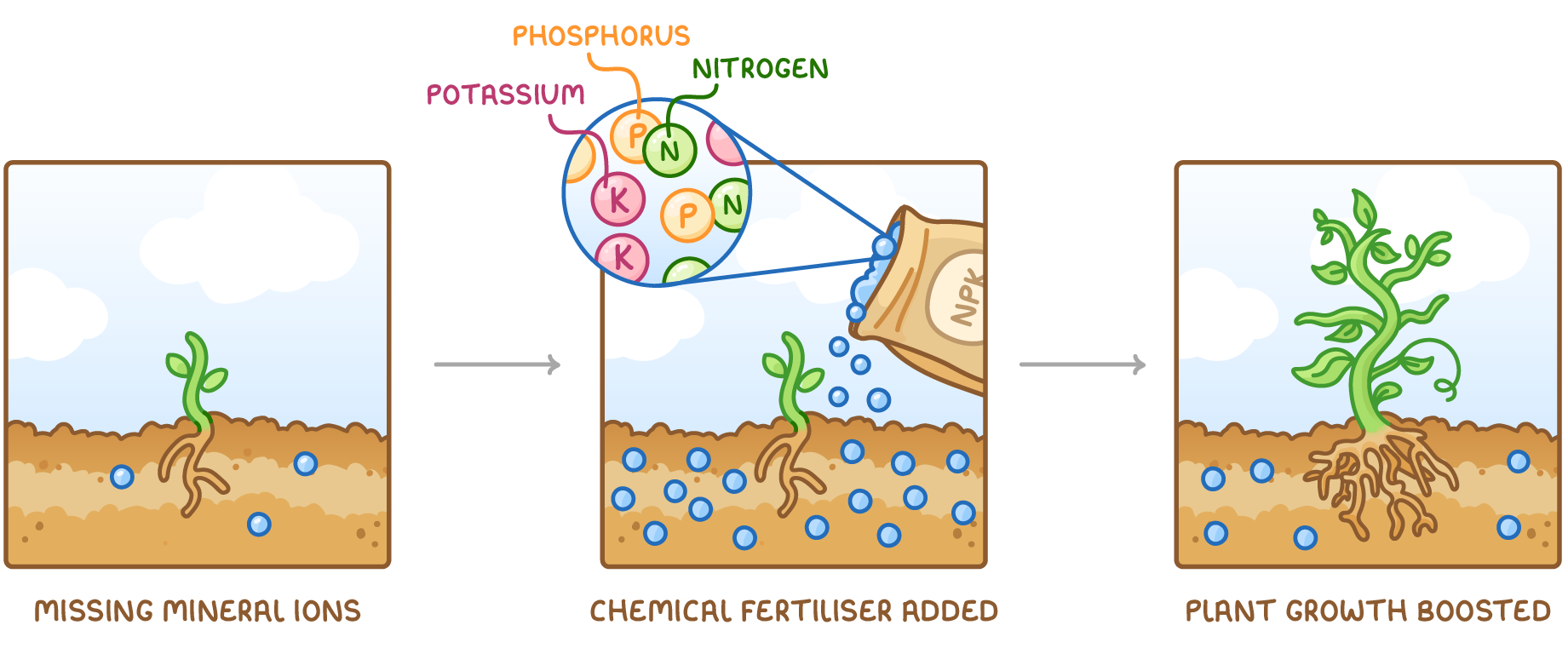
- Plants need mineral ions from the soil to grow properly - in particular nitrogen, phosphorus, and potassium.
- When a crop grows, it takes these mineral ions out of the soil, leaving the soil short of them for the next crop.
Replacing lost mineral ions
- Farmers add chemical fertiliser to replace the missing mineral ions.
- This boosts plant growth, which raises the crop yield.
- Fertiliser is usually rich in nitrogen, phosphorus, and potassium (NPK) - the ions a growing crop needs most.
Insecticides and herbicides
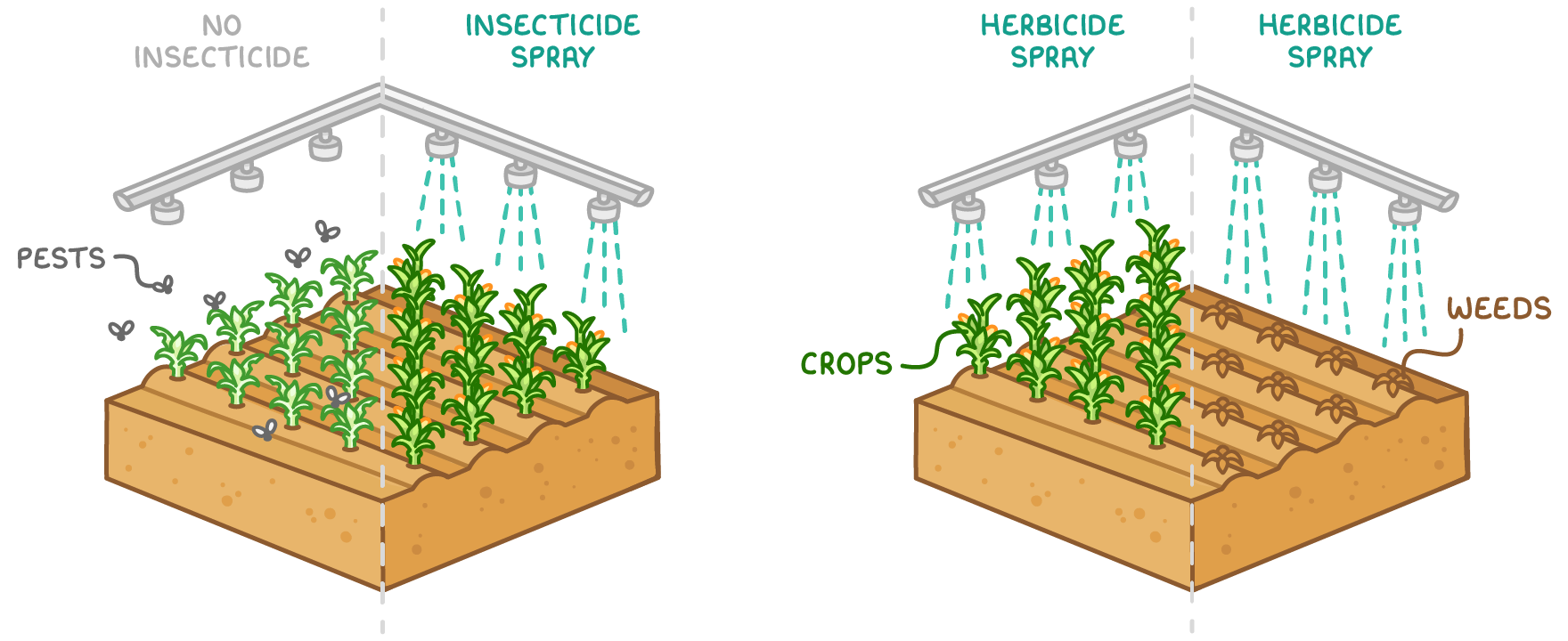
Two chemical methods raise the quality and yield of a crop by dealing with organisms that compete with it or damage it.
Insecticides
- Insecticides are chemicals sprayed onto crops to kill the insects that eat or damage them.
- They kill the insect pests without killing the crop itself.
- As a result, fewer plants are damaged or destroyed, so both the quality and yield of the crop go up.
Herbicides
- Herbicides are chemicals sprayed around a crop to kill weeds.
- Weeds compete with crop plants for nutrients, water, and light, so removing them means the crop faces less competition.
- With more of these resources available to it, the crop grows better - again raising its quality and yield.
Intensive animal farming
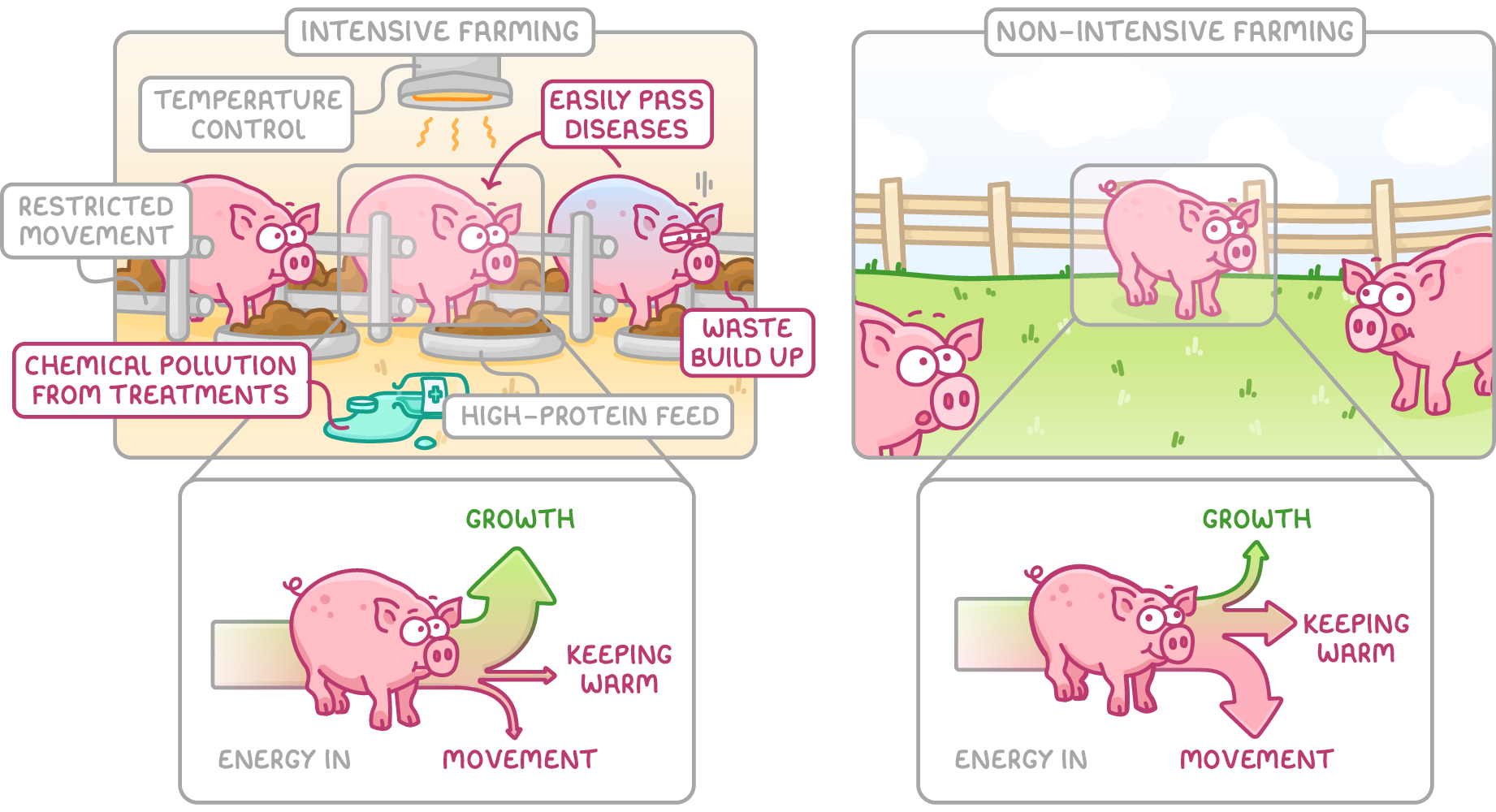
- Intensive (or efficient) animal farming aims to produce as much meat, milk or eggs as possible from a given input of resources.
- The central idea is to reduce the energy that farm animals transfer to their surroundings, so more of the energy in their food is left for growth.
How energy is channelled into growth
- Animals' movement is limited, often by keeping them in small pens or cages.
- They're kept in a temperature-controlled environment.
- An animal that moves little and doesn't have to keep itself warm uses less energy on those things, so more energy goes into building body mass - more food is produced from the same amount of feed.
- Animals are sometimes given high-protein feed to increase growth further.
Advantages
- More food is produced from the same amount of feed.
- Confining animals makes it easier for the farmer to monitor them and protect them from predators.
- It lowers the cost of the food for the consumer.
Disadvantages
- Animals kept close together can pass diseases between them easily.
- Their waste can build up and pollute nearby water.
- The chemicals used to treat them can pollute too.
- Many people have ethical objections, arguing that keeping animals in such cramped, unnatural conditions is cruel.
Large-scale crop production
- Two features of large-scale crop farming let a farmer produce food from a much bigger area of land: machinery and monocultures.
- Selective breeding of crops and livestock - choosing individuals with the most useful features to breed from over many generations - is a further way farmers raise food production (the method itself is covered in Topic 9).
Agricultural machinery
- Machines such as tractors and combine harvesters are used instead of people and working animals.
- Machinery is quicker and more efficient than manual labour.
- This means crops can be planted, tended, and harvested over far larger areas than would otherwise be possible.
Monocultures
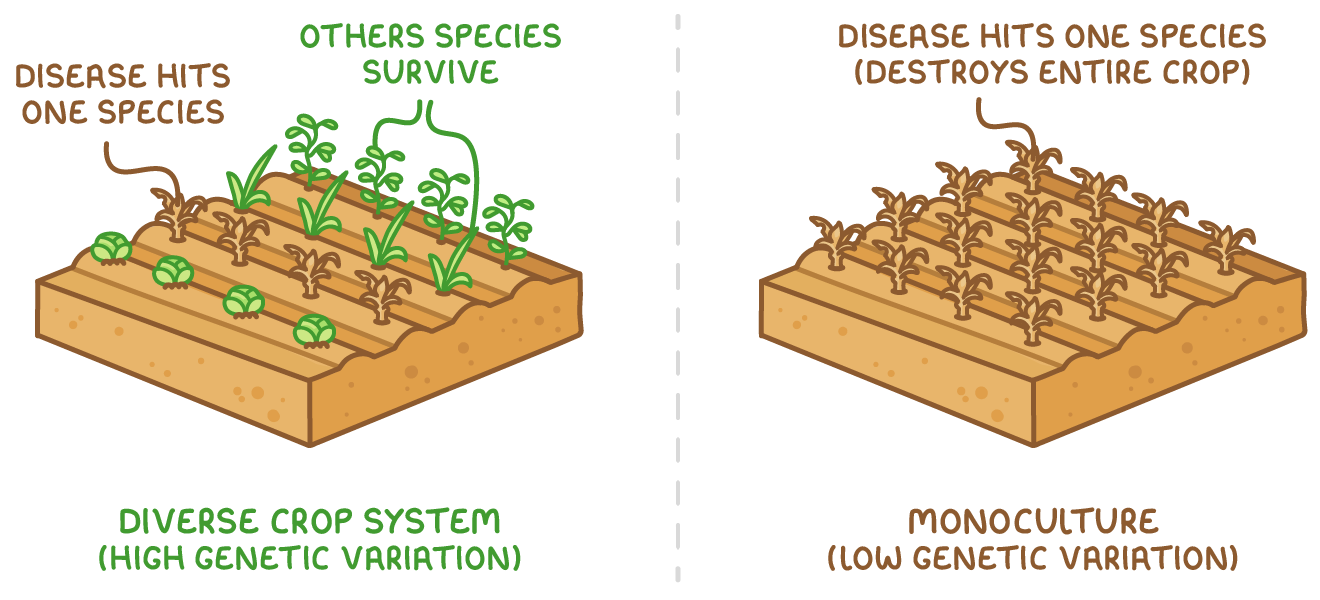
A monoculture is the growing of a single crop species at one time over a large area of land, rather than a mix of crops side by side.
Advantages:
- Every plant is grown, treated, and harvested in the same way, using the same machinery and chemicals, so the crop is easy to manage and cost-effective.
- This gives higher yields, more profit for the farmer, and cheaper food for the consumer.
Disadvantages:
- Genetic variation across the crop is low, so a single pest or disease affecting the species could destroy the entire crop.
- Farmers therefore use a lot of pesticide, and the excess can wash into water and pollute it or kill beneficial insects.
- A monoculture contains far fewer plant species than a natural ecosystem, so it supports fewer other organisms and reduces biodiversity.
Crops versus livestock - Energy efficiency
- Energy is lost at every step up a food chain.
- When an organism is eaten, only about a tenth of the energy stored in it becomes body mass in the organism that eats it.
- The rest is lost - mostly as heat from respiration and in waste.
- This makes each transfer of energy between trophic levels very inefficient.
Why this matters for food production
- If a person eats meat from an animal fed on plants, there is an extra trophic level - the animal - between the person and the original plants, so most of the energy is lost in that extra step.
- If the person eats the plants directly, that energy loss is avoided.
- So it's more energy-efficient for people to eat crops than to eat livestock that have been fed on crops.
- Farming crops to feed humans directly produces far more food from a given amount of plant material than farming the same crops to feed animals that are then eaten.

TermDefinition
MonocultureThe growing of a single crop species over a large area of land.