20.8 - Maintaining Biodiversity
Sustainable resources
- A sustainable resource is one that is produced as rapidly as it is removed from the environment, so it does not run out.
- The key idea is balance: if a resource is replaced at the same rate it's taken, the supply stays steady and future generations can still use it.
- Some resources will run out if we keep using them, but others can keep going indefinitely if they're looked after.
Fossil fuels are not sustainable
- Fossil fuels - coal, oil, and natural gas - are not sustainable.
- They take millions of years to form and are used far faster than they are replaced.
Living resources can be sustainable
Living resources are different because they can grow back. Two examples are:
- Forests - New trees can be grown to replace those that are cut down.
- Fish stocks - Fish breed and replace those that are caught.
Sustainable management:
- This only holds if the resource is managed carefully, so it's harvested no faster than it can renew itself.
- Managed this way, forests and fish stocks can be conserved and used sustainably - keeping a useful supply without using the resource up.

Conservation programmes
- When humans damage an ecosystem, biodiversity falls - but the trend can be reversed by reducing harmful practices or by protecting species and habitats so they recover.
- Conservation programmes are set up by scientists, governments, and concerned citizens to do this.
Breeding programmes
- Often set up for endangered species - those at high risk of extinction.
- Animals are bred in captivity (e.g. in zoos), where numbers can be built up safely with less infant mortality than in the wild.
- Individuals can later be reintroduced to the wild to boost an existing population or start a new one.
- This only works long term if the natural habitat is also safe.
Protecting and regenerating habitats
- Rare habitats worth protecting include mangroves, heathland, coral reefs, and wetlands.
- Protected areas - Creating national parks, nature reserves, and Sites of Special Scientific Interest, where building and farming are restricted.
- Managing habitats - For example, controlling water levels to conserve wetlands, and coppicing to conserve woodland.
Other conservation methods
- Seed banks - Store the seeds of rare and endangered plants, preserving their genetic diversity for the future.
- Controlling non-native species - The introduction of harmful non-native species can be controlled to protect native wildlife.
- Educating people - Teaching people about the value of biodiversity and how their choices affect it; public understanding and support make the other measures possible.
Conservation in farming and by law
Conservation can be built into farming, and supported by laws, international agreements, and ecotourism.
Conservation on farmland
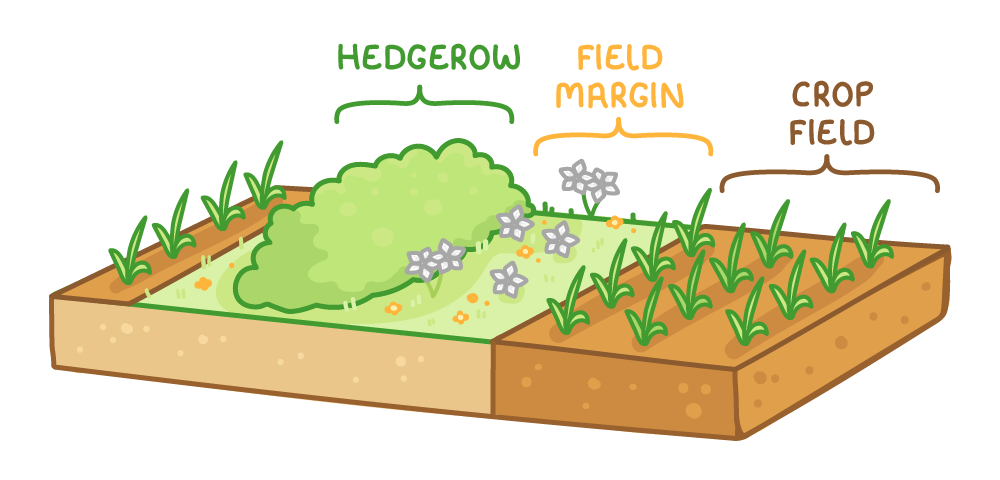
- Field margins - Narrow strips around fields where wild flowers and grasses are left to grow. They provide habitats and food for a wider range of species than a single crop allows.
- Hedgerows - Also provide habitats and food for more species than a single crop.
- Governments encourage these methods, sometimes by paying farmers a subsidy.
Laws and international agreements
- Governments set quotas on deforestation and carbon dioxide emissions.
- The CITES agreement restricts trade in endangered species.
- Individuals can reduce waste sent to landfill by recycling.
Ecotourism
- Ecotourism is tourism focused on appreciating and conserving nature.
- It brings money into biodiverse areas and helps fund conservation work.
Captive breeding by AI and IVF
- Captive breeding programmes use assisted-reproduction techniques to help endangered animals breed when they cannot do so easily themselves.
- This may be needed because of reproductive difficulties, or because suitable mates are kept far apart.
The two techniques
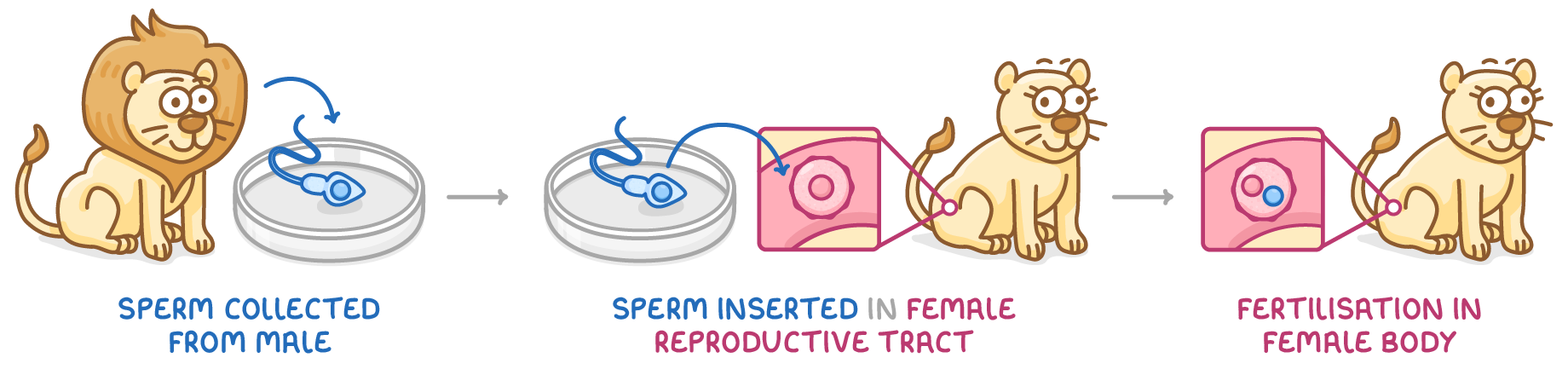
- Artificial insemination (AI) - Sperm collected from a male is inserted artificially into the female's reproductive tract, so fertilisation takes place inside her body.
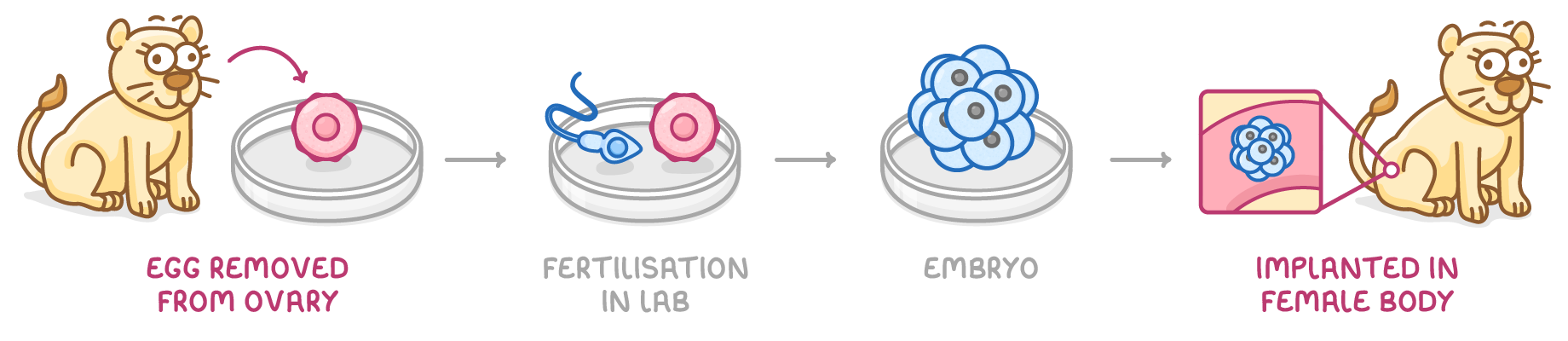
- In vitro fertilisation (IVF) - An egg is removed from a female's ovaries and fertilised by sperm in the laboratory. The resulting embryo is then implanted into the female.
Both techniques let individuals reproduce when natural breeding is not possible. Because sperm or eggs can be moved between distant populations, they can help increase the genetic variation of a captive-bred population.
Why genetic variation matters
- A species with a small population is at greater risk.
- A small population has reduced genetic variation.
- Simply increasing the population size again does not restore that variation - new variation depends on mutations arising over many generations.
- A species with low genetic variation is less able to adapt if its environment changes, so even a recovered population can still be at risk of extinction.
Conserving forests and fish stocks
Some resources can be conserved using methods suited to the resource, so it is used without being used up.
Ways of conserving forests
- Education - Teaching people about the value of forests builds support for protecting them
- Protected areas - National parks restrict where and how much felling may take place
- Quotas - Set a limit on the number of trees that may be cut down in a period
- Replanting - Growing new trees to replace those harvested keeps the forest from shrinking, especially when a mix of species is planted rather than a single type
Ways of conserving fish stocks
Fish stocks are conserved so that fish aren't caught faster than the population can breed and replace them.
- Education - Teaching fishers and consumers about protecting fish stocks
- Closed seasons - Ban fishing while the fish are breeding, giving populations time to recover
- Protected areas - Places where fishing isn't allowed, letting populations recover
- Net and mesh controls - Controlling the type of net and the size of its mesh lets young fish escape and go on to breed
- Quotas - Limit the mass of fish that may be landed
- Monitoring - Measuring the size of the fish population shows whether the measures are working and when they need to change
Why conservation programmes are worthwhile
- Maintain or increase biodiversity
- Reduce the rate at which species become extinct
- Protect vulnerable ecosystems
- Keep ecosystems functioning by maintaining natural processes such as nutrient cycling
- Safeguard the resources ecosystems provide - food, drugs, fuel, and the pool of genes that future crops and medicines may be bred from
TermDefinition
Sustainable resourceA resource that is produced as rapidly as it is removed from the environment so it does not run out.
Endangered speciesA species that is at a high risk of extinction.
EcotourismTourism that is focused on appreciating and conserving nature, which brings money into biodiverse areas to fund conservation.
Artificial insemination (AI)A reproductive technique where sperm collected from a male is inserted artificially into a female's reproductive tract.
In vitro fertilisation (IVF)A technique in which eggs are fertilised by sperm outside the body, in a laboratory.